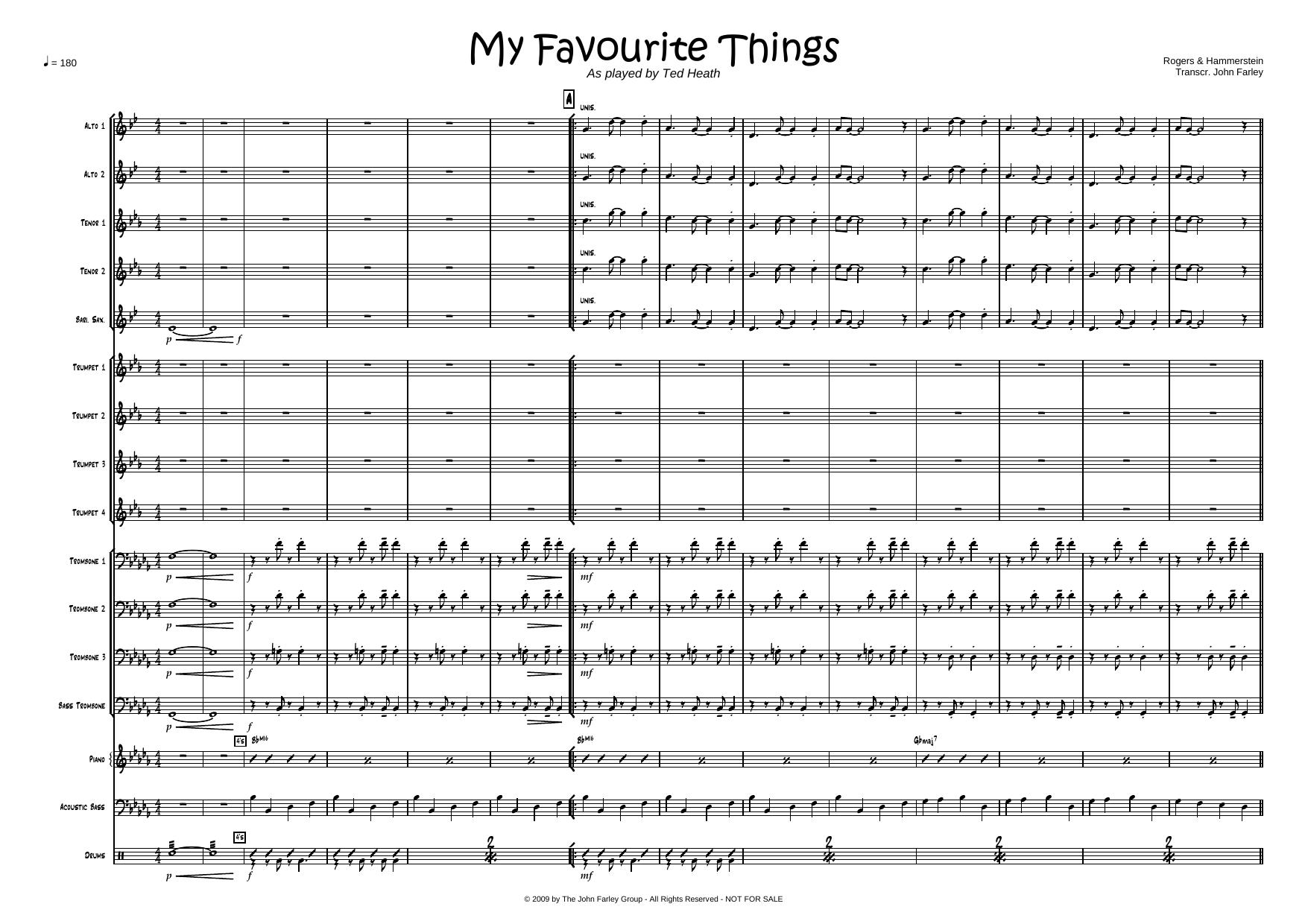
My Favourite Things (J.Farley) sheet music preview

My Favourite Things (J.Farley)

Composed by Richard Rodgers

Arranged by John Farley

  • Ensemble: Big Band
  • Pages: 53
  • Instruments (17): Alto Saxophone 1, Alto Saxophone 2, Tenor Saxophone 1, Tenor Saxophone 2, Baritone Saxophone, Trumpet 1, Trumpet 2, Trumpet 3, Trumpet 4, Trombone 1, Trombone 2, Trombone 3, Bass Trombone, Piano, Guitar, Acoustic Bass, Drums
  • Difficulty: advanced
  • Content: Individual Parts
  • Format: PDF Download (Instant)
  • Price: $24.99

Originally penned by Richard Rodgers and Oscar Hammerstein II for the 1959 Broadway milestone *The Sound of Music*, "My Favorite Things" underwent a radical metamorphosis when jazz icon John Coltrane claimed it in 1960. Coltrane’s modal, soprano-sax-driven exploration transformed the innocent waltz into an urgent, hypnotic vehicle for modal improvisation, forever cementing it as a pillar of the modern jazz canon. Subsequent interpretations by artists ranging from an upbeat Grant Green guitar groove to Bill Evans’ introspective trio settings have proven the composition's remarkable elasticity, welcoming reinvention across nearly every subgenre of jazz. John Farley’s dynamic big band adaptation captures this spirit of adventurous reinvention, translating the tune’s inherent tension and release into a vibrant 7-instrument ensemble framework. Driven by an infectious, pulsing contemporary swing feel in 4/4 time, the arrangement shifts fluidly between modal vamp sections and rich, chromatic harmonizations. The mood oscillates from mysterious and brooding in the opening minor-mode statements to an exhilarating, high-energy climax. Farley utilizes sophisticated extended chords—utilizing sharp 11ths and altered dominants—to evoke Coltrane-esque modal expansiveness while maintaining the punchy, brass-heavy impact characteristic of classic mid-century big band writing. The narrative of the chart unfolds through carefully structured instrumental interplay. The frontline horns—featuring prominent lines for Alto Sax, Tenor Sax, Trumpet, and Trombone—share the workload dynamically, carrying interlocking counter-melodies beneath the primary thematic statements. A standout feature of Farley’s writing is the tightly knit horn soli, which demands absolute precision and rhythmic unison, followed by designated solo changes that allow the Tenor Sax and Piano to stretch out over driving rhythm section vamps. Technical challenges primarily center on crisp articulation at a brisk tempo, navigating intricate modulations, and balancing inner-voice harmonies so the shifting color tones remain transparent against the rhythm section. Advanced high school ensembles, collegiate jazz orchestras, and professional freelance big bands will find this chart an exceptional vehicle for showcasing technical polish and stylistic versatility. Because the scoring is tailored for a nimble 7-instrument ensemble setup paired with a complete rhythm section, it offers the dense harmonic weight of a larger big band while demanding chamber-ensemble-level listening and accountability from every player. The resulting performance is guaranteed to captivate audiences, offering a fresh, sophisticated lens on one of the most beloved melodies in American music history. Conductors should approach John Farley’s arrangement with a focus on rhythmic crispness and subtle dynamic shading. Set the tempo at a brisk, driving medium-up swing (approx. Quarter Note = 208), ensuring the rhythm section locks into an unyielding, forward-moving pulse rather than dragging on the bridge. The primary technical hurdle lies in the execution of the fast-moving chromatic lines and tight ensemble solis; horn players must prioritize light, articulation-driven phrasing to keep the complex extended harmonies from sounding muddy. Pay close attention to the dynamic swells written beneath the vamp sections, using them to build organic tension leading into the solo choruses. The pianist should voice chord clusters cleanly, avoiding heavy lower-register pounding to leave sonic space for the bass and horns. Rehearsal should begin slowly, isolating the modal transition measures before attempting the chart at performance speed, ensuring all players internalize the shifting tonal centers. Q: What instruments and parts are included in this arrangement? A: The chart is scored for a 7-instrument ensemble featuring Alto Saxophone, Tenor Saxophone, Trumpet, Trombone, and a complete rhythm section including Piano, Bass, and Drums, totaling 53 pages of comprehensive parts and score. Q: What is the difficulty level of this arrangement? A: This arrangement is graded as advanced, making it best suited for collegiate ensembles, advanced high school bands, and professional groups capable of handling brisk tempos and complex extended harmonies. Q: What is the musical style and historical context of this version? A: Rooted in the jazz standard tradition popularized by John Coltrane, this arrangement reimagines the classic Rodgers and Hammerstein waltz into a driving, modal-inflected contemporary swing chart. Q: What makes John Farley's arrangement unique? A: Farley uniquely condenses the dense harmonic power of a full 17-piece big band into a nimble 7-instrument framework, utilizing intricate counter-melodies and sophisticated modal vamps that highlight individual player artistry. Q: What is the performance duration and recommended tempo? A: The arrangement runs approximately 5 to 6 minutes when performed at the recommended tempo of a brisk, driving medium-up swing (approx. Quarter Note = 208).

Questions and answers

What is included in the My Favourite Things (J.Farley) PDF?
The verified current file contains a conductor score and individual parts across 53 pages.
How many instruments or parts are listed for My Favourite Things (J.Farley)?
The verified instrumentation list contains 17 entries for this Big Band arrangement.
Who is credited for My Favourite Things (J.Farley)?
Composer: Richard Rodgers. Arranger: John Farley.
What difficulty is listed for My Favourite Things (J.Farley)?
The verified difficulty level is advanced.
Can I preview My Favourite Things (J.Farley) before buying?
Yes. The product page provides a preview generated from the current PDF file.
How is My Favourite Things (J.Farley) delivered?
After successful payment, the digital PDF is made available for download. The displayed price is $24.99.

Musicians Also Search For

My Favourite Things John Farley PDFMy Favourite Things John Farley sheet musicMy Favourite Things arranged by John FarleyJohn Farley big band chartsJohn Farley jazz arrangements PDFMy Favourite Things Richard Rodgers sheet musicMy Favourite Things Richard Rodgers big band arrangementsRichard Rodgers big band chartsMy Favourite Things big band arrangementsMy Favourite Things big band PDF downloadMy Favourite Things jazz sheet musicbig band sheet music downloadMy Favourite Things conductor score PDFMy Favourite Things individual parts downloadMy Favourite Things sheet music PDFbuy My Favourite Things sheet musicdownload My Favourite Things PDFMy Favourite Things jazz chartsbest John Farley big band arrangementsRichard Rodgers arranged by John FarleyMy Favourite Things printable sheet musicbig band repertoire PDF

All arrangements by John Farley All Richard Rodgers sheet music