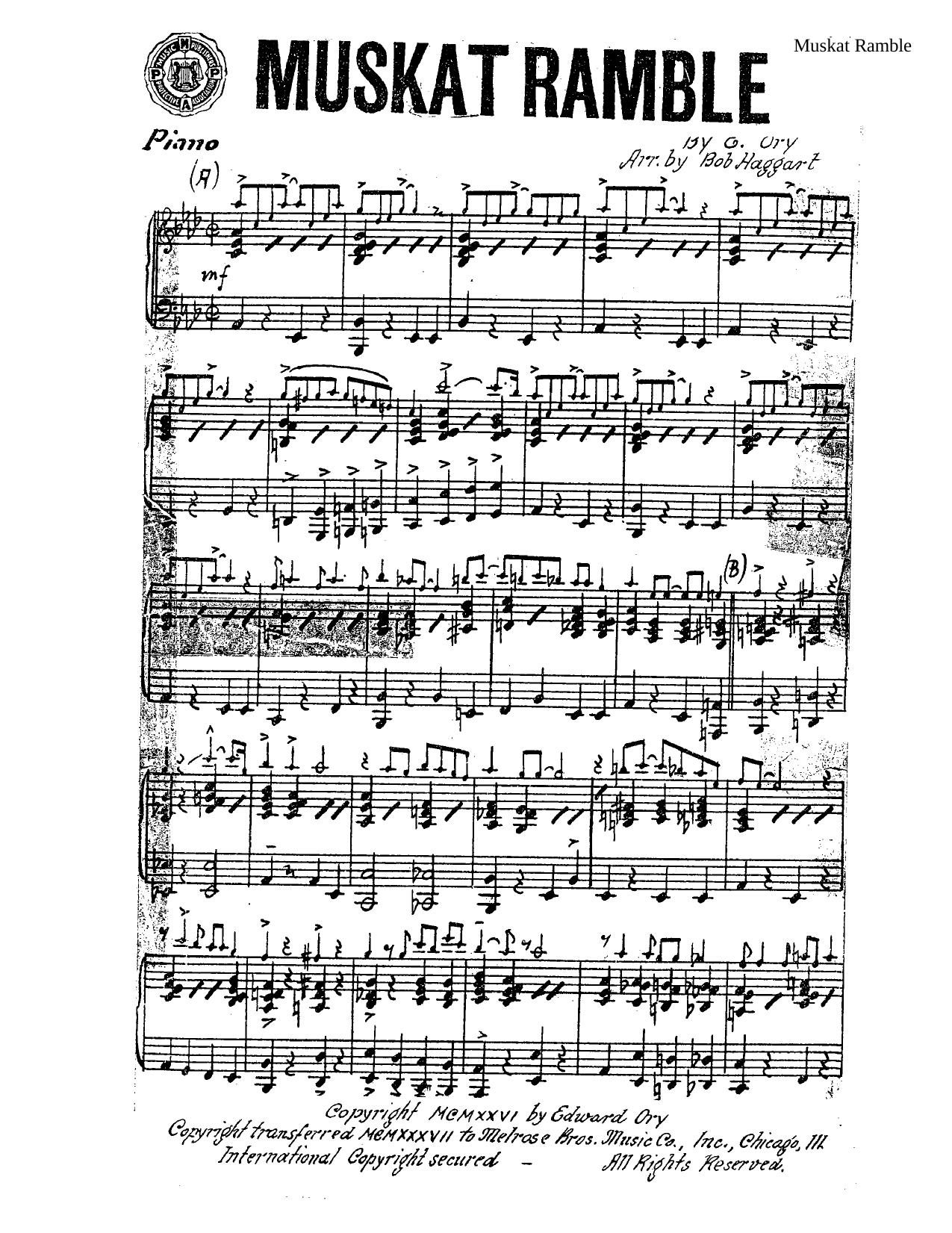
Muskrat Ramble (B.Haggart)
Composed by Kid Ory
Arranged by B.Haggart
- Ensemble: Big Band
- Style: Jazz Standard
- Pages: 26
- Instruments (13): 1st Sax. Eb Alto, 2nd Sax. Bb Tenor, 3rd Sax. Eb Alto, 4th Sax. Bb Tenor, 1st Trumpet in Bb, 2nd Trumpet in Bb, 3rd Trumpet in Bb, 1st Trombone, 2nd Trombone, Piano, Guitar, Bass, Drums
- Difficulty: medium
- Content: Individual Parts
- Format: PDF Download (Instant)
- Price: $24.99
Written by legendary bassist and arranger Bob Haggart, this big band adaptation of Kid Ory’s 1926 New Orleans jazz classic, "Muskrat Ramble," breathes fresh life into one of the most enduring Dixieland anthems of the early jazz era. Originally popularized by Louis Armstrong and his Hot Five, the tune represents the transitional bridge between collective polyphonic-improvisational jazz and the structured, swinging sensibilities of the big band era. Haggart, renowned for his work with the Bob Crosby Orchestra and his mastery of classic swing style, approaches the composition with a sophisticated yet infectious traditional flair, balancing the raw, joyful exuberance of early jazz with the precision and dynamic contrast of a 13-piece swing ensemble. Driven by a bright, bounding two-feel and a bouncy medium-up swing tempo, the arrangement radiates an irrepressible, celebratory mood. The harmonic framework honors the cheerful, cyclical chord changes of the original while injecting clever counterlines and polished brass punctuations. The arrangement opens with a bright ensemble intro before trading bouncy thematic statements between the reeds and brass. Haggart utilizes crisp section solis and roaring, traditional-style ensemble shout choruses that evoke the smoky, high-energy atmosphere of a 1930s ballroom, while maintaining the transparent texture required to keep the counterpoint clean and intelligible. Throughout the chart, the melody is passed seamlessly between sections, allowing both the trumpets and trombones to shine in true tailgate fashion, while the rhythm section—anchored by piano, guitar, bass, and drum set—lays down an assertive, propulsive groove. Featured solo spaces allow the ensemble to showcase individual improvisers over traditional choruses, supported by punchy background riffs from the horns. Technical demands center primarily on stylistic articulation, crisp phrasing, and endurance rather than ultra-complex modern harmonies. Horn players must master buoyant, swinging eighth-note subdivisions and clean dynamic control, while the rhythm section needs a strong command of early swing and stride-influenced comping to maintain the track's buoyant momentum. Advanced high school, collegiate, and professional community big bands will find this chart to be an absolute crowd-pleaser that provides a masterclass in early jazz stylings adapted for a modern horn section. Because the instrumentation is tailored for 13 instruments—including a compact horn lineup and full rhythm section—it offers a rich, full-sounding ensemble blend without requiring a massive, full-complement jazz orchestra. It serves as an ideal festival showcase piece or a high-impact program closer that bridges historical reverence with irresistible swinging entertainment. Achieving the authentic, driving energy of this Haggart chart requires careful attention to articulation and stylistic balance. The tempo should remain steady and bright, avoiding any tendency to drag during ensemble transitions or rush during the high-register shout choruses. Conductors should instruct the brass to utilize traditional jazz articulations—such as short, punchy staccatos and subtle, tasteful falls—without letting the brass overwhelm the woodwinds during countermelodic sections. The rhythm section is the engine of this arrangement; the bass player should lock into a strong, bouncing two-beat or four-beat walking bass line that mimics traditional upright styles, while the drummer drives the ensemble with crisp ride-cymbal patterns and strategic press rolls rather than heavy, modern backbeats. Rehearsals should initially focus on sectional balance, ensuring that inner-voice countermelodies in the trombone and tenor saxophone parts cut through the texture cleanly before bringing the entire 13-piece ensemble together at full tempo. Q: What specific instruments and parts are included in this 13-instrument configuration? A: The arrangement is scored for a 13-piece big band instrumentation, featuring a standard rhythm section (Piano, Drum Set, Guitar, Bass) alongside a dynamic horn lineup that includes multiple brass and reed parts, specifically featuring Trombone 2 and surrounding ensemble voices. Q: What is the difficulty level of this arrangement? A: This chart is graded at a medium difficulty level, making it well-suited for advanced high school, collegiate, and professional community big bands looking for accessible yet historically rich swing repertoire. Q: What is the historical style and musical background of this piece? A: Originally composed by Kid Ory in 1926 and made famous by Louis Armstrong, "Muskrat Ramble" is reimagined here in a classic swing style by arranger Bob Haggart, blending New Orleans polyphonic roots with 1930s big band sophistication. Q: What makes this specific Bob Haggart arrangement unique? A: Haggart's treatment stands out through its clever integration of traditional Dixieland counterpoint with polished swing-era shout choruses, tight section solis, and a compact 13-instrument voicing that maximizes ensemble warmth and clarity. Q: What is the recommended performance duration and tempo feel? A: The arrangement is set at a bright, bouncy medium-up swing tempo (typically around 160–180 BPM) with a driving two-feel and 4/4 swing groove, yielding a standard performance duration of roughly 3 to 4 minutes.
Questions and answers
- What is included in the Muskrat Ramble (B.Haggart) PDF?
- The verified current file contains individual parts across 26 pages.
- How many instruments or parts are listed for Muskrat Ramble (B.Haggart)?
- The verified instrumentation list contains 13 entries for this Big Band arrangement.
- Who is credited for Muskrat Ramble (B.Haggart)?
- Composer: Kid Ory. Arranger: B.Haggart.
- What difficulty is listed for Muskrat Ramble (B.Haggart)?
- The verified difficulty level is medium.
- What style is listed for Muskrat Ramble (B.Haggart)?
- The catalog lists the style as Jazz Standard.
- Can I preview Muskrat Ramble (B.Haggart) before buying?
- Yes. The product page provides a preview generated from the current PDF file.
- How is Muskrat Ramble (B.Haggart) delivered?
- After successful payment, the digital PDF is made available for download. The displayed price is $24.99.
Musicians Also Search For
Muskrat Ramble B.Haggart PDF • Muskrat Ramble B.Haggart sheet music • Muskrat Ramble arranged by B.Haggart • B.Haggart big band charts • B.Haggart jazz arrangements PDF • Muskrat Ramble Kid Ory sheet music • Muskrat Ramble Kid Ory big band arrangements • Kid Ory big band charts • Muskrat Ramble big band arrangements • Muskrat Ramble big band PDF download • Muskrat Ramble jazz sheet music • big band sheet music download • Muskrat Ramble individual parts download • Muskrat Ramble sheet music PDF • Muskrat Ramble Jazz Standard charts • Jazz Standard big band arrangements • buy Muskrat Ramble sheet music • download Muskrat Ramble PDF • Muskrat Ramble jazz charts • best B.Haggart big band arrangements • Kid Ory arranged by B.Haggart • Muskrat Ramble printable sheet music • big band repertoire PDF