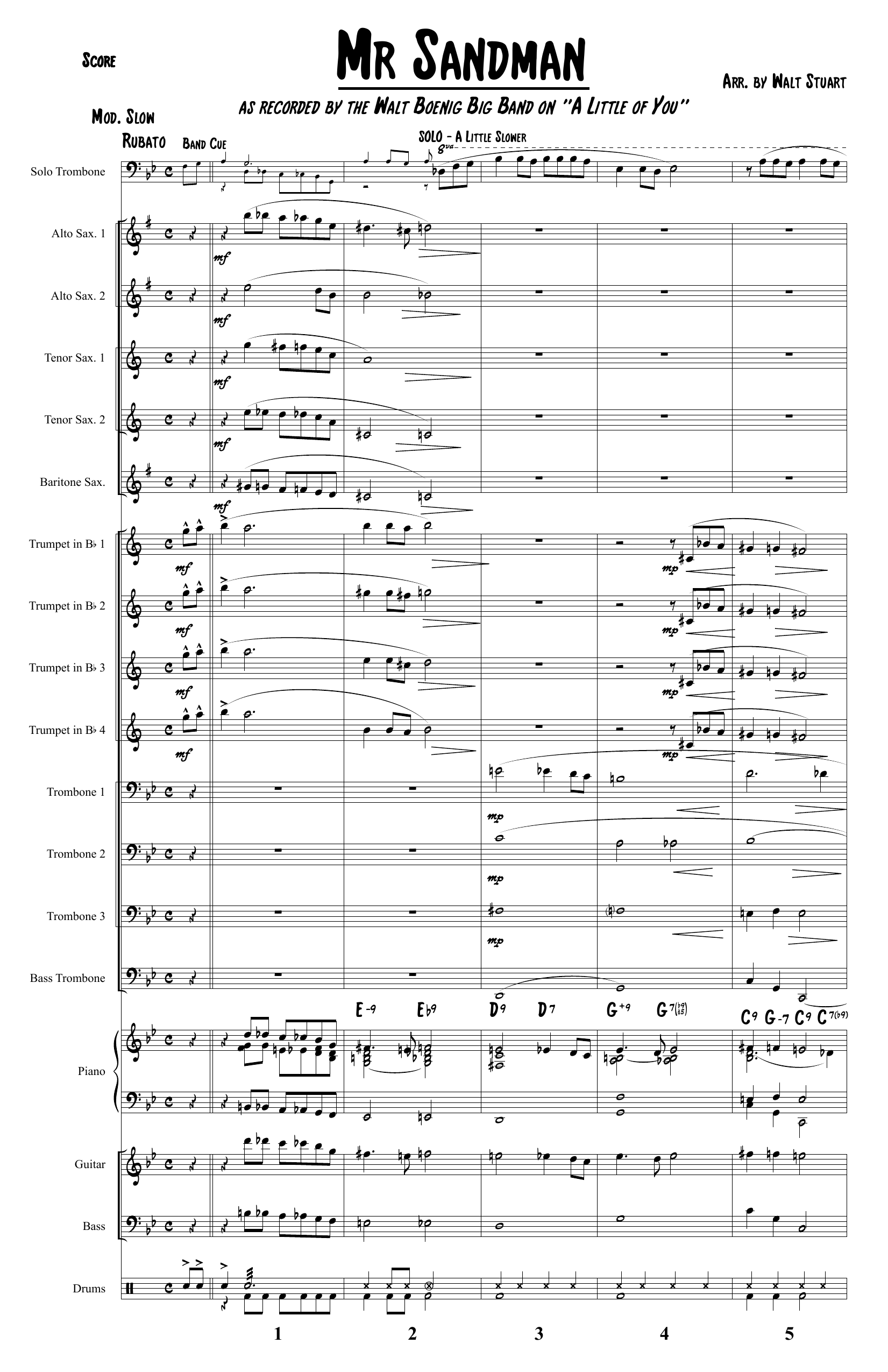
Mr.Sandman (W.Stuart)
Composed by Pat Ballard
Arranged by Walt Stuart
- Ensemble: Big Band
- Pages: 106
- Instruments (18): Solo Trombone, Alto Saxophone 1, Alto Saxophone 2, Tenor Saxophone 1, Tenor Saxophone 2, Baritone Saxophone, Trumpet 1, Trumpet 2, Trumpet 3, Trumpet 4, Trombone 1, Trombone 2, Trombone 3, Bass Trombone, Piano, Guitar, Bass, Drums
- Difficulty: advanced
- Content: Individual Parts
- Format: PDF Download (Instant)
- Price: $24.99
Pat Ballard’s timeless 1954 classic "Mr. Sandman" occupies a cherished place in the American popular songbook, forever immortalized by The Chordettes’ crystalline vocal harmonies and later adapted across numerous jazz idioms. Originally conceived during the twilight of the classic pop-vocal era, the tune’s instantly recognizable ostinato-like phrasing and catchy, descending melodic contour made it an immediate crossover success. Over the decades, jazz arrangers have seized upon its sturdy harmonic framework and playful symmetry, transforming a novelty pop hit into a versatile vehicle for sophisticated big band voicings, swinging counterpoint, and clever ensemble interplay. Walt Stuart’s dynamic big band adaptation breathes fresh, sophisticated life into the material, reframing the nostalgic vocal standard through a lens of classic mid-century swing. Set at a bright, buoyant medium-swing tempo, the chart opens with an inviting, understated vamp before unfolding into lush, harmonically rich section solis that evoke the polished brilliance of the late-swing and studio eras. Stuart skillfully balances accessibility with harmonic intrigue, infusing standard chord progressions with subtle chromatic passing tones, extended upper-structure voicings, and crisp rhythmic kicks. The mood is persistently upbeat, effervescent, and theatrical, evoking the buoyant optimism of 1950s jazz radio while maintaining the structural rigor demanded by serious instrumental ensembles. A defining feature of this 106-page arrangement is its clever democratic distribution of thematic material across the entire 18-instrument ensemble. While the foundational melody is initially introduced by the saxes and later reinforced by tight brass punctuations, the chart provides a brilliant showcase for a featured Solo Trombone, allowing the low-brass section to step into the spotlight with lyrical warmth and dexterity. The arrangement builds steadily through inventive transitional modulations and interlocking horn riffs, culminating in an exhilarating shout chorus that trades traditional bombast for sparkling dynamic contrast and razor-sharp articulation. Advanced high school ensembles, collegiate jazz orchestras, and professional community big bands will find this chart to be an exceptionally rewarding addition to their repertoire. While the syncopated figures and brisk tempo require clean articulation and precise sectional unity, the idiomatic writing ensures that the ensemble's hard work yields an immediate, crowd-pleasing payoff. Complete with a comprehensive conductor score and fully articulated parts for a standard 18-piece big band instrumentation, Stuart’s treatment offers an ideal balance of historical charm and modern compositional flair. Conductors should approach Walt Stuart’s arrangement of "Mr. Sandman" with a focus on buoyant, driving swing phrasing and crystal-clear articulation. The tempo should remain steady and danceable, avoiding any tendency to rush the syncopated figures in the brass. Section leaders must emphasize the lightweight, bouncy character of eighth-note pairs, ensuring that swung eighths are played with a relaxed, forward-moving pulse rather than a heavy triplet feel. Key technical challenges lie in the tight interplay between the saxophones and brass during the developmental interludes, where dynamic contrast is essential to let the countermelodies speak. The featured solo trombone must project a warm, confident tone that cuts cleanly through the underlying comping without forcing the volume. Pay close attention to marked dynamic shifts, sudden subitos, and stylistic accents—such as controlled falls and short stenciled staccatos—which give the chart its characteristic mid-century punch. Rehearsals should initially isolate the rhythm section to lock in the foundational groove before layering in the horn sections section by section. Q: What instruments and parts are included in this big band arrangement? A: The 106-page package includes a full conductor score and complete parts for an 18-instrument big band lineup, featuring Solo Trombone, two Alto Saxophones, two Tenor Saxophones, Baritone Saxophone, four Trumpets, four Trombones, and a standard four-piece rhythm section of piano, guitar, bass, and drums. Q: What is the difficulty level of this arrangement? A: This chart is graded as medium-advanced, making it well-suited for proficient high school jazz bands, collegiate ensembles, and professional community big bands that are comfortable with standard swing idioms and precise sectional synchronization. Q: What musical style and historical context does this arrangement draw from? A: Rooted in the 1954 Pat Ballard pop standard famously popularized by The Chordettes, this arrangement translates the iconic vocal classic into a sophisticated, mid-century-style jazz big band chart featuring classic swing feels and rich harmonic voicings. Q: What makes Walt Stuart’s arrangement of "Mr. Sandman" unique? A: Unlike typical vocal-heavy adaptations, this instrumental chart highlights a featured Solo Trombone and distributes clever countermelodies and crisp shout choruses across the entire 18-instrument ensemble, blending nostalgic charm with modern compositional depth. Q: What is the recommended performance tempo and duration for this piece? A: The arrangement is designed to be performed at a bright, energetic medium-swing tempo, typically lasting around three to four minutes depending on the length of the trombone feature and the execution of the dynamic interludes.
Questions and answers
- What is included in the Mr.Sandman (W.Stuart) PDF?
- The verified current file contains a conductor score and individual parts across 106 pages.
- How many instruments or parts are listed for Mr.Sandman (W.Stuart)?
- The verified instrumentation list contains 18 entries for this Big Band arrangement.
- Who is credited for Mr.Sandman (W.Stuart)?
- Composer: Pat Ballard. Arranger: Walt Stuart.
- What difficulty is listed for Mr.Sandman (W.Stuart)?
- The verified difficulty level is advanced.
- Can I preview Mr.Sandman (W.Stuart) before buying?
- Yes. The product page provides a preview generated from the current PDF file.
- How is Mr.Sandman (W.Stuart) delivered?
- After successful payment, the digital PDF is made available for download. The displayed price is $24.99.
Musicians Also Search For
Mr.Sandman Walt Stuart PDF • Mr.Sandman Walt Stuart sheet music • Mr.Sandman arranged by Walt Stuart • Walt Stuart big band charts • Walt Stuart jazz arrangements PDF • Mr.Sandman Pat Ballard sheet music • Mr.Sandman Pat Ballard big band arrangements • Pat Ballard big band charts • Mr.Sandman big band arrangements • Mr.Sandman big band PDF download • Mr.Sandman jazz sheet music • big band sheet music download • Mr.Sandman conductor score PDF • Mr.Sandman individual parts download • Mr.Sandman sheet music PDF • buy Mr.Sandman sheet music • download Mr.Sandman PDF • Mr.Sandman jazz charts • best Walt Stuart big band arrangements • Pat Ballard arranged by Walt Stuart • Mr.Sandman printable sheet music • big band repertoire PDF