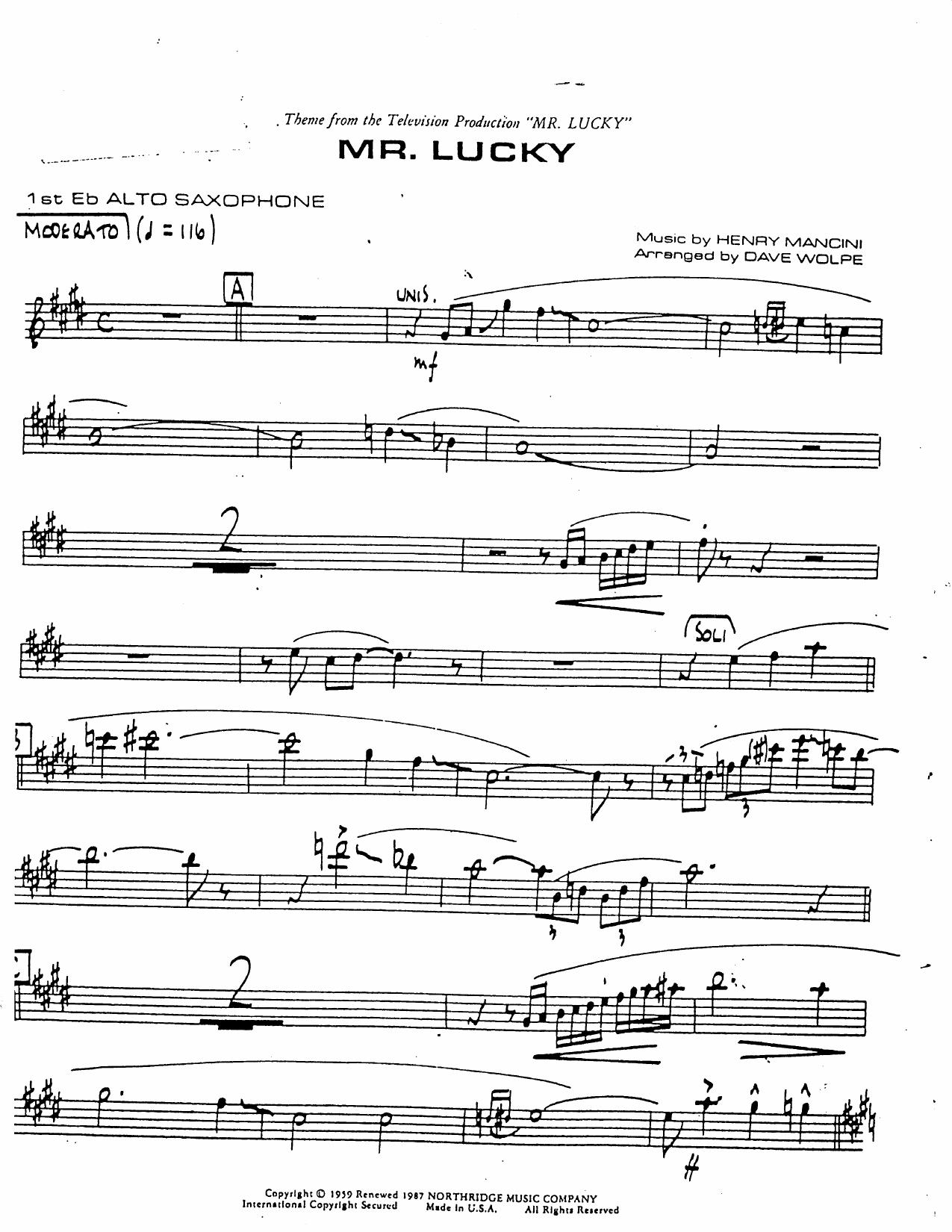
Mr.Lucky (D.Wolpe) sheet music preview

Mr.Lucky (D.Wolpe)

Composed by Henry Mancini

Arranged by Dave Wolpe

  • Ensemble: Big Band
  • Pages: 36
  • Instruments (17): 1st Eb Alto Saxophone, 2nd Eb Alto Saxophone, 1st Bb Tenor Saxophone, 2nd Bb Tenor Saxophone, Eb Baritone Saxophone, 1st Bb Trumpet, 2nd Bb Trumpet, 3rd Bb Trumpet, 4th Bb Trumpet, 1st Trombone, 2nd Trombone, 3rd Trombone, 4th Trombone, Bass, Guitar, Drums, Piano
  • Difficulty: medium
  • Content: Individual Parts
  • Format: PDF Download (Instant)
  • Price: $24.99

Henry Mancini’s iconic theme "Mr. Lucky," originally composed for the 1959 CBS television series of the same name, stands as a masterclass in suave, cool-jazz sophistication. Capturing the smoky, high-stakes atmosphere of a floating casino and the suave demeanor of its protagonist, Mancini’s timeless composition bridges the gap between West Coast cool and driving big band orchestration. While the original recording relied on Mancini's signature cinematic textures—blending muted brass, sultry flutes, and a hypnotic rhythm section groove—it quickly crossed over into the jazz canon, interpreted by luminaries like James Moody and Wes Montgomery. This composition represents the pinnacle of late-fifties television scoring, where jazz idioms were successfully commercialized without losing an ounce of their artistic integrity or rhythmic street-cred. Master arranger Dave Wolpe has taken this legendary motif and retooled it into a powerhouse big band chart that oozes mid-century swagger. Driven by an infectious, medium-tempo swing groove in 4/4 time, the arrangement balances tight, crystalline ensemble writing with relaxed, swinging interludes. The mood is effortlessly cool, sophisticated, and tinged with subtle mystery, evoking a late-night Manhattan penthouse or a classic noir film sequence. Wolpe maintains the seductive melodic contours of Mancini’s original head while injecting a robust harmonic vocabulary that expands the chord extensions, giving the brass and saxophones a rich, contemporary bite that cuts cleanly through any room. True to Wolpe’s celebrated arranging style, the chart features pristine sectional writing, highlighted by a lush, harmonically sophisticated saxophone soli that showcases sectional blend and intonation. The brass section acts as both a cushion and a sharp punctuating force, utilizing strategic dynamic contrasts to build tension leading into a tightly wound, hard-swinging shout chorus. The melody is shared fluidly across the ensemble, transitioning organically from the brass to the reeds, keeping every player engaged. Open solo sections provide a prime vehicle for featured improvisers—typically ideal for tenor saxophone or piano—to stretch out over accessible blues-infused changes that stay true to the chart's swinging aesthetic. Advanced high school, collegiate, and community jazz ensembles will find this arrangement to be an ideal programming centerpiece. While it does not demand the blistering technical pyrotechnics of ultra-complex contemporary charts, it requires exceptional stylistic cohesion, a deeply locked-in pocket from the rhythm section, and absolute precision in articulation to nail the "cool" phrasing. Directors will appreciate how naturally the chart teaches stylistic integrity, ensemble listening, and subtle dynamic control, making it equally rewarding for festival adjudication or as a crowd-pleasing highlight in a standard concert set. Success with this Dave Wolpe chart hinges entirely on the rhythm section establishing an unyielding, relaxed medium-swing groove right from the downbeat. The quarter-note pulse should feel driving yet completely laid-back, avoiding any tendency to rush the tempo. Horn players must pay close attention to short, clipped articulations on off-beat figures, ensuring that stenciled accents are crisp rather than heavy-handed. Brass players should utilize cup mutes or harmon mutes where indicated to capture that authentic Mancini-esque cinematic timbre, ensuring that muted passages project evenly without forcing the tone. Pay meticulous attention to dynamic markings during the sax soli; the background figures from the brass must remain strictly subordinate to let the reed melody breathe. In the shout chorus, resist the urge to over-blow—let Wolpe’s natural-sounding, high-register voicings do the heavy lifting while maintaining a balanced, warm ensemble blend. Rehearsals should initially focus on locking in the syncopated background figures at a slower tempo before bringing the chart up to performance speed. Q: What instruments and parts are included in this big band arrangement? A: The complete 36-page set is scored for a standard 17-instrument big band lineup, comprising Alto Saxophone 1, Alto Saxophone 2, Tenor Saxophone 1, Tenor Saxophone 2, Baritone Saxophone, 4 Trumpets, 4 Trombones, Piano, Guitar, Bass, and Drum Set. Q: What is the difficulty level of this Dave Wolpe arrangement? A: This chart is graded as medium to medium-advanced, making it exceptionally well-suited for advanced high school, collegiate, and skilled community jazz orchestras that have developed good ensemble blend and swing feel. Q: What is the musical style and historical background of "Mr. Lucky"? A: Originally composed by Henry Mancini for the 1959 television series, the piece is a quintessential cool-jazz standard rooted in the sleek, sophisticated aesthetic of late-fifties cinematic and television scoring. Q: What makes this specific arrangement by Dave Wolpe unique? A: Wolpe expertly translates Mancini's moody, small-screen atmosphere into a full-scale big band format, featuring lush saxophone solis, clever harmonic extensions, and a brilliantly structured shout chorus that honors the original melody. Q: What is the performance duration and recommended tempo feel? A: The arrangement runs approximately 3 to 4 minutes and is anchored by a steady, relaxed medium-swing groove in 4/4 time designed to showcase a tight rhythm section pocket and crisp articulation.

Questions and answers

What is included in the Mr.Lucky (D.Wolpe) PDF?
The verified current file contains individual parts across 36 pages.
How many instruments or parts are listed for Mr.Lucky (D.Wolpe)?
The verified instrumentation list contains 17 entries for this Big Band arrangement.
Who is credited for Mr.Lucky (D.Wolpe)?
Composer: Henry Mancini. Arranger: Dave Wolpe.
What difficulty is listed for Mr.Lucky (D.Wolpe)?
The verified difficulty level is medium.
Can I preview Mr.Lucky (D.Wolpe) before buying?
Yes. The product page provides a preview generated from the current PDF file.
How is Mr.Lucky (D.Wolpe) delivered?
After successful payment, the digital PDF is made available for download. The displayed price is $24.99.

Musicians Also Search For

Mr.Lucky Dave Wolpe PDFMr.Lucky Dave Wolpe sheet musicMr.Lucky arranged by Dave WolpeDave Wolpe big band chartsDave Wolpe jazz arrangements PDFMr.Lucky Henry Mancini sheet musicMr.Lucky Henry Mancini big band arrangementsHenry Mancini big band chartsMr.Lucky big band arrangementsMr.Lucky big band PDF downloadMr.Lucky jazz sheet musicbig band sheet music downloadMr.Lucky individual parts downloadMr.Lucky sheet music PDFbuy Mr.Lucky sheet musicdownload Mr.Lucky PDFMr.Lucky jazz chartsbest Dave Wolpe big band arrangementsHenry Mancini arranged by Dave WolpeMr.Lucky printable sheet musicbig band repertoire PDF

All arrangements by Dave Wolpe All Henry Mancini sheet music