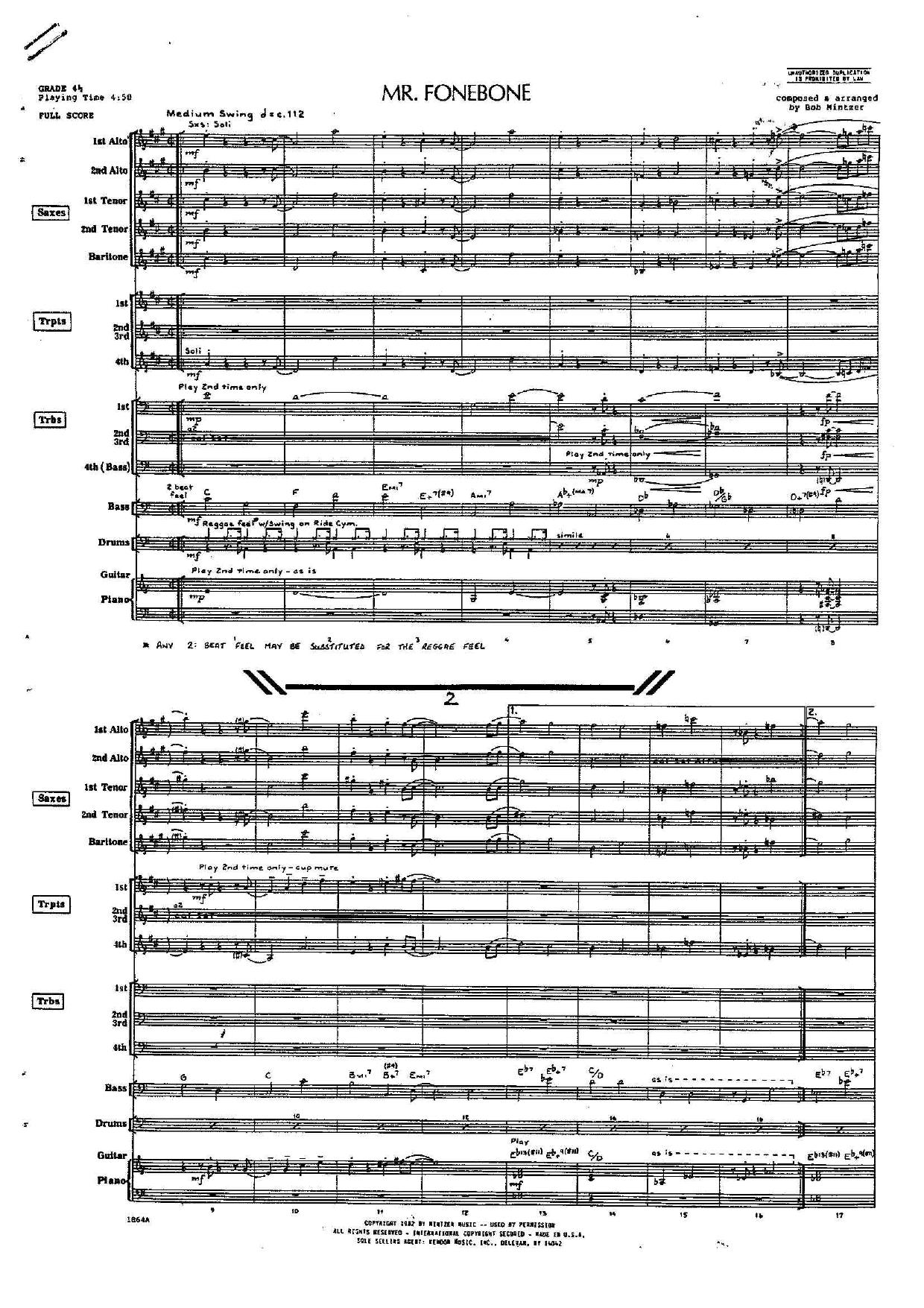
Mr.Fonebone (B.Mintzer) sheet music preview

Mr.Fonebone (B.Mintzer)

Composed by Bob Mintzer

Arranged by Bob Mintzer

  • Ensemble: Big Band
  • Pages: 46
  • Instruments (16): 1st Eb Alto Sax, 2nd Eb Alto Sax, 1st Bb Tenor Sax, 2nd Bb Tenor Sax, Eb Baritone Sax, 1st Bb Trumpet, 2nd Bb Trumpet, 3rd Bb Trumpet, 4th Bb Trumpet, 1st Trombone, 2nd Trombone, 3rd Trombone, 4th (Bass) Trombone, Bass, Piano/Guitar, Drums
  • Difficulty: medium
  • Content: Individual Parts
  • Format: PDF Download (Instant)
  • Price: $24.99

Bob Mintzer’s iconic composition "Mr. Fonebone" stands as a towering achievement in modern big band writing, originally recorded by the Yellowjackets and subsequently adapted for large jazz ensemble. Emerging from the vibrant fusion and post-bop landscape of the 1980s and 1990s, this chart captures the sophisticated compositional voice of Mintzer, a multi-Grammy-winning saxophonist, composer, and long-time leader of the Yellowjackets and the WDR Big Band. "Mr. Fonebone" translates small-group interplay into a massive orchestral canvas, showcasing how Mintzer bridges the gap between traditional swing-era big band architecture and contemporary harmonic language. It has since become a staple of advanced collegiate and professional big band repertoire, celebrated for its driving momentum and intricate ensemble interplay. Driven by an infectious, high-energy straight-eighth or upbeat swing groove, "Mr. Fonebone" operates at a brisk tempo that demands absolute rhythmic precision from every section. The mood is relentlessly optimistic, urgent, and intellectually stimulating, characterized by angular melodic lines that twist through extended tertian and quartal harmonies. The harmonic language employs sophisticated chromaticism, modal shifts, and punchy syncopated figures that evoke the urban sophistication of modern New York jazz. The emotional arc moves from a breathless, high-velocity opening theme straight into an expansive developmental middle ground, ultimately culminating in a ferocious, brass-heavy shout chorus that pushes the ensemble to its absolute limits. Mintzer’s structural approach relies heavily on interlocking woodwind solis, dense brass voicings that avoid clutter while maximizing power, and seamless transitions between tutti ensemble hits and exposed solo sections. True to his signature style, the saxophones often act as a nimble, harmonically rich unit executing scalar runs in unison or tight block chords, while the brass punctuates the texture with razor-sharp staccato attacks. The melody is shared dynamically across the ensemble, passing fluidly from the saxes to the trumpets before opening up for extended blowing changes. Solo opportunities are provided for key chair holders—typically tenor saxophone and piano or trombone—allowing improvisers to stretch out over modern modal and altered dominant harmonic frameworks. Advanced high school, collegiate, and professional jazz ensembles will find this chart an exceptional vehicle for developing ensemble articulation, stamina, and modern stylistic awareness. The primary technical challenges lie in the rapid-fire unison lines, wide dynamic contrasts, and the sheer endurance required of the brass section through the dense, high-register shout choruses. Rhythmic execution is paramount; the chart succeeds only when the ensemble locks into a unified articulation concept, treating sharp accents and ghosted notes with equal care. Performing "Mr. Fonebone" rewards the band with an unmatched adrenaline rush and provides audiences with a masterclass in contemporary big band orchestration, making it a pinnacle programming choice for any serious jazz ensemble concert. Conductors must approach "Mr. Fonebone" with a meticulous focus on rhythmic exactness and articulation uniformity. The primary technical challenge lies in executing the dense, fast-moving syncopated figures cleanly across all sections without dragging the tempo. Establish a rock-solid internal pulse with the rhythm section before layering in the horn parts; the bass and drums must drive the ensemble with an assertive, conversational feel rather than a rigid metronomic grid. Brass players should prioritize a bright, centered tone without forcing the sound, ensuring that high-register entries remain musical and in tune. Pay special attention to dynamic markings: the contrast between muted background figures and roaring open-horn unisons creates the architectural depth of Mintzer’s writing. Rehearsals should isolate difficult scalar passages at a slower tempo, gradually building speed while maintaining strict adherence to marked staccato and accented notes. Encourage soloists to lean into the altered and extended harmony rather than relying solely on diatonic vocabulary, capturing the sophisticated, modern-bop ethos of the composition. Q: What instruments and parts are included in this arrangement? A: This arrangement is scored for a standard 17-piece big band instrumentation, comprising 2 alto saxophones, 2 tenor saxophones, 1 baritone saxophone, 4 trumpets, 4 trombones, guitar, piano, bass, and drums, alongside a comprehensive conductor score spanning 46 pages. Q: What is the difficulty level of this chart? A: This arrangement is rated as advanced, making it exceptionally well-suited for top-tier high school bands, collegiate jazz ensembles, and professional or community big bands with strong technical proficiency. Q: What is the musical style and historical context of "Mr. Fonebone"? A: Composed and arranged by Bob Mintzer, this piece reflects the dynamic post-bop and contemporary jazz-fusion ethos of the late 20th century, merging small-group harmonic sophistication with the powerhouse energy of a modern big band. Q: What makes this specific arrangement unique? A: Mintzer’s signature writing style shines through intricate, interlocking woodwind solis, angular melodic motifs, and dense, contemporary brass voicings that demand total ensemble cohesion and dynamic control. Q: What is the performance duration and tempo feel of the piece? A: While performance duration typically ranges from 5 to 6 minutes depending on the length of the improvised solos, the chart is driven by a brisk, high-energy tempo that requires sustained rhythmic stamina and focus.

Questions and answers

What is included in the Mr.Fonebone (B.Mintzer) PDF?
The verified current file contains a conductor score and individual parts across 46 pages.
How many instruments or parts are listed for Mr.Fonebone (B.Mintzer)?
The verified instrumentation list contains 16 entries for this Big Band arrangement.
Who is credited for Mr.Fonebone (B.Mintzer)?
Composer: Bob Mintzer. Arranger: Bob Mintzer.
What difficulty is listed for Mr.Fonebone (B.Mintzer)?
The verified difficulty level is medium.
Can I preview Mr.Fonebone (B.Mintzer) before buying?
Yes. The product page provides a preview generated from the current PDF file.
How is Mr.Fonebone (B.Mintzer) delivered?
After successful payment, the digital PDF is made available for download. The displayed price is $24.99.

Musicians Also Search For

Mr.Fonebone Bob Mintzer PDFMr.Fonebone Bob Mintzer sheet musicMr.Fonebone arranged by Bob MintzerBob Mintzer big band chartsBob Mintzer jazz arrangements PDFMr.Fonebone Bob Mintzer big band arrangementsMr.Fonebone big band arrangementsMr.Fonebone big band PDF downloadMr.Fonebone jazz sheet musicbig band sheet music downloadMr.Fonebone conductor score PDFMr.Fonebone individual parts downloadMr.Fonebone sheet music PDFbuy Mr.Fonebone sheet musicdownload Mr.Fonebone PDFMr.Fonebone jazz chartsbest Bob Mintzer big band arrangementsMr.Fonebone printable sheet musicbig band repertoire PDF

All arrangements by Bob Mintzer All Bob Mintzer sheet music