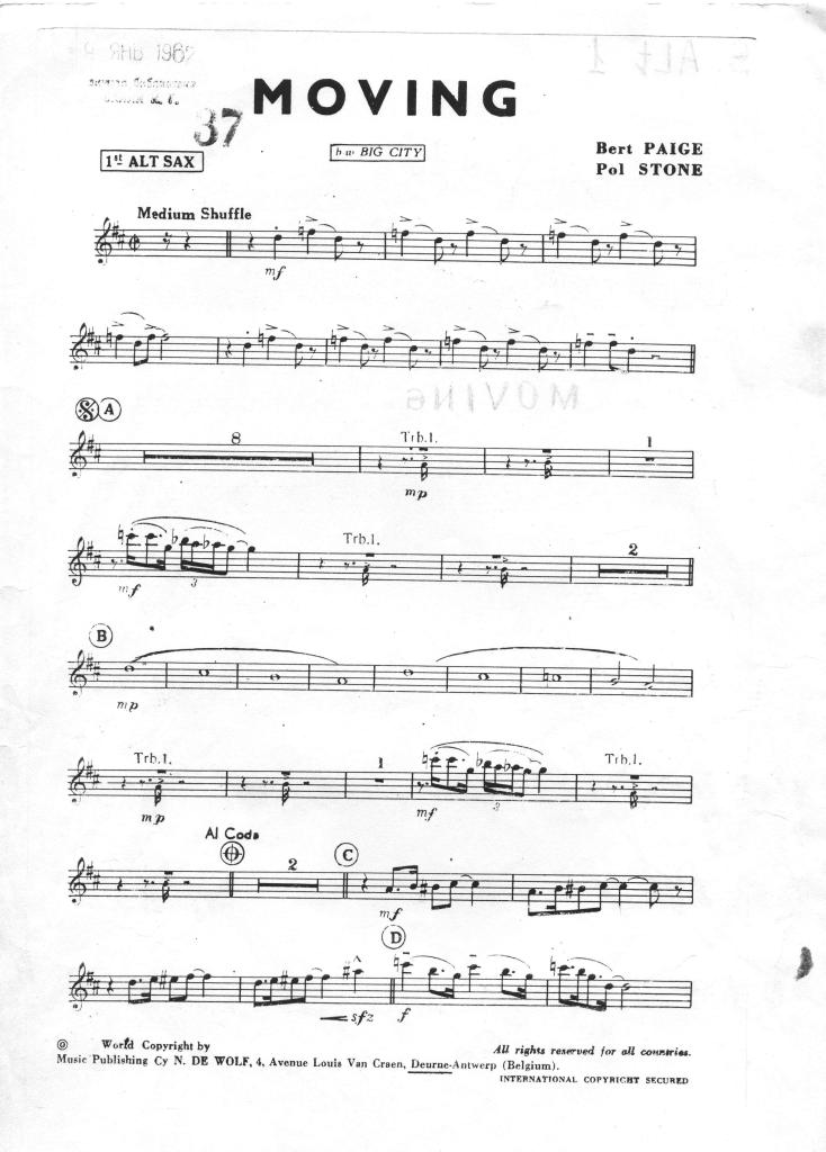
Moving (B.Paige)
Composed by Bert Paige
Arranged by B.Paige
- Ensemble: Big Band
- Style: Jazz Standard
- Pages: 30
- Instruments (17): Alto Saxophone 1, Alto Saxophone 2, Tenor Saxophone 1, Tenor Saxophone 2, Baritone Saxophone, Trumpet 1, Trumpet 2, Trumpet 3, Trumpet 4, Trombone 1, Trombone 2, Trombone 3, Bass Trombone, Guitar, Piano, Bass, Drums
- Difficulty: medium
- Content: Individual Parts
- Format: PDF Download (Instant)
- Price: $24.99
"Moving (B.Paige)" is a vibrant big band arrangement that breathes new life into a classic jazz standard, originally composed by Bert Paige. While the specific recording that popularized "Moving" isn't universally cited in the same vein as a "Take the 'A' Train" or "In the Mood," Bert Paige himself was a prolific Belgian composer, arranger, and bandleader whose work in the mid-20th century, particularly from the 1950s through the 1970s, contributed significantly to the European big band and easy listening sound. His compositions often blended sophisticated jazz harmonies with accessible melodies, making them ripe for interpretation by various ensembles. This piece encapsulates the elegant, yet driving, swing feel characteristic of that post-war big band era, offering a bridge between traditional swing and the more modern harmonic explorations of the mid-century. This arrangement establishes a bright, medium-up swing tempo, typically hovering around 180-200 BPM, immediately setting an energetic and sophisticated mood. The primary key of F major provides a comfortable yet resonant foundation, allowing for rich brass voicings and soaring saxophone lines. The overall character is one of buoyant optimism and refined drive, evoking the feeling of a classic big band performance from a bygone era, yet with a timeless appeal. The harmonic language is firmly rooted in traditional jazz, utilizing extended dominant chords, clear ii-V-I progressions, and occasional chromatic embellishments that add color without sacrificing clarity. The piece maintains a consistent, infectious groove throughout, making it an excellent choice for showcasing a band's collective rhythmic precision and stylistic understanding. B.Paige's arrangement of "Moving" is a masterclass in big band writing, distinguishing itself through its intelligent voicings and dynamic contour. The melody is initially presented by the lead alto saxophone, often doubled by trumpet 1, providing a bright and assertive statement. Subsequent melodic developments feature intricate saxophone soli sections that weave together with precision, showcasing the ensemble's blend and articulation. The brass sections are utilized effectively for powerful punctuations and counter-melodies, building tension and release. A standout feature is the expertly crafted shout chorus, which arrives with compelling force, demonstrating B.Paige's knack for building excitement through layered rhythmic figures and full-ensemble harmonies. The arrangement includes ample space for improvisation, typically featuring a tenor saxophone solo over the form, followed by a trumpet solo, allowing individual musicians to shine within the ensemble context. Performing "Moving (B.Paige)" is a rewarding experience for a big band. While technically accessible, it demands a strong sense of swing feel and dynamic control. The primary technical challenges lie in achieving tight ensemble articulation within the saxophone solis and ensuring precise brass attacks in the shout chorus. The lead trumpet range extends to a written high C, requiring a capable player. The arrangement is well-suited for advanced high school, collegiate, community, and semi-professional big bands. Its clear structure, engaging melodies, and opportunities for both ensemble precision and individual improvisation make it an ideal vehicle for developing stylistic authenticity and stage presence. The piece culminates in a powerful, full-ensemble coda, leaving a lasting impression of sophisticated swing. "Moving (B.Paige)" should be approached with a consistent, driving medium-up swing feel, ideally between 180-200 BPM. Emphasize a light, buoyant eighth-note feel rather than a heavy, straight interpretation. Key technical challenges include achieving precise articulation and blend within the saxophone soli sections; encourage players to listen across the section for unified attacks and releases. The brass sections require strong, confident attacks, particularly in the shout chorus, where dynamic contrast is crucial for impact. Lead trumpet extends to a written high C, demanding a player with solid upper register command. No special techniques like plunger mutes or falls are explicitly notated, allowing the ensemble to focus on fundamental swing articulation and dynamics. Rehearsal time should be dedicated to locking in the rhythmic groove, ensuring clean transitions between sections, and balancing the improvised solos against the ensemble accompaniment. Pay close attention to dynamic shaping throughout, building naturally towards the powerful shout chorus and final coda. Q: What instruments are included in this arrangement? A: This arrangement is scored for a standard 17-piece big band: Alto Saxophone 1 & 2, Tenor Saxophone 1 & 2, Baritone Saxophone, Trumpet 1-4, Trombone 1-4, Piano, Bass, and Drums. Q: What is the difficulty level of "Moving (B.Paige)"? A: This arrangement is rated as Medium-Advanced. It is suitable for advanced high school, collegiate, community, and semi-professional big bands, requiring solid ensemble playing and capable soloists. Q: What style and historical context does this arrangement represent? A: "Moving (B.Paige)" is a vibrant big band arrangement of a jazz standard, embodying the sophisticated, driving medium-up swing feel characteristic of mid-20th century big band jazz, particularly influenced by European jazz composers like Bert Paige. Q: What makes this arrangement unique compared to other big band charts? A: B.Paige's arrangement stands out for its intelligent voicings, intricate saxophone soli sections, a powerful and well-constructed shout chorus, and its ability to blend classic swing aesthetics with engaging harmonic clarity. Q: What is the typical performance duration and tempo for this piece? A: The typical performance duration for "Moving (B.Paige)" is approximately 3:30 to 4:30 minutes, depending on the length of the improvised solos. It is designed to be played at a bright, medium-up swing tempo, usually between 180-200 BPM.
Musicians Also Search For
Moving B.Paige PDF • Moving B.Paige sheet music • Moving arranged by B.Paige • B.Paige big band charts • B.Paige jazz arrangements PDF • Moving Bert Paige sheet music • Moving Bert Paige big band arrangement • Bert Paige big band charts • Moving big band arrangement • Moving big band PDF download • Moving jazz ensemble sheet music • big band sheet music instant download • Moving individual parts download • Moving sheet music with parts • Moving Jazz Standard chart • Jazz Standard big band arrangements • buy Moving sheet music online • download Moving PDF • Moving jazz chart • best B.Paige big band arrangements • Bert Paige songs arranged by B.Paige • Moving printable sheet music • big band repertoire PDF