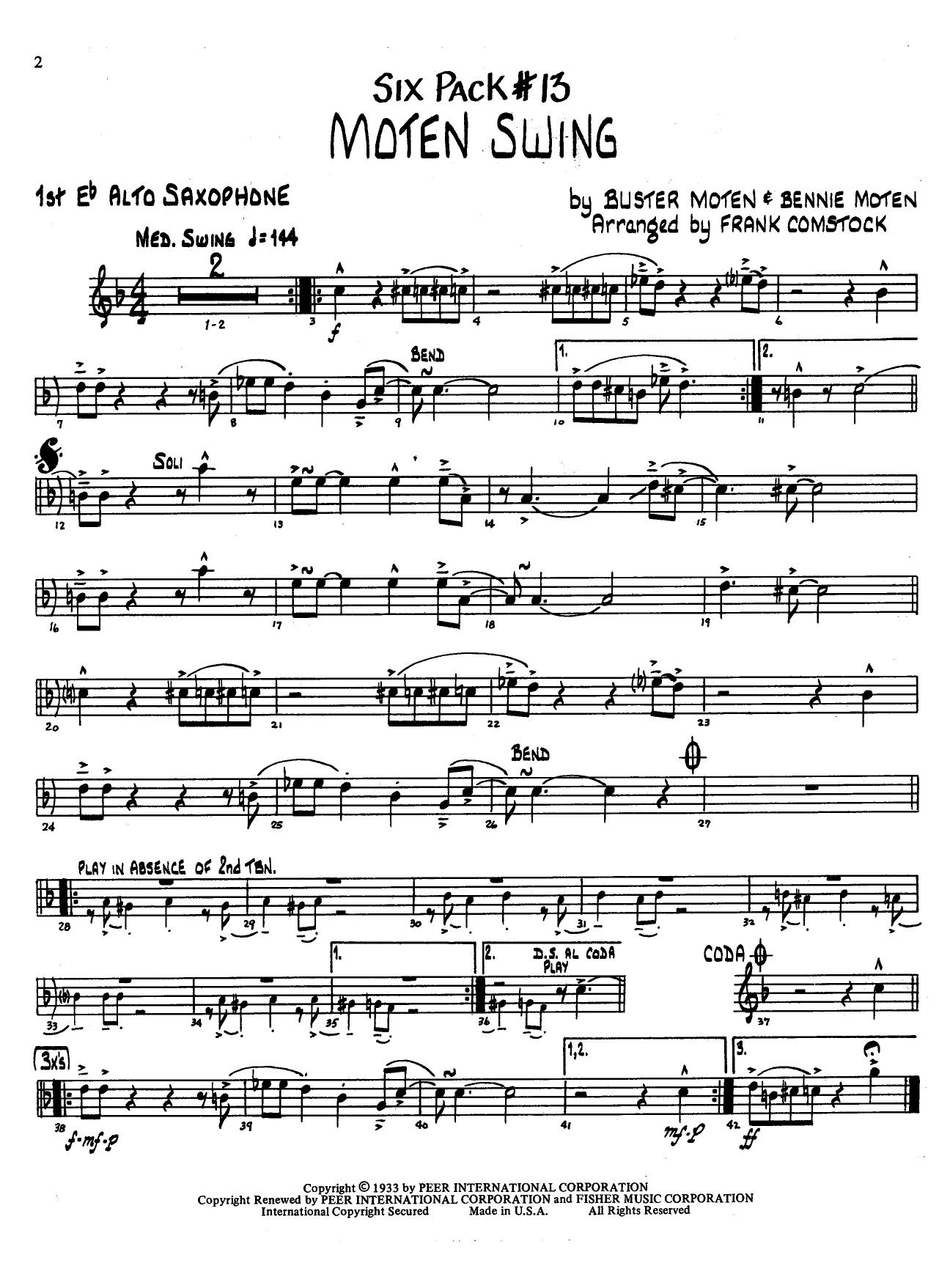
Moten Swing (F.Comstock)
Composed by Frank Comstock
Arranged by Frank Comstock
- Ensemble: Big Band
- Pages: 22
- Instruments (15): 1st Eb Alto Saxophone, 2nd Eb Alto Saxophone, 1st Bb Tenor Saxophone, 2nd Bb Tenor Saxophone, Eb Baritone Saxophone, 1st Bb Trumpet, 2nd Bb Trumpet, 3rd Bb Trumpet, 1st Trombone, 2nd Trombone, 3rd Trombone, Piano, Guitar, Bass, Drums
- Difficulty: medium
- Content: Individual Parts
- Format: PDF Download (Instant)
- Price: $24.99
Originating from the brilliant Kansas City jazz tradition established by Bennie Moten and famously popularized by the Count Basie Orchestra, "Moten Swing" stands as a monumental cornerstone of the swing era. Written in 1932, this driving riff-based composition defined the infectious, blues-inflected rhythm and pulse that propelled big band jazz into the national spotlight. Its enduring appeal lies in its deceptively simple head, which builds immense momentum through call-and-response figures and cyclical harmonic structures, making it an essential vehicle for studying classic swing vernacular. Frank Comstock’s masterful treatment captures the quintessential excitement of the genre while bringing the refined, polished sensibility of a veteran Hollywood arranger. Set at a driving medium-swing tempo, the chart opens with crisp, snappy rhythmic kicks in the rhythm section before laying out the iconic theme. Comstock utilizes clever dynamic contrasts and sparkling upper-structure voicings across the horns, shifting the mood from smoky, relaxed grooving to high-octane ensemble intensity. The energy builds steadily through tight sectional interplay, evoking the electric atmosphere of mid-century dance halls and late-night studio sessions. Comstock’s arranging genius shines in his economic yet highly effective distribution of lines, tailor-made to maximize the impact of a flexible ensemble. The melody is shared fluidly between the saxophones and brass, demanding clean articulation and unified phrasing. Interlocking soli sections allow individual sections to shine without sacrificing collective drive, while the arrangement culminates in a powerful shout chorus. This section weaves contrasting counterlines against the main motif, challenging the ensemble to balance raw power with exact intonation and stylistic cohesion. Crafted with versatility in mind, this 22-page publication is specifically engineered to accommodate flexible instrumentation ranging from compact 9-instrument configurations (featuring Alto Sax, Tenor Sax, Baritone Sax, Trumpet, Trombone, and a complete rhythm section) up to fuller big band setups. Advanced high school ensembles, collegiate jazz groups, and professional community bands will find this chart deeply rewarding. It offers an ideal pedagogical tool for teaching authentic swing subdivision, jazz articulation, and section balance, all while delivering a crowd-pleasing performance piece that anchors any jazz program concert. Achieving an authentic groove on this chart requires strict adherence to a relaxed, forward-moving medium-swing feel, avoiding any tendency to rush the quarter-note pulse. Pay close attention to standard swing eighth-note interpretation, ensuring that off-beats are properly accented and articulated with a light tongue. The primary technical challenge lies in maintaining crisp synchronization during dense, fast-moving unison lines between the saxophones and brass. Conductors should rehearse these passages slowly at first, isolating problem rhythms until the entire ensemble locks into a unified articulation style. Ensure that short notes (staccatos) are clipped sharply and long notes receive proper breath support and subtle dynamic shaping. Dynamic contrast is crucial for a successful execution; do not allow the band to sit at a constant mezzo-forte. Maximize the contrast between the understated, sultry background figures and the explosive peaks of the shout chorus. Drumset players should drive the ensemble with a steady ride cymbal pattern and crisp hi-hat chicks on beats two and four, utilizing tasteful fills to set up major ensemble hits without overpowering the horns. Q: What instruments and parts are included in this arrangement? A: This publication contains 22 pages of full score and parts, structured to support a 9-instrument core ensemble (including Alto Saxophone, Tenor Saxophone, Baritone Saxophone, Trumpet, Trombone, Piano, Guitar, Bass, and Drum Set) with voicing options that scale up seamlessly for standard big band instrumentation. Q: What is the difficulty level of this chart? A: This arrangement is graded at a medium difficulty level, making it accessible to competent high school musicians while offering enough sophisticated harmonic and stylistic depth to engage collegiate and professional players. Q: What is the historical background of the musical style? A: The piece is based on the 1932 swing classic by Bennie Moten, a foundational anthem of the Kansas City jazz style that heavily influenced the Count Basie Orchestra and the broader big band era. Q: What makes Frank Comstock’s arrangement unique? A: Comstock’s setting is uniquely structured to sound full and authentic even when performed by smaller 9-piece horn sections, utilizing clever counterpoint, rich Hollywood-style voicings, and flexible scoring that doesn't sacrifice the punch of a full big band. Q: What is the recommended tempo and performance duration? A: The chart is designed for a driving medium-swing tempo (typically around quarter note = 132–144 BPM), resulting in a performance duration of approximately 3 to 4 minutes depending on solo extensions.
Questions and answers
- What is included in the Moten Swing (F.Comstock) PDF?
- The verified current file contains a conductor score and individual parts across 22 pages.
- How many instruments or parts are listed for Moten Swing (F.Comstock)?
- The verified instrumentation list contains 15 entries for this Big Band arrangement.
- Who is credited for Moten Swing (F.Comstock)?
- Composer: Frank Comstock. Arranger: Frank Comstock.
- What difficulty is listed for Moten Swing (F.Comstock)?
- The verified difficulty level is medium.
- Can I preview Moten Swing (F.Comstock) before buying?
- Yes. The product page provides a preview generated from the current PDF file.
- How is Moten Swing (F.Comstock) delivered?
- After successful payment, the digital PDF is made available for download. The displayed price is $24.99.
Musicians Also Search For
Moten Swing Frank Comstock PDF • Moten Swing Frank Comstock sheet music • Moten Swing arranged by Frank Comstock • Frank Comstock big band charts • Frank Comstock jazz arrangements PDF • Moten Swing Frank Comstock big band arrangements • Moten Swing big band arrangements • Moten Swing big band PDF download • Moten Swing jazz sheet music • big band sheet music download • Moten Swing conductor score PDF • Moten Swing individual parts download • Moten Swing sheet music PDF • buy Moten Swing sheet music • download Moten Swing PDF • Moten Swing jazz charts • best Frank Comstock big band arrangements • Moten Swing printable sheet music • big band repertoire PDF