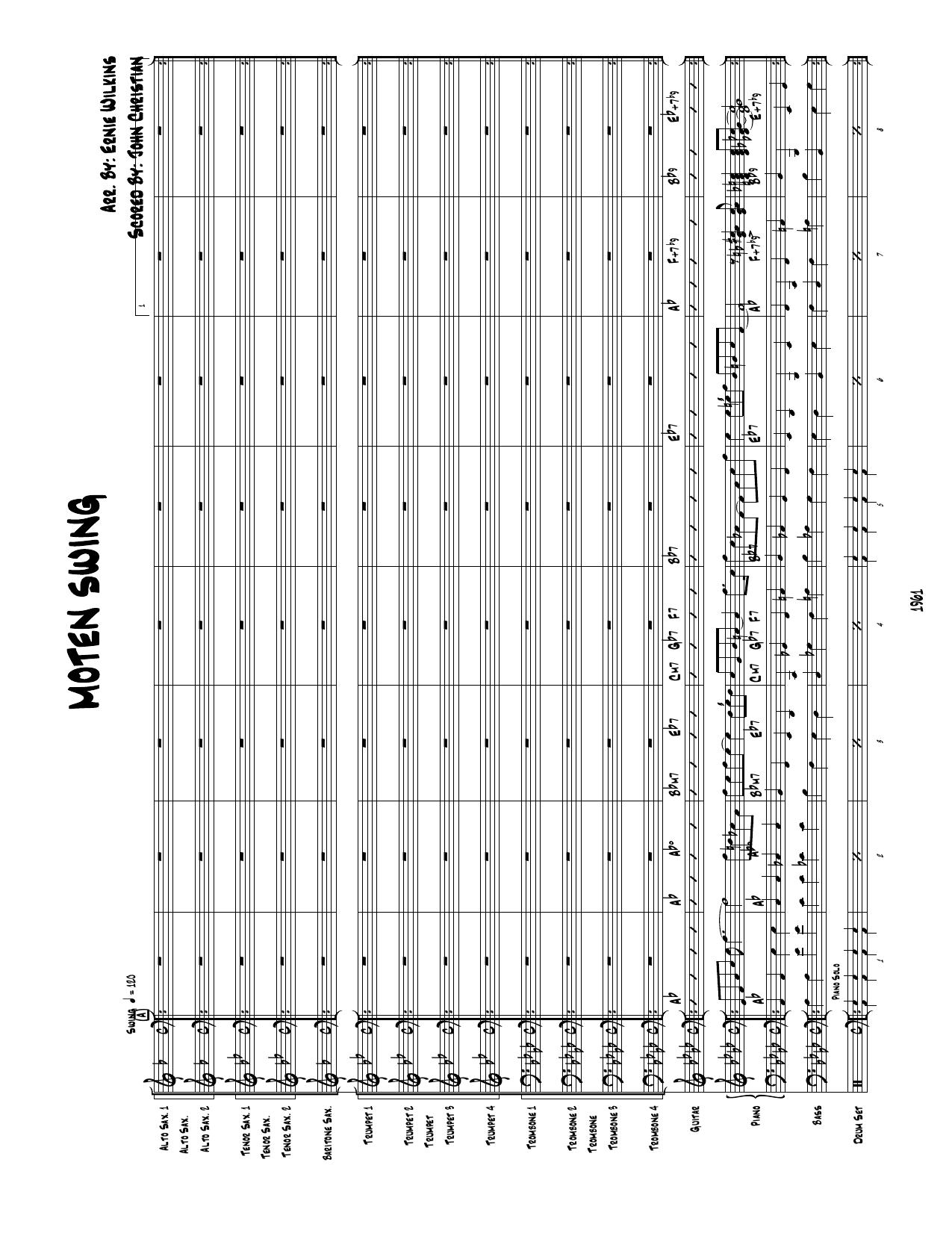
Moten Swing (E.Wilkins- J.Christian) sheet music preview

Moten Swing (E.Wilkins- J.Christian)

Composed by Bennie Moten

Arranged by Ernie Wilkins

  • Ensemble: Big Band
  • Pages: 52
  • Instruments (17): Alto Sax 1, Alto Sax 2, Tenor Sax 1, Tenor Sax 2, Baritone Sax, Trumpet 1, Trumpet 2, Trumpet 3, Trumpet 4, Trombone 1, Trombone 2, Trombone 3, Trombone 4, Guitar, Piano, Bass, Drum Set
  • Difficulty: advanced
  • Content: Individual Parts
  • Format: PDF Download (Instant)
  • Price: $24.99

Bennie Moten’s quintessential Kansas City jazz anthem "Moten Swing," co-credited to guitarist extraordinaire Charlie Christian, stands as a towering pillar of Southwestern swing history. Originally recorded by the Bennie Moten's Kansas City Orchestra in 1932, this infectious head arrangement helped codify the driving, blues-infused, riff-driven style that defined the Count Basie ecosystem—Moten's orchestra serving as the direct precursor to the Basie band. When master arranger and composer Ernie Wilkins applied his pen to this classic, he injected the sophisticated, hard-swinging modernism of the 1950s and 60s Count Basie Orchestra into its DNA. Wilkins, celebrated for his brilliant writing on landmark Basie albums like *The Atomic Mr. Basie*, transforms the historic Kansas City stomper into a powerhouse showcase of dynamic tension, rhythmic precision, and timeless big band swagger. Propelled by an insistent, mid-tempo swing feel in 4/4 time, this arrangement radiates an irrepressible, foot-tapping energy that balances effortless Kansas City blues phrasing with razor-sharp bebop-infused horn solis. The chart opens with the deceptive simplicity of the iconic riff before expanding into lush, brass-heavy interludes and soaring woodwind counterlines. Wilkins utilizes the smaller 8-instrument instrumentation—featuring Alto Saxophone, Tenor Saxophone, Baritone Saxophone, Trumpet, Trombone, and a rhythm section core—with masterclass efficiency, making a compact ensemble sound with the sonic weight and textural variety of a full sixteen-piece big band. The dynamic contour builds masterfully from simmering, understated rhythm section grooves up to a roaring, high-octane shout chorus that demands absolute precision and rhythmic unity from the horns. Throughout the 52-page score, the melodic weight is shared dynamically across the frontline horns, with the saxophones frequently driving the thematic material in tight, harmonized solis that echo the classic Basie saxophone section sound. Solos are open for featured improvisers in the tenor saxophone and trumpet chairs, allowing players to stretch out over traditional blues-in-B-flat or rhythm changes-adjacent harmonic territory. Technical demands center primarily on articulation, swing eighth-note consistency, and maintaining a relaxed yet intensely focused groove at a moderate-to-brisk tempo. The challenges lie not in labyrinthine chord substitutions, but in achieving the elusive, feather-light articulation and immaculate ensemble blend required to make standard swing licks genuinely breathe. Advanced high school ensembles, collegiate jazz orchestras, and professional regional big bands will find this chart an exceptional vehicle for developing stylistic authenticity and ensemble cohesion. Because of the sophisticated voicings adapted by Wilkins from his legendary Basie library, it serves as an indispensable educational tool for teaching students how to phrase traditional swing with modern attitude. Performing this specific arrangement offers musicians a direct masterclass in how historic Kansas City swing was reinterpreted by one of the mid-century's most brilliant arrangers, resulting in a timeless crowd-pleaser that consistently brings jazz audiences to their feet. Achieving success with this Ernie Wilkins chart requires a deep commitment to authentic Kansas City swing phrasing. The tempo should sit firmly in a comfortable, driving medium-up swing zone—never rushed, allowing the quarter-note pulse to anchor the entire ensemble. The rhythm section must lock in tightly; the piano should comp with sparse, tasteful voicings, while the bass walks a relentless, articulated line that emphasizes the beat without dragging. Horn players must pay strict attention to short, crisp articulations on off-beats, ensuring that all written accents are clipped rather than heavy. Dynamics are crucial: respect the whispered counter-melodies under the soloists so that the eventual crescendo into the final shout chorus packs maximum visceral impact. Rehearsal time should be heavily invested in sectional balance, particularly ensuring that the baritone saxophone and trombone anchor the bottom of the ensemble chord without overpowering the upper-register trumpet and alto lines. Q: What instruments and parts are included in this 52-page publication? A: This arrangement is scored for an 8-instrument ensemble consisting of Alto Saxophone, Tenor Saxophone, Baritone Saxophone, Trumpet, Trombone, and a standard rhythm section (Piano, Bass, and Drums), complete with full conductor and instrumental parts. Q: What is the difficulty level of this Ernie Wilkins arrangement? A: It is geared toward advanced high school, collegiate, and professional jazz ensembles due to its demands for stylistic maturity, stamina, and precise swing articulation. Q: What is the historical style and background of this piece? A: Rooted in the 1932 Kansas City jazz classic by Bennie Moten and Charlie Christian, this chart filters historical swing through the sophisticated, high-energy arranging lens of Ernie Wilkins, who was renowned for his work with the Count Basie Orchestra. Q: What makes this specific arrangement unique compared to other versions of "Moten Swing"? A: Wilkins brilliantly condenses the massive, roaring power of a full 16-piece Count Basie style big band chart into an agile 8-instrument format without sacrificing harmonic richness, dynamic range, or the iconic shout chorus intensity. Q: What is the recommended performance tempo and duration? A: The piece is designed to be performed at an energetic, driving medium-swing tempo, typically lasting around 4 to 5 minutes depending on the length of the improvised solos.

Questions and answers

What is included in the Moten Swing (E.Wilkins- J.Christian) PDF?
The verified current file contains a conductor score and individual parts across 52 pages.
How many instruments or parts are listed for Moten Swing (E.Wilkins- J.Christian)?
The verified instrumentation list contains 17 entries for this Big Band arrangement.
Who is credited for Moten Swing (E.Wilkins- J.Christian)?
Composer: Bennie Moten. Arranger: Ernie Wilkins.
What difficulty is listed for Moten Swing (E.Wilkins- J.Christian)?
The verified difficulty level is advanced.
Can I preview Moten Swing (E.Wilkins- J.Christian) before buying?
Yes. The product page provides a preview generated from the current PDF file.
How is Moten Swing (E.Wilkins- J.Christian) delivered?
After successful payment, the digital PDF is made available for download. The displayed price is $24.99.

Musicians Also Search For

Moten Swing Ernie Wilkins PDFMoten Swing Ernie Wilkins sheet musicMoten Swing arranged by Ernie WilkinsErnie Wilkins big band chartsErnie Wilkins jazz arrangements PDFMoten Swing Bennie Moten sheet musicMoten Swing Bennie Moten big band arrangementsBennie Moten big band chartsMoten Swing big band arrangementsMoten Swing big band PDF downloadMoten Swing jazz sheet musicbig band sheet music downloadMoten Swing conductor score PDFMoten Swing individual parts downloadMoten Swing sheet music PDFbuy Moten Swing sheet musicdownload Moten Swing PDFMoten Swing jazz chartsbest Ernie Wilkins big band arrangementsBennie Moten arranged by Ernie WilkinsMoten Swing printable sheet musicbig band repertoire PDF

All arrangements by Ernie Wilkins All Bennie Moten sheet music