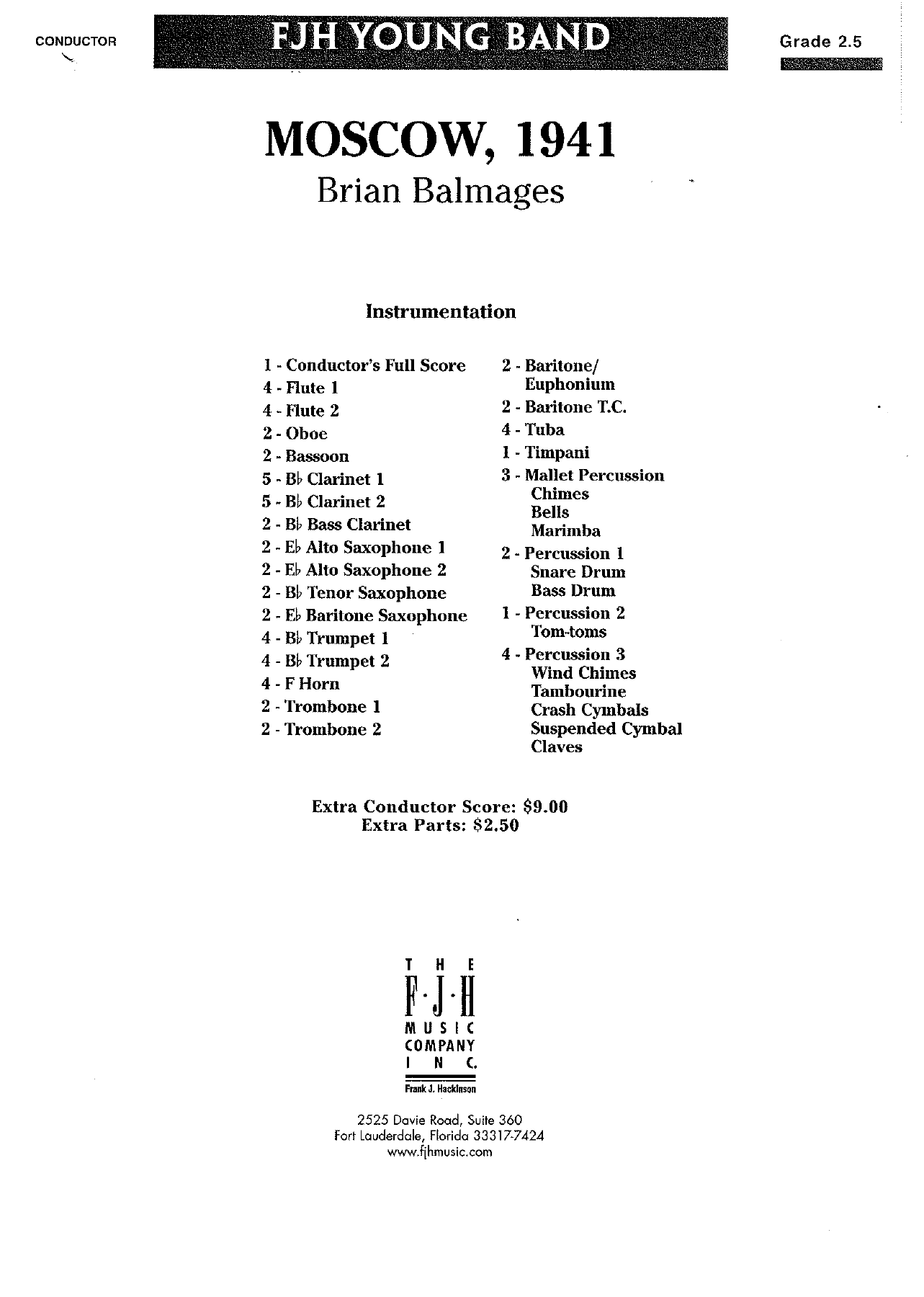
Moscow 1941(Poluhko-Pole)
Composed by Poluhko-Pole
Arranged by Pole) arr. Brian Balmages
- Ensemble: Concert Band
- Style: Film Music
- Pages: 72
- Instruments (23): Flute 1, Flute 2, Oboe, Bassoon, Bb Clarinet 1, Bb Clarinet 2, Bb Bass Clarinet, Eb Alto Saxophone 1, Eb Alto Saxophone 2, Bb Tenor Saxophone, Eb Baritone Saxophone, Bb Trumpet 1, Bb Trumpet 2, F Horn, Trombone 1, Trombone 2, Baritone/Euphonium, Tuba, Timpani, Mallet Percussion, Percussion 1, Percussion 2, Percussion 3
- Difficulty: advanced
- Content: Individual Parts
- Format: PDF Download (Instant)
- Price: $22.99
"Moscow 1941 (Poluhko-Pole)," as reimagined by Brian Balmages for concert band, transports audiences to a pivotal moment in history through a powerful and evocative musical narrative. While the original composition by Poluhko-Pole is not a traditional jazz standard, it draws from the rich tapestry of 20th-century film music, a genre renowned for its dramatic scope and ability to convey profound emotion. This particular piece, with its title referencing a critical year of World War II, likely evokes themes of struggle, resilience, and perhaps ultimate triumph, characteristic of the era's cinematic scores. The original work would have been crafted to underscore visual storytelling, employing grand orchestral gestures and poignant melodic lines to create an immersive experience. Balmages' arrangement skillfully translates this cinematic grandeur into the concert band idiom, making it accessible for a wide range of ensembles. Brian Balmages' distinctive arranging style is immediately apparent in his treatment of "Moscow 1941." Known for his ability to craft compelling and pedagogically sound works, Balmages approaches this piece with a keen understanding of concert band sonorities. His signature techniques often include rich, layered voicings that maximize the ensemble's harmonic potential, dynamic contrasts that build tension and release, and intelligent orchestration that ensures every section contributes meaningfully. Expect soaring melodic lines often carried by the brass and upper woodwinds, underpinned by a robust foundation from the low brass and percussion. While not a jazz piece in the traditional sense, Balmages' background often informs his rhythmic precision and harmonic color, bringing a sophisticated, almost improvisatory feel to certain passages, even within the structured framework of film music. The arrangement likely features powerful soli sections for various instrument families, showcasing their collective strength and individual character, culminating in a climactic full-ensemble statement. The musical character of "Moscow 1941" is undoubtedly dramatic and emotionally charged. While a specific tempo feel isn't provided, given the historical context and "Film Music" style, one can anticipate a dynamic range from somber, reflective passages to powerful, driving sections, possibly incorporating moments of martial intensity or hopeful resolution. The key signature will likely be chosen to facilitate powerful brass writing and resonant woodwind textures, contributing to an overall mood that is both serious and inspiring. Balmages excels at creating moments of profound musical impact; listeners can expect sweeping melodic contours that evoke a sense of epic scale, punctuated by robust percussion writing that drives the narrative forward. The piece will likely feature a clear melodic arc, with the main themes introduced and developed across different sections of the band, culminating in a powerful, full-ensemble conclusion. Performing "Moscow 1941" offers significant rewards for a concert band. The primary melody will likely be shared across various sections, allowing different instrumental groups to shine, from the lyrical woodwinds to the majestic brass. While specific featured solos are not explicitly mentioned, Balmages often integrates exposed lines that function as solos within the larger texture, challenging individual players within the context of the ensemble. Technical challenges will include maintaining precise intonation within dense chords, executing dynamic shifts with accuracy, and achieving a cohesive ensemble sound across a wide dynamic and emotional spectrum. Rhythmic precision will be crucial, particularly in any driving or martial sections. This arrangement is highly suitable for high school, college, and community concert bands seeking a programmatically rich and musically rewarding piece. Its dramatic scope and accessible yet sophisticated writing make it an excellent choice for developing ensemble musicianship, dynamic control, and expressive performance. Conductors should emphasize careful attention to dynamic contrasts and phrasing to fully realize the dramatic narrative of "Moscow 1941." The piece likely features significant tempo fluctuations, requiring precise control and clear cueing to transition smoothly between reflective and powerful sections. Intonation within sustained chords, particularly in brass and woodwind soli passages, will be a key technical challenge; dedicated tuning exercises focusing on these specific harmonies are recommended. Percussionists must be prepared for a wide range of timbres and dynamics, from subtle snare drum rolls to powerful bass drum and cymbal crashes, ensuring each contributes to the overall emotional impact. Rehearsal time should be allocated to building the ensemble's collective sound, focusing on balance and blend, especially during full-ensemble climaxes. Encourage musicians to understand the historical context to inform their expressive choices, allowing the music to tell its powerful story. Q: What instruments and parts are included in this arrangement of "Moscow 1941"? A: This arrangement for concert band typically includes a full complement of standard wind and percussion instruments, such as flutes, oboes, clarinets, bassoons, saxophones, trumpets, horns, trombones, euphonium, tuba, and a comprehensive percussion section. Specific instrumentation details are usually found on the score's title page. Q: What is the difficulty level of "Moscow 1941" (Poluhko-Pole) arr. Brian Balmages? A: Brian Balmages' arrangements are generally crafted to be accessible yet challenging, making this piece suitable for high school, college, and advanced community concert bands. It requires solid technical proficiency, strong ensemble cohesion, and expressive musicality. Q: What musical style and historical context does "Moscow 1941" represent? A: "Moscow 1941" is categorized as Film Music, drawing on the dramatic and evocative traditions of cinematic scores. The title specifically references a pivotal year of World War II, suggesting a piece rich in historical context, conveying themes of struggle, resilience, and triumph. Q: What makes Brian Balmages' arrangement of "Moscow 1941" unique? A: Balmages' arrangement is distinguished by his masterful orchestration, which maximizes the concert band's sonic palette, creating rich harmonic voicings and dynamic contrasts. His approach translates the original cinematic grandeur into a compelling and pedagogically sound work for modern ensembles. Q: What is the typical performance duration or tempo of this piece? A: While exact duration can vary with interpretation, film music pieces of this scope often range from 5 to 8 minutes. The tempo will likely encompass a broad range, from slower, reflective passages to more driving, powerful sections, dictated by the dramatic narrative.
Questions and answers
- What is included in the Moscow 1941(Poluhko-Pole) PDF?
- The verified current file contains a conductor score and individual parts across 72 pages.
- How many instruments or parts are listed for Moscow 1941(Poluhko-Pole)?
- The verified instrumentation list contains 23 entries for this Concert Band arrangement.
- Who is credited for Moscow 1941(Poluhko-Pole)?
- Composer: Poluhko-Pole. Arranger: Pole) arr. Brian Balmages.
- What difficulty is listed for Moscow 1941(Poluhko-Pole)?
- The verified difficulty level is advanced.
- What style is listed for Moscow 1941(Poluhko-Pole)?
- The catalog lists the style as Film Music.
- Can I preview Moscow 1941(Poluhko-Pole) before buying?
- Yes. The product page provides a preview generated from the current PDF file.
- How is Moscow 1941(Poluhko-Pole) delivered?
- After successful payment, the digital PDF is made available for download. The displayed price is $22.99.
Musicians Also Search For
Moscow 1941 Pole) arr. Brian Balmages PDF • Moscow 1941 Pole) arr. Brian Balmages sheet music • Moscow 1941 arranged by Pole) arr. Brian Balmages • Pole) arr. Brian Balmages concert band charts • Pole) arr. Brian Balmages jazz arrangements PDF • Moscow 1941 Poluhko-Pole sheet music • Moscow 1941 Poluhko-Pole concert band arrangements • Poluhko-Pole concert band charts • Moscow 1941 concert band arrangements • Moscow 1941 concert band PDF download • Moscow 1941 jazz sheet music • concert band sheet music download • Moscow 1941 conductor score PDF • Moscow 1941 individual parts download • Moscow 1941 sheet music PDF • Moscow 1941 Film Music charts • Film Music concert band arrangements • buy Moscow 1941 sheet music • download Moscow 1941 PDF • Moscow 1941 jazz charts • best Pole) arr. Brian Balmages concert band arrangements • Poluhko-Pole arranged by Pole) arr. Brian Balmages • Moscow 1941 printable sheet music • concert band repertoire PDF