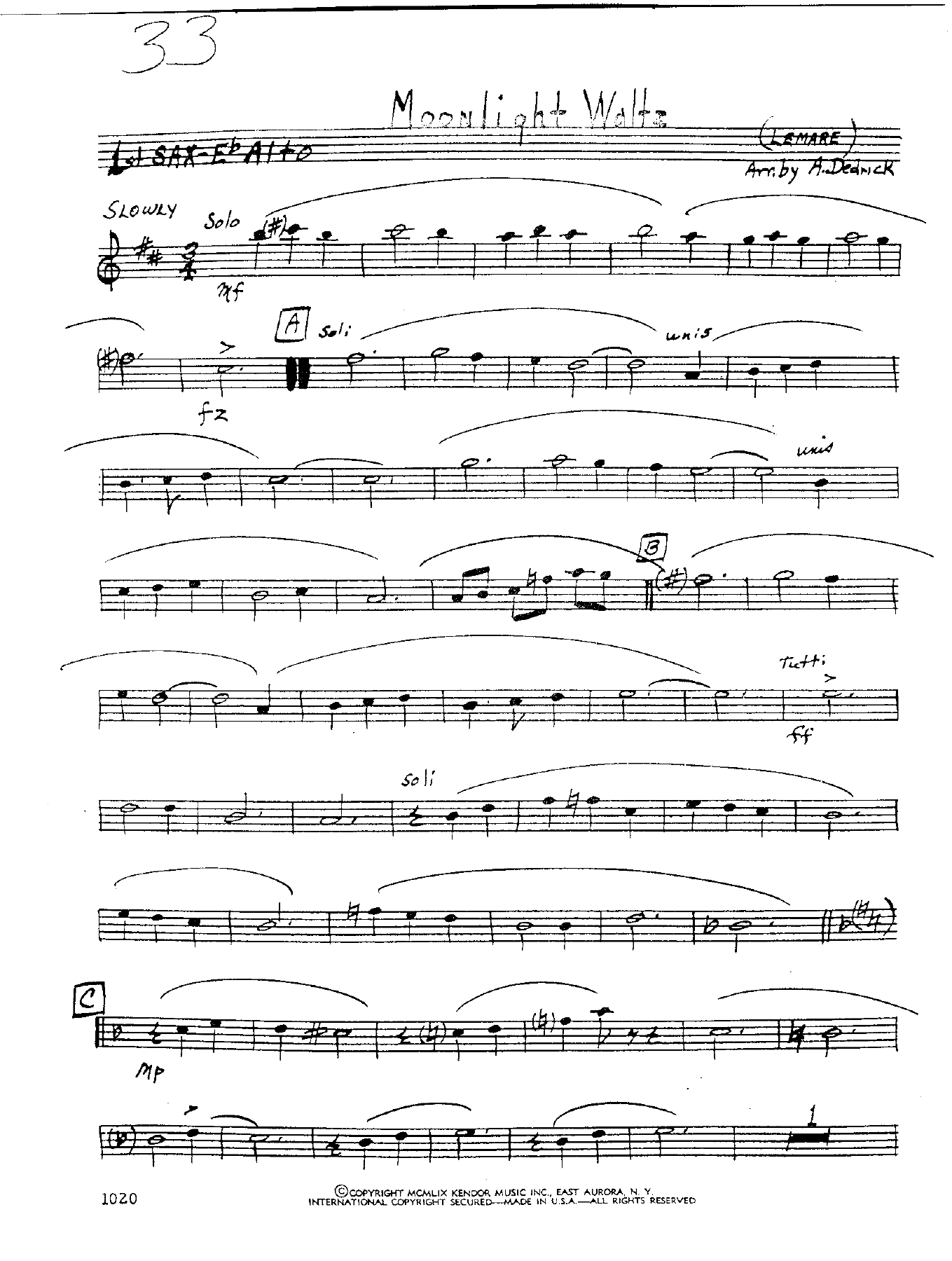
Moonlight Waltz (A.Dedrick)
Composed by Art Dedrick
Arranged by Art Dedrick
- Ensemble: Big Band
- Style: Jazz Standard
- Pages: 21
- Instruments (17): Alto Saxophone 1, Alto Saxophone 2, Tenor Saxophone 1, Tenor Saxophone 2, Baritone Saxophone, Trumpet 1, Trumpet 2, Trumpet 3, Trumpet 4, Trombone 1, Trombone 2, Trombone 3, Bass Trombone, Guitar, Piano, Bass, Drums
- Difficulty: medium
- Content: Individual Parts
- Format: PDF Download (Instant)
- Price: $24.99
Art Dedrick's "Moonlight Waltz" stands as a testament to the enduring appeal of the jazz waltz, a subgenre that gained prominence in the mid-20th century, offering a sophisticated and often introspective alternative to the dominant 4/4 swing feel. While Dedrick himself is the original composer, his work embodies the spirit of an era when composers like Dave Brubeck ("Take Five") and John Coltrane ("My Favorite Things") explored the rhythmic possibilities of triple meter within a jazz idiom. This piece, though perhaps not as universally known as those giants, fits comfortably within the canon of jazz standards by virtue of its elegant melodic lines, harmonic richness, and its consistent presence in educational and professional big band libraries. It represents a refined approach to jazz composition, emphasizing melodic beauty and harmonic clarity over raw improvisational fire, making it a staple for bands seeking to showcase their musicality and ensemble blend. This arrangement of "Moonlight Waltz" is conceived as a medium-tempo jazz waltz, typically performed in 3/4 time at a relaxed, flowing pace. The mood is one of sophisticated introspection, evoking a sense of moonlit serenity or a gentle, graceful dance. Dedrick masterfully crafts an arrangement that is both accessible and deeply musical, utilizing lush, extended harmonies that are characteristic of the mid-century big band sound. The piece is primarily in the key of C minor, but navigates through beautifully crafted modulations, adding harmonic color and interest without ever feeling abrupt. The energy is sustained through careful orchestration rather than sheer volume, building to moments of understated power through layered voicings and dynamic contrast. Art Dedrick's distinctive arranging approach is immediately evident in his treatment of "Moonlight Waltz." Known for his pedagogical prowess and ability to write for a wide range of ensembles, Dedrick prioritizes clarity, balance, and musicality. The melody is initially presented by the lead alto saxophone, often doubled or harmonized by the trumpet section, providing a bright yet lyrical timbre. Throughout the piece, Dedrick employs rich, often closed-position voicings in the saxophone section, creating a warm, cohesive sound. There are carefully placed soli sections for the saxophones that showcase their blend and articulation, and the brass receive their own moments to shine with well-crafted counter-melodies and rhythmic punctuations. While there are no extended shout choruses in the traditional sense, the arrangement builds dynamically, culminating in a powerful, yet controlled, ensemble statement before a return to the initial reflective mood. A featured solo for tenor saxophone offers an opportunity for expressive improvisation over the piece's elegant chord changes. This arrangement is ideally suited for college, community, and advanced high school jazz ensembles. Its technical demands are moderate, focusing more on precise ensemble playing, dynamic control, and musical interpretation than on extreme ranges or blistering tempos. The rewarding aspect lies in achieving the nuanced balance and sophisticated mood Dedrick intended, allowing the band to develop its collective musicality and expressiveness. The flowing melodic lines and harmonically interesting changes make it a joy to perform and a sophisticated addition to any concert program. "Moonlight Waltz" thrives on a consistent, flowing 3/4 feel; avoid rushing the beat, allowing the waltz rhythm to breathe naturally. A metronome marking around quarter note = 132-140 will capture the intended medium tempo. The primary technical challenge lies in achieving a unified ensemble sound, particularly within the saxophone soli sections, which require precise articulation and intonation. Dynamics are crucial: observe the subtle crescendos and decrescendos to build and release tension, especially in the brass. The tenor saxophone solo should be played with lyrical expressiveness. Rehearsal time should focus on balancing the rich voicings, ensuring clarity of inner voices, and maintaining a steady, elegant rhythmic pulse throughout the ensemble. Q: What instruments and parts are included in this arrangement? A: This arrangement is scored for a standard 17-piece big band, including Alto Saxophone 1, Alto Saxophone 2, Tenor Saxophone 1, Tenor Saxophone 2, Baritone Saxophone, Trumpet 1, Trumpet 2, Trumpet 3, Trumpet 4, Trombone 1, Trombone 2, Trombone 3, Trombone 4, Piano, Bass, Drums, and Guitar. Q: What is the difficulty level of "Moonlight Waltz (A. Dedrick)"? A: This arrangement is rated as a Grade 4 (Medium-Advanced) difficulty, making it appropriate for advanced high school, college, and community jazz ensembles. It demands good ensemble blend, dynamic control, and a solid understanding of jazz waltz feel. Q: What is the musical style and historical context of this piece? A: "Moonlight Waltz" is a jazz standard in the medium-tempo jazz waltz style, composed by Art Dedrick. It embodies the sophisticated big band sound of the mid-20th century, offering a melodic and harmonically rich exploration of triple meter within a jazz idiom. Q: What makes Art Dedrick's arrangement of "Moonlight Waltz" unique? A: Dedrick's arrangement is characterized by its lush, extended harmonies, elegant melodic presentation (often by lead alto), and carefully crafted soli sections for the saxophones. It prioritizes musicality, balance, and sophisticated voicings, showcasing the ensemble's blend and expressive capabilities. Q: What is the typical performance duration and tempo for this arrangement? A: The typical performance duration for "Moonlight Waltz" is approximately 3-4 minutes. It is designed to be played at a medium jazz waltz tempo, around quarter note = 132-140, emphasizing a flowing and graceful feel.
Musicians Also Search For
Moonlight Waltz Art Dedrick PDF • Moonlight Waltz Art Dedrick sheet music • Moonlight Waltz arranged by Art Dedrick • Art Dedrick big band charts • Art Dedrick jazz arrangements PDF • Moonlight Waltz Art Dedrick big band arrangement • Moonlight Waltz big band arrangement • Moonlight Waltz big band PDF download • Moonlight Waltz jazz ensemble sheet music • big band sheet music instant download • Moonlight Waltz individual parts download • Moonlight Waltz sheet music with parts • Moonlight Waltz Jazz Standard chart • Jazz Standard big band arrangements • buy Moonlight Waltz sheet music online • download Moonlight Waltz PDF • Moonlight Waltz jazz chart • best Art Dedrick big band arrangements • Moonlight Waltz printable sheet music • big band repertoire PDF