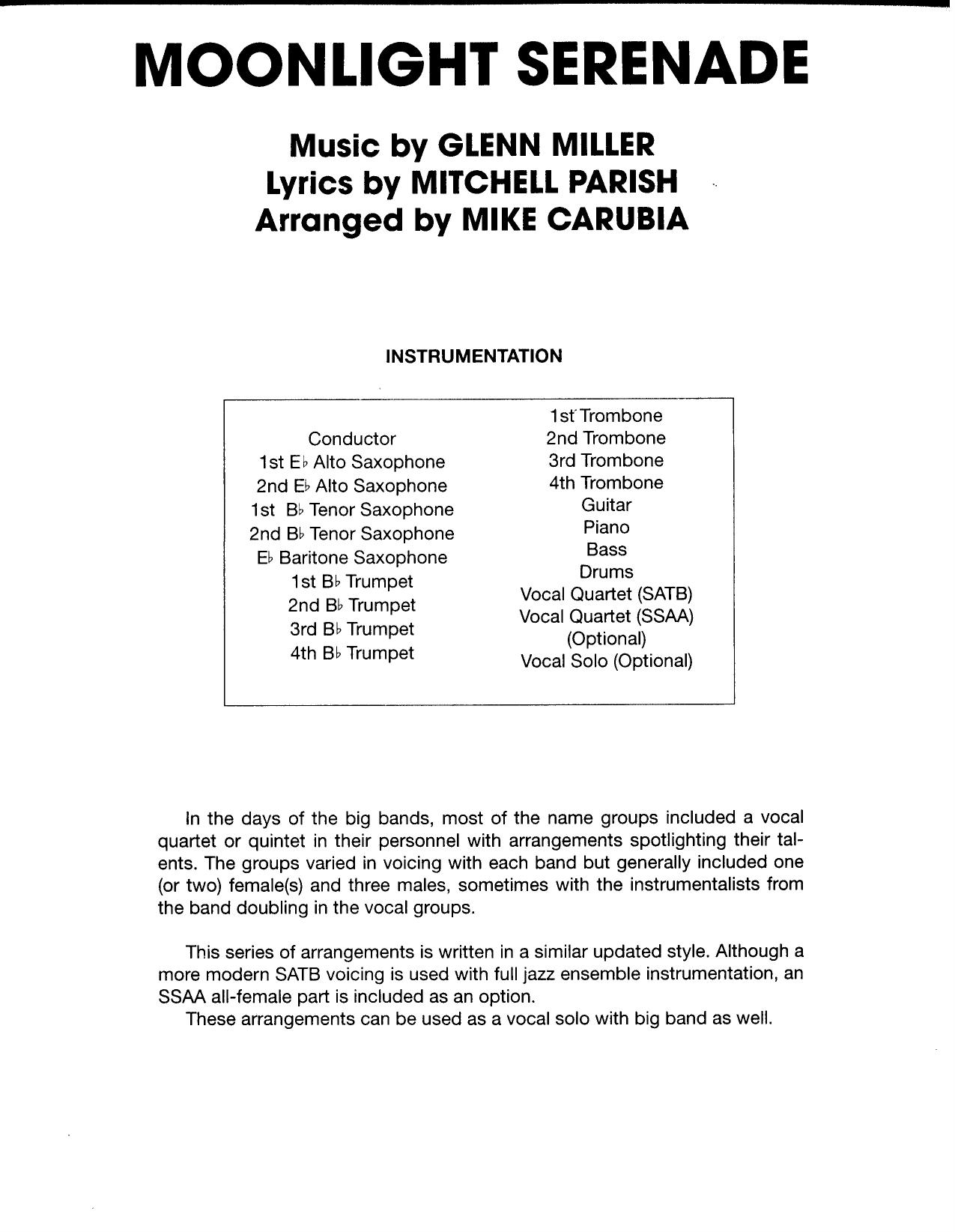
Moonlight Serenade (Carubia) sheet music preview

Moonlight Serenade (Carubia)

Composed by Glenn Miller

Arranged by Carubia

  • Ensemble: Big Band Vocal
  • Style: Swing
  • Pages: 67
  • Instruments (21): Conductor, Vocal Solo, Vocal Quartet (SATB), Vocal Quartet (SSAA), 1st Eb Alto Saxophone, 2nd Eb Alto Saxophone, 1st Bb Tenor Saxophone, 2nd Bb Tenor Saxophone, Eb Baritone Saxophone, 1st Bb Trumpet, 2nd Bb Trumpet, 3rd Bb Trumpet, 4th Bb Trumpet, 1st Trombone, 2nd Trombone, 3rd Trombone, 4th Trombone, Piano, Guitar, Bass, Drums
  • Difficulty: medium
  • Content: Individual Parts
  • Format: PDF Download (Instant)
  • Price: $24.99

Glenn Miller's iconic "Moonlight Serenade," originally composed in 1939, stands as one of the most enduring and recognizable melodies of the American Big Band era. This timeless piece, instantly identifiable by its soaring clarinet lead over a lush saxophone section, became the signature theme song for the Glenn Miller Orchestra, symbolizing the sophisticated yet accessible sound of swing that captivated audiences during the late 1930s and early 1940s. Its smooth, lyrical quality and memorable harmonic progression cemented its status as a foundational jazz standard, evoking a sense of nostalgic romance and elegant dance halls. Miller's original recording defined an era, showcasing a meticulously crafted sound that blended precision with undeniable swing. Carubia's arrangement of "Moonlight Serenade" masterfully reimagines this classic for the contemporary big band, retaining the original's essential character while infusing it with fresh harmonic and dynamic interest. The arrangement maintains a medium swing tempo, perfectly capturing the original's relaxed yet propulsive feel. Carubia's distinctive approach is evident in the rich, extended voicings that add depth and color to the saxophone soli sections, often featuring sophisticated inner-voice movement that enriches the familiar melody. While honoring the iconic clarinet lead, Carubia introduces subtle harmonic alterations and reharmonizations that provide a contemporary sheen without betraying the piece's historical integrity. The mood remains one of serene elegance and nostalgic beauty, but with an underlying current of refined energy. Performance of this arrangement offers a rewarding experience for both musicians and audiences. The melody is predominantly carried by the lead alto saxophone (doubling on clarinet for the iconic opening) and the saxophone section, with brass interjections providing harmonic support and dynamic contrast. There are no extended improvised solos, keeping the focus on the ensemble's blend and precision, much in the spirit of the original. Technical challenges include achieving a seamless legato in the saxophone soli passages, maintaining precise intonation within the dense voicings, and executing dynamic swells and fades with unified control. The brass sections require strong breath support and blend for sustained chords and controlled releases. The rhythm section needs to establish a consistent, flowing medium swing feel, providing a solid foundation without overpowering the melodic lines. This arrangement is ideally suited for advanced high school, college, community, and professional big bands. Its faithful yet updated treatment of a beloved standard makes it an excellent choice for concert programs, dances, or any occasion where classic swing with a touch of modern sophistication is desired. Bands will find the detailed scoring and thoughtful dynamics allow for expressive interpretation, making it a valuable addition to any repertoire. The 67-page score and parts reflect a comprehensive and well-articulated arrangement designed for serious study and performance. Conductors should emphasize a smooth, legato approach throughout the saxophone section, particularly in the iconic opening and subsequent soli passages. The lead alto saxophonist should aim for a warm, controlled tone on both clarinet and alto, ensuring a seamless transition between instruments if doubling. Brass players must focus on precise attacks and releases, maintaining a rich, sustained sound in the chordal sections without becoming harsh. Pay close attention to Carubia's dynamic markings, which are crucial for shaping the emotional arc of the piece; subtle crescendos and decrescendos will enhance the lyrical quality. The rhythm section should establish a relaxed yet driving medium swing feel, with the bassist providing a walking line that is both supportive and propulsive, and the drummer utilizing brushes or light sticks for a refined texture. Rehearsal time should be dedicated to balancing the dense voicings and achieving unified phrasing across all sections. Q: What instruments and parts are included in this arrangement? A: This big band vocal arrangement includes a full score and individual parts for 5 saxophones (AATTB, with lead alto doubling clarinet), 4 trumpets, 4 trombones, piano, bass, drums, and guitar. Q: What is the difficulty level of "Moonlight Serenade (Carubia)"? A: This arrangement is considered advanced high school, college, or community band level, requiring solid ensemble playing, good intonation, and a developed understanding of swing style. Q: How does this arrangement honor the original Glenn Miller style while offering something new? A: Carubia's arrangement maintains the signature medium swing tempo and the iconic clarinet lead, but introduces richer, extended harmonies and sophisticated voicings in the saxophone soli sections, giving it a contemporary yet authentic feel. Q: Are there any improvised solos in this arrangement? A: No, this arrangement focuses on ensemble precision and blend, similar to the original Glenn Miller style, with no dedicated improvised solo sections. Q: What is the typical performance duration and tempo for this piece? A: The typical performance duration for "Moonlight Serenade (Carubia)" is approximately 3-4 minutes, performed at a medium swing tempo, usually around 110-120 beats per minute.

Questions and answers

What is included in the Moonlight Serenade (Carubia) PDF?
The verified current file contains a conductor score and individual parts across 67 pages.
How many instruments or parts are listed for Moonlight Serenade (Carubia)?
The verified instrumentation list contains 21 entries for this Big Band Vocal arrangement.
Who is credited for Moonlight Serenade (Carubia)?
Composer: Glenn Miller. Arranger: Carubia.
What difficulty is listed for Moonlight Serenade (Carubia)?
The verified difficulty level is medium.
What style is listed for Moonlight Serenade (Carubia)?
The catalog lists the style as Swing.
Can I preview Moonlight Serenade (Carubia) before buying?
Yes. The product page provides a preview generated from the current PDF file.
How is Moonlight Serenade (Carubia) delivered?
After successful payment, the digital PDF is made available for download. The displayed price is $24.99.

Musicians Also Search For

Moonlight Serenade Carubia PDFMoonlight Serenade Carubia sheet musicMoonlight Serenade arranged by CarubiaCarubia big band vocal chartsCarubia jazz arrangements PDFMoonlight Serenade Glenn Miller sheet musicMoonlight Serenade Glenn Miller big band vocal arrangementsGlenn Miller big band vocal chartsMoonlight Serenade big band vocal arrangementsMoonlight Serenade big band vocal PDF downloadMoonlight Serenade jazz sheet musicbig band vocal sheet music downloadMoonlight Serenade conductor score PDFMoonlight Serenade individual parts downloadMoonlight Serenade sheet music PDFMoonlight Serenade Swing chartsSwing big band vocal arrangementsbuy Moonlight Serenade sheet musicdownload Moonlight Serenade PDFMoonlight Serenade jazz chartsbest Carubia big band vocal arrangementsGlenn Miller arranged by CarubiaMoonlight Serenade printable sheet musicbig band vocal repertoire PDF

All arrangements by Carubia All Glenn Miller sheet music