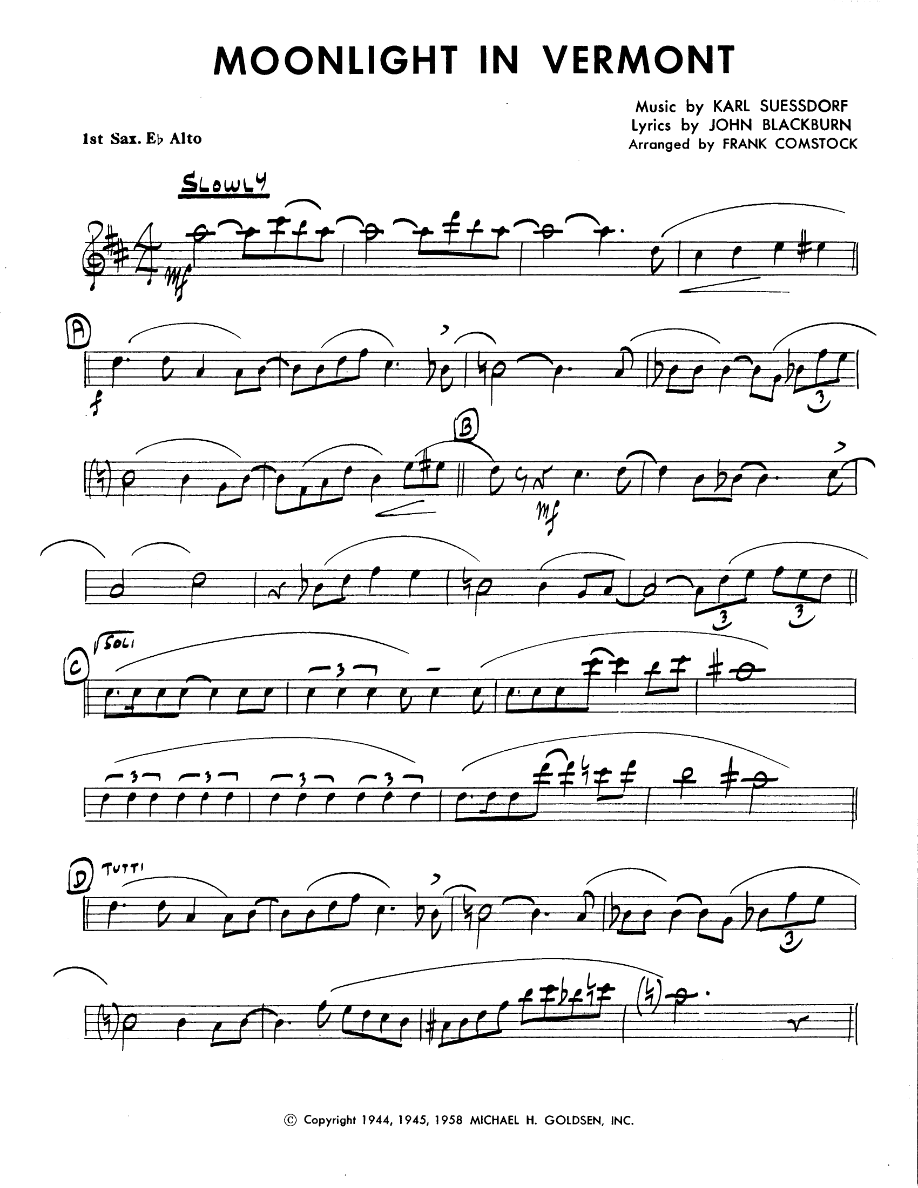
Moonlight In Vermont (F.Comstock)
Composed by Karl Suessdorf
Arranged by F.Comstock
- Ensemble: Big Band
- Style: Jazz Standard
- Pages: 35
- Instruments (17): 1st Sax. Eb Alto, 2nd Sax. Bb Tenor, 3rd Sax. Eb Alto, 4th Sax. Bb Tenor, 5th Sax. Eb Baritone, 1st Bb Trumpet, 2nd Bb Trumpet, 3rd Bb Trumpet, 4th Trumpet, 1st Trombone, 2nd Trombone, 3rd Trombone, 4th Trombone, Piano, Drums, Guitar, String Bass
- Difficulty: medium
- Content: Individual Parts
- Format: PDF Download (Instant)
- Price: $24.99
Moonlight in Vermont stands as one of the most evocative entries in the Great American Songbook, originally composed by Karl Suessdorf in 1944 with lyrics by John Blackburn. Unlike many standards of the era, the song is celebrated for its unconventional structure—the lyrics notably lack rhymes and follow a rhythmic pattern reminiscent of haiku. While Margaret Whiting’s 1944 recording initially brought the tune to national prominence, it was the subsequent interpretations by artists like Frank Sinatra and Billie Holiday that solidified its status as a quintessential jazz ballad. This piece captures the serene, pastoral beauty of the New England landscape, making it a staple for any ensemble looking to showcase lyrical phrasing and harmonic depth. Frank Comstock’s arrangement brings a sophisticated, mid-century elegance to this classic, drawing on his extensive experience writing for Les Brown and His Band of Renown. Comstock is renowned for his ability to weave intricate woodwind textures with a brass section that provides warmth without overpowering the delicate nature of the melody. In this iteration, he utilizes lush, extended harmonies—often employing 9th, 11th, and 13th chords—to create a shimmering "moonlight" effect. The arrangement avoids the clichés of standard ballad writing, instead opting for a fluid, through-composed feel that allows the ensemble to breathe together and emphasizes the "cool" West Coast jazz aesthetic. The performance demands a high level of dynamic control and ensemble blend. The melody is often shared across the sections, requiring the saxophones to maintain a velvety, "sub-tone" quality while the brass must execute precise, soft attacks. While there is space for melodic interpretation, the strength of Comstock’s writing lies in the ensemble soli sections where the five-part saxophone choir (arranged as 1st Alto, 2nd Tenor, 3rd Alto, 4th Tenor, and 5th Baritone) moves with a unified, vocal-like vibrato. The 35-page score provides ample detail for the rhythm section, ensuring the pulse remains steady but flexible throughout the ballad's rubato-leaning passages. This arrangement is particularly rewarding for advanced high school or collegiate ensembles that have developed a mature sense of "time" at slow tempos. Professional bands will find it a perfect "change of pace" number that highlights the group's ability to play with nuance and restraint. Because the technical challenges lie in intonation and phrasing rather than sheer velocity, it serves as an excellent vehicle for teaching students how to sustain energy through long, melodic lines and how to balance complex, close-position voicings within a 17-piece big band setting. The primary technical challenge in this arrangement is maintaining pitch center and tonal warmth at a very low dynamic level. Conductors should aim for a tempo of approximately quarter note = 64–72 BPM, ensuring the feel remains a "slow ballad" without dragging. The brass section should utilize cup mutes where indicated to achieve the characteristic mid-century "cool" sound, paying close attention to the balance between the trumpets and the woodwinds. The saxophone section must prioritize a unified vibrato and consistent breath support to navigate Comstock’s dense, five-part voicings. Rehearsing the saxophones alone (a cappella) is highly recommended to lock in the intonation of the altered extensions. For the rhythm section, the pianist and guitarist should keep their comping sparse, allowing the lush orchestral colors of the horns to remain the focal point. Encourage the drummer to use brushes throughout to maintain the delicate, atmospheric mood of the Vermont evening. Q: What is the specific instrumentation required for this arrangement? A: This is a standard 17-piece big band arrangement consisting of 5 saxophones (1st Alto, 2nd Tenor, 3rd Alto, 4th Tenor, 5th Baritone), 4 trumpets, 4 trombones, and a 4-piece rhythm section (piano, bass, drums, and guitar). Q: What is the difficulty level of Frank Comstock’s "Moonlight In Vermont"? A: This arrangement is classified as Medium-Advanced (Grade 4) due to its sophisticated harmonic language and the high level of dynamic control required. While the ranges are accessible, the challenge lies in the ensemble's ability to maintain a professional ballad feel and perfect intonation. Q: What musical style does this arrangement represent? A: This is a classic Big Band Jazz Ballad that reflects the "Band of Renown" style of the late 1940s and 1950s. It features lush, orchestral-style jazz harmonies and a focus on ensemble blend rather than high-energy swing. Q: What makes this F. Comstock arrangement unique compared to other versions? A: Comstock’s version is distinguished by its specific woodwind voicings and its "through-composed" feel that emphasizes the pastoral mood of the lyrics. His use of the 2nd Tenor and 3rd Alto as inner voices creates a unique, dense texture that is a hallmark of his writing style. Q: What is the suggested tempo and approximate duration for a performance? A: The piece should be performed as a slow ballad, typically between 60 and 72 BPM, resulting in a performance duration of approximately 3 to 4 minutes. The focus should be on a relaxed, flowing pulse rather than a rigid metronomic beat.
Questions and answers
- What is included in the Moonlight In Vermont (F.Comstock) PDF?
- The verified current file contains individual parts across 35 pages.
- How many instruments or parts are listed for Moonlight In Vermont (F.Comstock)?
- The verified instrumentation list contains 17 entries for this Big Band arrangement.
- Who is credited for Moonlight In Vermont (F.Comstock)?
- Composer: Karl Suessdorf. Arranger: F.Comstock.
- What difficulty is listed for Moonlight In Vermont (F.Comstock)?
- The verified difficulty level is medium.
- What style is listed for Moonlight In Vermont (F.Comstock)?
- The catalog lists the style as Jazz Standard.
- Can I preview Moonlight In Vermont (F.Comstock) before buying?
- Yes. The product page provides a preview generated from the current PDF file.
- How is Moonlight In Vermont (F.Comstock) delivered?
- After successful payment, the digital PDF is made available for download. The displayed price is $24.99.
Musicians Also Search For
Moonlight In Vermont F.Comstock PDF • Moonlight In Vermont F.Comstock sheet music • Moonlight In Vermont arranged by F.Comstock • F.Comstock big band charts • F.Comstock jazz arrangements PDF • Moonlight In Vermont Karl Suessdorf sheet music • Moonlight In Vermont Karl Suessdorf big band arrangements • Karl Suessdorf big band charts • Moonlight In Vermont big band arrangements • Moonlight In Vermont big band PDF download • Moonlight In Vermont jazz sheet music • big band sheet music download • Moonlight In Vermont individual parts download • Moonlight In Vermont sheet music PDF • Moonlight In Vermont Jazz Standard charts • Jazz Standard big band arrangements • buy Moonlight In Vermont sheet music • download Moonlight In Vermont PDF • Moonlight In Vermont jazz charts • best F.Comstock big band arrangements • Karl Suessdorf arranged by F.Comstock • Moonlight In Vermont printable sheet music • big band repertoire PDF