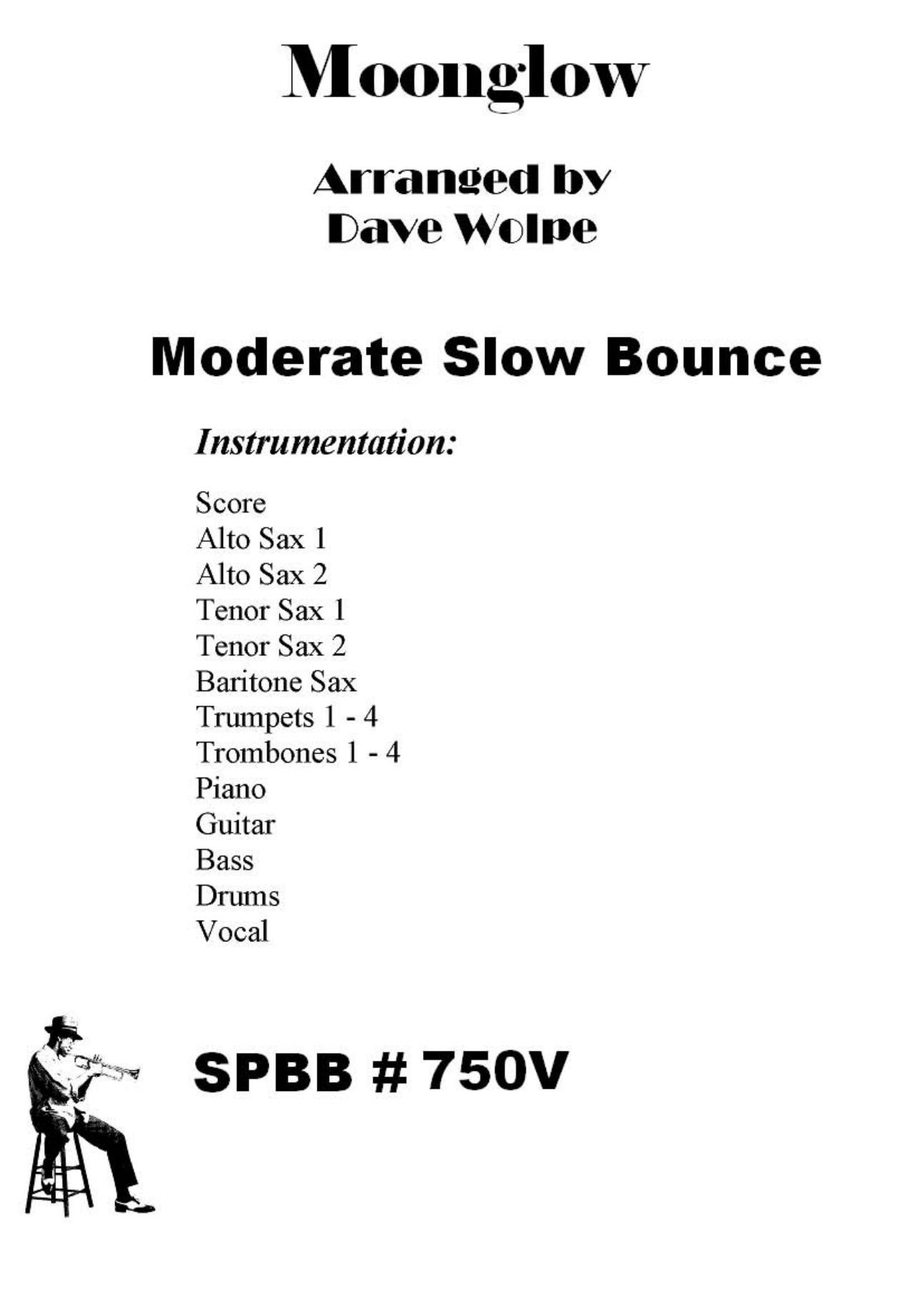
Moonglow (D.Wolpe) vocal
Composed by Will Hudson
Arranged by Dave Wolpe
- Ensemble: Big Band
- Pages: 50
- Instruments (18): Vocal Solo, 1st Eb Alto Saxophone, 2nd Eb Alto Saxophone, 1st Bb Tenor Saxophone, 2nd Bb Tenor Saxophone, Eb Baritone Saxophone, 1st Bb Trumpet, 2nd Bb Trumpet, 3rd Bb Trumpet, 4th Bb Trumpet, 1st Trombone, 2nd Trombone, 3rd Trombone, Bass Trombone, Piano, Guitar, Bass, Drums
- Difficulty: advanced
- Content: Individual Parts
- Format: PDF Download (Instant)
- Price: $24.99
Composed in 1933 by Will Hudson, with lyrics later added by Eddie DeLange and Irving Mills, "Moonglow" stands as one of the defining atmospheric masterpieces of the swing era. Originally catapulted to national prominence by Benny Goodman’s small group and later recorded by Artie Shaw, Duke Ellington, and countless vocal stylists, this quintessential standard bridges the gap between sultry late-night romance and infectious mid-tempo swing. The composition's sophisticated harmonic framework, built around a lush 32-bar AABA form, invites interpreters to explore subtle shades of melancholy and warmth, making it a timeless vehicle for jazz vocalists seeking to connect deeply with an audience through intimate storytelling and lyrical phrasing. Dave Wolpe’s masterwork arrangement captures the sophisticated allure of the 1930s while infusing the score with the polished, crisp sectional writing characteristic of modern big band scoring. Operating at a comfortable, swinging medium tempo—often hovering around a relaxed 112 to 120 BPM—the chart establishes a sultry, midnight-blue mood driven by a steady, buoyant rhythm section groove. The arrangement opens with a seductive instrumental preamble that gently introduces the principal theme before yielding the spotlight to the vocalist. Wolpe expertly balances rich, cascading saxophone voicings with punchy, muted brass counterlines that provide harmonic depth without ever obscuring the vocal line, creating a luxurious sonic cushion for the soloist. As the chart unfolds, Wolpe showcases his signature knack for dynamic contrast, steering the ensemble through subtle textural shifts that culminate in a tasteful, soaring shout chorus. This climactic section lifts the energy of the room, utilizing tight, interlocking brass harmonies and classic swing-era syncopation before dropping back down into an intimate, whisper-soft coda. The instrumental winds and reeds engage in sparkling call-and-response figures behind the vocal cadenzas, demanding acute listening and stylistic cohesion from every player on the bandstand. The arrangement accommodates standard vocal keys while giving the instrumentalists ample opportunity to display clean articulation, blend, and a refined sense of swing phrasing. Advanced high school ensembles, collegiate jazz orchestras, and professional community big bands will find this arrangement to be an exceptionally rewarding addition to their repertoire. Because the chart relies heavily on nuance, dynamic control, and stylistic precision rather than breakneck technical speeds, it serves as an ideal vehicle for teaching young musicians the subtleties of accompanying a live jazz vocalist. Directors will appreciate how naturally the chart sits under the fingers, allowing the ensemble to focus entirely on stylistic authenticity, relaxed time feel, and sophisticated ensemble blend. Conductors should approach this chart with a primary focus on relaxed, behind-the-beat swing phrasing. The tempo must remain steady and unhurried; pushing the rhythm section will instantly strip the arrangement of its signature late-night charm. The rhythm section is the anchor here: the drummer should utilize a crisp, feather-light ride cymbal pattern with a gentle two-and-four hi-hat choke, while the bassist walks a quarter-note line that emphasizes a connected, acoustic-style pulse. Key technical challenges lie in the balance between the vocal soloist and the accompanying horns. Muted brass must observe strict dynamic restraint, ensuring that background figures enhance the vocal rather than compete with it. Saxophones should focus on a warm, breathy tone quality during the soli passages, paying meticulous attention to articulation markings and long-short swing values. Ensure that the brass section executes any required falls and doits with stylistic taste, keeping them clean and unified rather than brassy or abrasive. Rehearsals should begin with the rhythm section alone to lock in the groove before layering in the horns and finally introducing the vocalist. Q: What instrumentation and parts are included in this arrangement? A: This chart is scored for a flexible 9-instrument big band lineup that includes a Vocal part, Alto Saxophone, Tenor Saxophone, Baritone Saxophone, Trumpet, and accompanying rhythm section elements distributed across a comprehensive 50-page score and parts set. Q: What is the difficulty level of this Dave Wolpe arrangement? A: It is rated at an intermediate difficulty level, making it accessible for proficient high school groups while offering enough musical sophistication and stylistic nuance to challenge college and professional ensembles. Q: What is the historical style and background of "Moonglow"? A: "Moonglow" is a timeless 1933 jazz standard composed by Will Hudson that became a staple of the swing era, famously interpreted by legendary bandleaders like Benny Goodman and Artie Shaw before evolving into a premier vehicle for jazz vocalists. Q: What makes this specific arrangement by Dave Wolpe unique? A: Wolpe’s arrangement stands out for its lush, authentic swing-era voicings combined with modern dynamic shading, providing a sophisticated, vocalist-friendly chart that features elegant background figures and a tastefully crafted shout chorus. Q: What is the recommended performance duration and tempo feel? A: The arrangement is designed for a relaxed, medium swing tempo (approximately 112-120 BPM) and typically runs around 3 to 4 minutes in duration, depending on the chosen vocal cadenzas and performance pacing.
Questions and answers
- What is included in the Moonglow (D.Wolpe) vocal PDF?
- The verified current file contains a conductor score and individual parts across 50 pages.
- How many instruments or parts are listed for Moonglow (D.Wolpe) vocal?
- The verified instrumentation list contains 18 entries for this Big Band arrangement.
- Who is credited for Moonglow (D.Wolpe) vocal?
- Composer: Will Hudson. Arranger: Dave Wolpe.
- What difficulty is listed for Moonglow (D.Wolpe) vocal?
- The verified difficulty level is advanced.
- Can I preview Moonglow (D.Wolpe) vocal before buying?
- Yes. The product page provides a preview generated from the current PDF file.
- How is Moonglow (D.Wolpe) vocal delivered?
- After successful payment, the digital PDF is made available for download. The displayed price is $24.99.
Musicians Also Search For
Moonglow Dave Wolpe PDF • Moonglow Dave Wolpe sheet music • Moonglow arranged by Dave Wolpe • Dave Wolpe big band charts • Dave Wolpe jazz arrangements PDF • Moonglow Will Hudson sheet music • Moonglow Will Hudson big band arrangements • Will Hudson big band charts • Moonglow big band arrangements • Moonglow big band PDF download • Moonglow jazz sheet music • big band sheet music download • Moonglow conductor score PDF • Moonglow individual parts download • Moonglow sheet music PDF • buy Moonglow sheet music • download Moonglow PDF • Moonglow jazz charts • best Dave Wolpe big band arrangements • Will Hudson arranged by Dave Wolpe • Moonglow printable sheet music • big band repertoire PDF