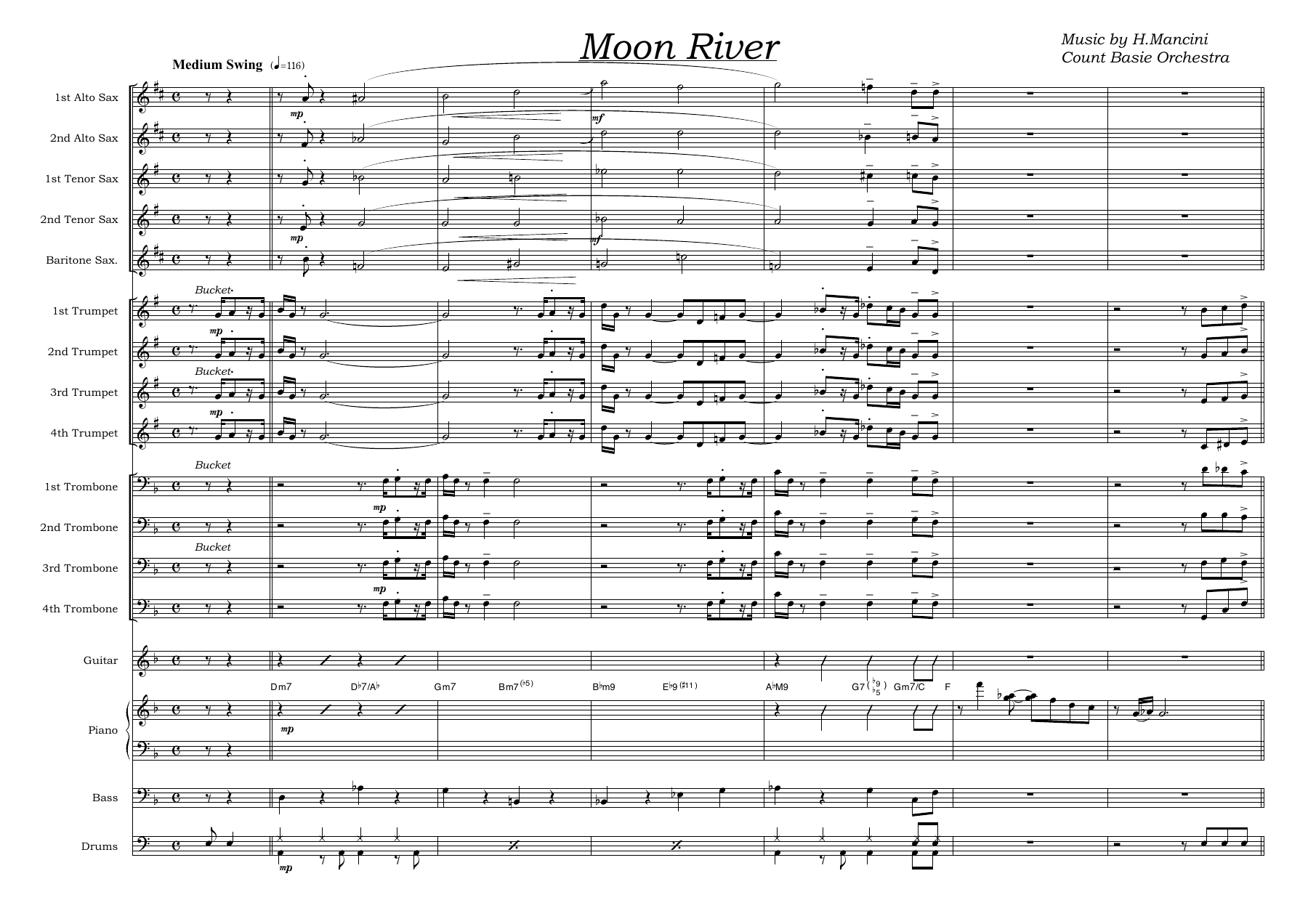
Moon River (Q.Jones)
Composed by Henry Mancini
Arranged by Count Basie
- Ensemble: Big Band
- Style: Jazz Standard
- Pages: 45
- Instruments (17): Alto Sax. 1, Alto Sax. 2, Tenor Sax. 1, Tenor Sax. 2, Baritone Sax., Trumpet 1, Trumpet 2, Trumpet 3, Trumpet 4, Trombone 1, Trombone 2, Trombone 3, Bass Trombone, Piano, Piano/Guitar, Bass, Drum Set
- Difficulty: easy
- Content: Individual Parts
- Format: PDF Download (Instant)
- Price: $24.99
Henry Mancini and Johnny Mercer’s timeless cinematic ballad "Moon River," immortalized in the 1961 film *Breakfast at Tiffany's*, received a masterclass in jazz translation when it entered the repertoire of the Count Basie Orchestra. Though originally conceived as a fragile, pastoral waltz for voice and acoustic guitar, this definitive big band adaptation reimagines the iconic melody through the lens of mid-century Kansas City swing. By expanding the harmonic palette and reshaping the rhythmic framework, the arrangement elevates a beloved silver-screen melody into a sophisticated vehicle for large-ensemble jazz expression, bridging the gap between accessible popular song and high-art orchestral swing. At its core, this arrangement balances a lingering, wistful nostalgia with the understated, driving propulsion that defined the Basie brand. Rather than rushing through the familiar theme, the chart unfolds at a relaxed, unhurried medium-tempo groove, anchored by the unmistakable pulse of a classic rhythm section. The mood transitions gracefully from intimate, breathy woodwind textures to rich, full-ensemble warmth. The emotional arc evokes a late-night smoky club atmosphere, where lush, extended chord voicings in the brass create a deep, resonant cushion beneath the horns, shifting seamlessly from melancholy introspection to moments of subtle, blues-infused optimism. Count Basie’s signature arranging approach permeates every measure of the 45-page score, favoring space, dynamic contrast, and economical voicings over dense, cluttered counterpoint. Instead of a bombastic, wall-of-sound shout chorus, the arrangement relies on the classic Basie strategy of building tension through restrained power—utilizing call-and-response figures between the muted brass and the cascading saxophones. The melody is initially introduced with pristine clarity by the lead alto saxophone, supported by shimmering reed backgrounds that mimic the gentle flow of a river. Harmonically, the chart introduces sophisticated tritone substitutions and chromatic passing tones while fiercely protecting the emotional core of Mancini’s original melody. Intermediate-to-advanced collegiate, community, and professional big bands will find this chart an extraordinary programming choice that demands exquisite control over dynamic shading and intonation. The 17-instrument orchestration (featuring a standard five-saxophone, four-trumpet, four-trombone, and four-rhythm setup) requires pristine balance, particularly during the delicate exposed passages where the horns must play at a whisper without losing their core tone. While the technical demands on individual finger technique are moderate, the true challenge lies in the stylistic execution: nailing the precise placement of the backbeat, achieving a unified ensemble blend on the sustained chord clusters, and executing the expressive solo spaces with authentic phrasing and deep blues sensibility. Success with this arrangement hinges entirely on the ensemble’s ability to master the subtle, relaxed swing feel; conductors must guard against any tendency to rush the tempo. The rhythm section acts as the primary engine, requiring a feather-light ride cymbal pattern and a deep, pulsing bass line that walks with supreme confidence yet absolute economy of weight. Brass players should utilize cup or straight mutes where indicated to achieve the authentic period warmth, keeping vibrato controlled and tasteful. Pay meticulous attention to dynamic markings: the contrast between the hushed, intimate intro and the warmer, more expansive middle statements creates the dramatic narrative of the piece. Rehearsals should isolate the saxophone soli sections to ensure flawless articulation and intonation across the reed choir before integrating the brass backgrounds. Q: What instruments and parts are included in this big band score? A: The 45-page arrangement is scored for a standard 17-instrument big band instrumentation, comprising 2 alto saxophones, 2 tenor saxophones, 1 baritone saxophone, 4 trumpets, 4 trombones, and a 4-piece rhythm section consisting of piano, guitar, bass, and drums. Q: What is the designated difficulty level of this Count Basie arrangement? A: This chart is best suited for advanced high school, collegiate, community, and professional big bands due to its heavy reliance on mature ensemble balance, dynamic restraint, and subtle stylistic interpretation rather than sheer technical speed. Q: How does this chart fit into the broader jazz standard and big band tradition? A: It represents the legendary Count Basie Orchestra’s sophisticated treatment of a classic Henry Mancini film melody, transforming a 3/4 cinematic waltz into a lush, swinging jazz standard that honors the Kansas City tradition of understated power and deep groove. Q: What makes this specific arrangement of "Moon River" unique compared to other versions? A: It stands out through its masterclass use of space, chromatic passing harmonies, and signature Basie call-and-response dynamics, avoiding a heavy-handed shout chorus in favor of intimate voicings and a sophisticated, late-night mood. Q: What is the general performance tempo and duration of this piece? A: The arrangement is set at a relaxed, unhurried medium swing tempo that typically yields a performance duration of approximately 4 to 5 minutes, depending on the length of the improvised solo sections taken during the performance.
Questions and answers
- What is included in the Moon River (Q.Jones) PDF?
- The verified current file contains a conductor score and individual parts across 45 pages.
- How many instruments or parts are listed for Moon River (Q.Jones)?
- The verified instrumentation list contains 17 entries for this Big Band arrangement.
- Who is credited for Moon River (Q.Jones)?
- Composer: Henry Mancini. Arranger: Count Basie.
- What difficulty is listed for Moon River (Q.Jones)?
- The verified difficulty level is easy.
- What style is listed for Moon River (Q.Jones)?
- The catalog lists the style as Jazz Standard.
- Can I preview Moon River (Q.Jones) before buying?
- Yes. The product page provides a preview generated from the current PDF file.
- How is Moon River (Q.Jones) delivered?
- After successful payment, the digital PDF is made available for download. The displayed price is $24.99.
Musicians Also Search For
Moon River Count Basie PDF • Moon River Count Basie sheet music • Moon River arranged by Count Basie • Count Basie big band charts • Count Basie jazz arrangements PDF • Moon River Henry Mancini sheet music • Moon River Henry Mancini big band arrangements • Henry Mancini big band charts • Moon River big band arrangements • Moon River big band PDF download • Moon River jazz sheet music • big band sheet music download • Moon River conductor score PDF • Moon River individual parts download • Moon River sheet music PDF • Moon River Jazz Standard charts • Jazz Standard big band arrangements • buy Moon River sheet music • download Moon River PDF • Moon River jazz charts • best Count Basie big band arrangements • Henry Mancini arranged by Count Basie • Moon River printable sheet music • big band repertoire PDF