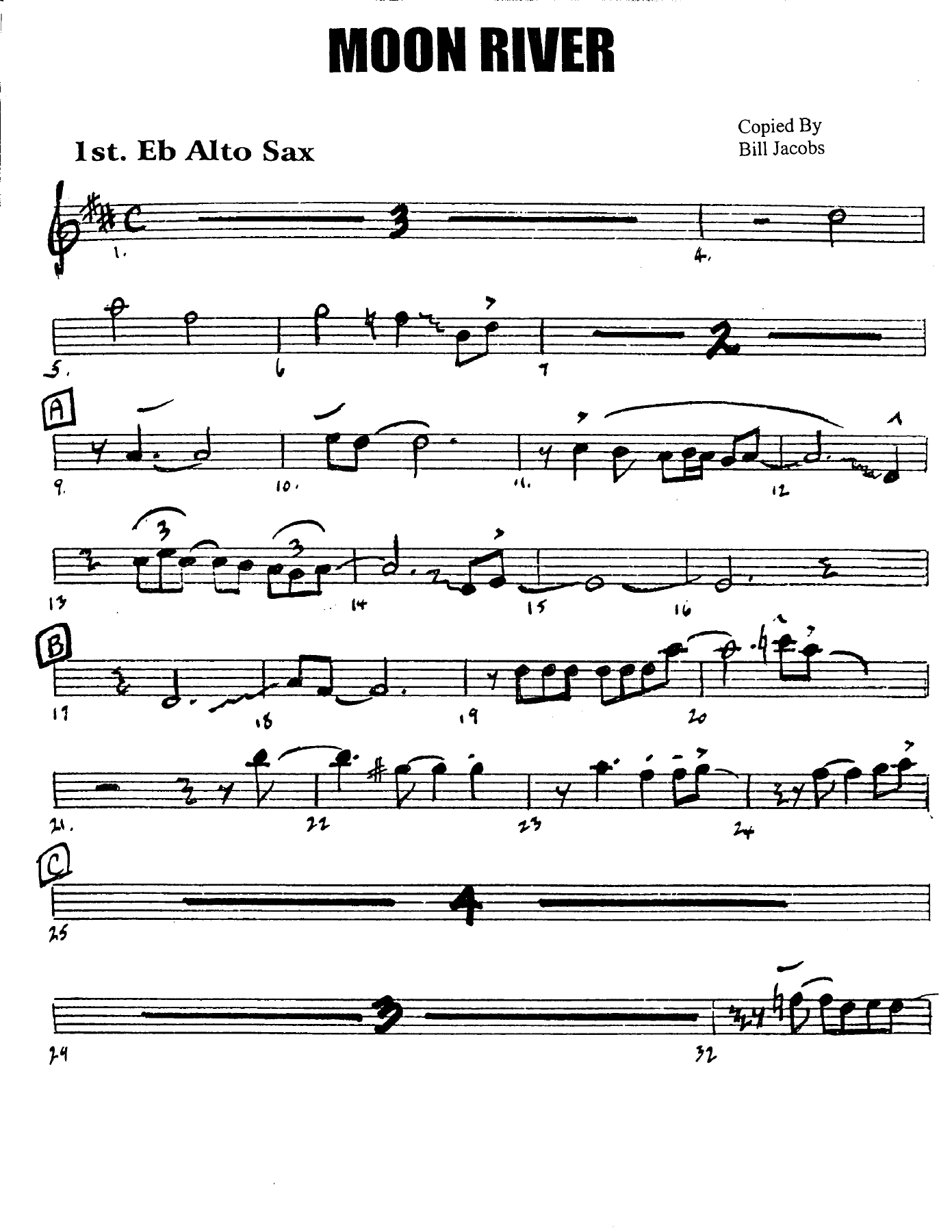
Moon River (B.Byers)
Composed by Henry Mancini
Arranged by Billy Byers
- Ensemble: Big Band
- Style: Jazz Standard
- Pages: 51
- Instruments (17): 1st Eb Alto Sax, 2nd Eb Alto Sax, 1st Bb Tenor Sax, 2nd Bb Tenor Sax, 5th Eb Baritone Sax, 1st Bb Trumpet, 2nd Bb Trumpet, 3rd Bb Trumpet, 4th Bb Trumpet, 1st Trombone, 2nd Trombone, 3rd Trombone, 4th Trombone, Piano, Bass, Guitar, Drums
- Difficulty: advanced
- Content: Individual Parts
- Format: PDF Download (Instant)
- Price: $24.99
Henry Mancini's timeless ballad, "Moon River," originally composed for the 1961 film *Breakfast at Tiffany's*, stands as a quintessential American standard, beloved for its lyrical simplicity and profound emotional resonance. The song, famously performed by Audrey Hepburn in the film, quickly transcended its cinematic origins to become a global phenomenon, earning Mancini an Academy Award for Best Original Song and a Grammy Award for Song of the Year. Its enduring popularity stems from a melody that is both instantly recognizable and deeply moving, often associated with themes of longing, journey, and the search for connection. As a jazz standard, "Moon River" offers a rich harmonic canvas for interpretation, inviting arrangers and improvisers to explore its inherent beauty through various stylistic lenses. Billy Byers' masterful big band arrangement of "Moon River" transforms this iconic melody into a sophisticated, medium-slow swing ballad, imbued with his characteristic elegance and harmonic depth. Byers, renowned for his work with Count Basie, Buddy Rich, and his own ensembles, approaches the piece with a keen understanding of orchestral jazz voicings. The arrangement opens with a tender, almost ethereal quality, often featuring a delicate interplay between the saxophones and brass, creating a lush harmonic bed. As the piece develops, Byers introduces subtle rhythmic shifts and dynamic swells, building intensity without ever sacrificing the song's inherent grace. His use of extended harmonies and rich chord substitutions provides a fresh perspective on the familiar melody, offering both warmth and a sophisticated edge. A hallmark of Byers' style is evident in the artful way he distributes the melody and develops the texture. The primary melodic statements are gracefully passed between sections, often starting with a lead alto saxophone or a harmonized saxophone section, then transitioning to the brass, creating a conversational feel. While this arrangement is primarily a feature for the ensemble's collective sound, there are opportunities for sensitive interplay and expressive phrasing from individual lead voices. The technical demands are focused on blend, balance, and precise articulation, particularly within the meticulously crafted soli sections that are a signature of Byers' writing. These moments require a mature understanding of ensemble playing and a unified musical vision to achieve their full impact. This arrangement is ideally suited for college-level jazz ensembles, advanced community bands, and professional big bands seeking a challenging yet profoundly rewarding piece. Its sophisticated harmonic language and nuanced rhythmic demands provide an excellent vehicle for developing advanced ensemble skills, particularly in achieving a cohesive ballad sound. Performing "Moon River (B.Byers)" offers musicians the chance to delve into the art of lyrical jazz interpretation, fostering a deep appreciation for dynamic control, expressive phrasing, and the subtle power of a well-executed big band ballad. The arrangement's enduring beauty and Byers' masterful touch ensure it remains a captivating experience for both performers and audiences alike. Conductors should emphasize a medium-slow swing feel, maintaining a consistent, gentle pulse without rushing. The tempo should allow ample space for the rich harmonies to breathe and for melodic lines to unfold expressively. Key technical challenges include achieving precise intonation and blend within the dense saxophone and brass voicings, particularly in the delicate opening and the interwoven soli passages. Encourage musicians to listen across sections to ensure seamless transitions and balanced dynamics. Articulation should be legato and warm, with careful attention to releases to maintain the ballad's flowing character. There are no specific extended techniques like plungers or falls required; the focus is on pure tone and musicality. Rehearsal time should be dedicated to shaping phrases, establishing consistent dynamics, and ensuring a unified interpretation of the melodic contours, allowing the ensemble to fully convey the arrangement's emotional depth. Q: What instruments are included in this arrangement? A: This arrangement is scored for a standard 17-piece big band, including Alto Saxophone 1, Alto Saxophone 2, Tenor Saxophone 1, Tenor Saxophone 2, Eb Baritone Saxophone, Trumpet 1, Trumpet 2, Trumpet 3, Trumpet 4, Trombone 1, Trombone 2, Trombone 3, Bass Trombone, Piano, Bass, Drums, and Guitar. Q: What is the difficulty level of "Moon River (B.Byers)"? A: This arrangement is considered advanced, suitable for college-level jazz ensembles, advanced community bands, and professional big bands. It requires strong musicianship, excellent ensemble blend, and a mature understanding of ballad interpretation. Q: What is the musical style and historical context of this arrangement? A: This is a sophisticated big band arrangement of the classic jazz standard "Moon River," originally composed by Henry Mancini in 1961. Billy Byers' treatment presents it as a medium-slow swing ballad, reflecting the elegant orchestral jazz style prevalent in the mid-20th century. Q: What makes Billy Byers' arrangement of "Moon River" unique? A: Byers' unique approach lies in his rich harmonic voicings, sophisticated chord substitutions, and the artful distribution of the melody across sections. The arrangement features meticulously crafted soli sections and a profound emotional depth, characteristic of his renowned arranging style. Q: What is the typical performance duration and tempo for this piece? A: The typical performance duration for this arrangement is approximately 4-5 minutes, depending on the ensemble's interpretation. It is intended to be performed at a medium-slow swing tempo, emphasizing a flowing and expressive feel.
Questions and answers
- What is included in the Moon River (B.Byers) PDF?
- The verified current file contains individual parts across 51 pages.
- How many instruments or parts are listed for Moon River (B.Byers)?
- The verified instrumentation list contains 17 entries for this Big Band arrangement.
- Who is credited for Moon River (B.Byers)?
- Composer: Henry Mancini. Arranger: Billy Byers.
- What difficulty is listed for Moon River (B.Byers)?
- The verified difficulty level is advanced.
- What style is listed for Moon River (B.Byers)?
- The catalog lists the style as Jazz Standard.
- Can I preview Moon River (B.Byers) before buying?
- Yes. The product page provides a preview generated from the current PDF file.
- How is Moon River (B.Byers) delivered?
- After successful payment, the digital PDF is made available for download. The displayed price is $24.99.
Musicians Also Search For
Moon River Billy Byers PDF • Moon River Billy Byers sheet music • Moon River arranged by Billy Byers • Billy Byers big band charts • Billy Byers jazz arrangements PDF • Moon River Henry Mancini sheet music • Moon River Henry Mancini big band arrangements • Henry Mancini big band charts • Moon River big band arrangements • Moon River big band PDF download • Moon River jazz sheet music • big band sheet music download • Moon River individual parts download • Moon River sheet music PDF • Moon River Jazz Standard charts • Jazz Standard big band arrangements • buy Moon River sheet music • download Moon River PDF • Moon River jazz charts • best Billy Byers big band arrangements • Henry Mancini arranged by Billy Byers • Moon River printable sheet music • big band repertoire PDF