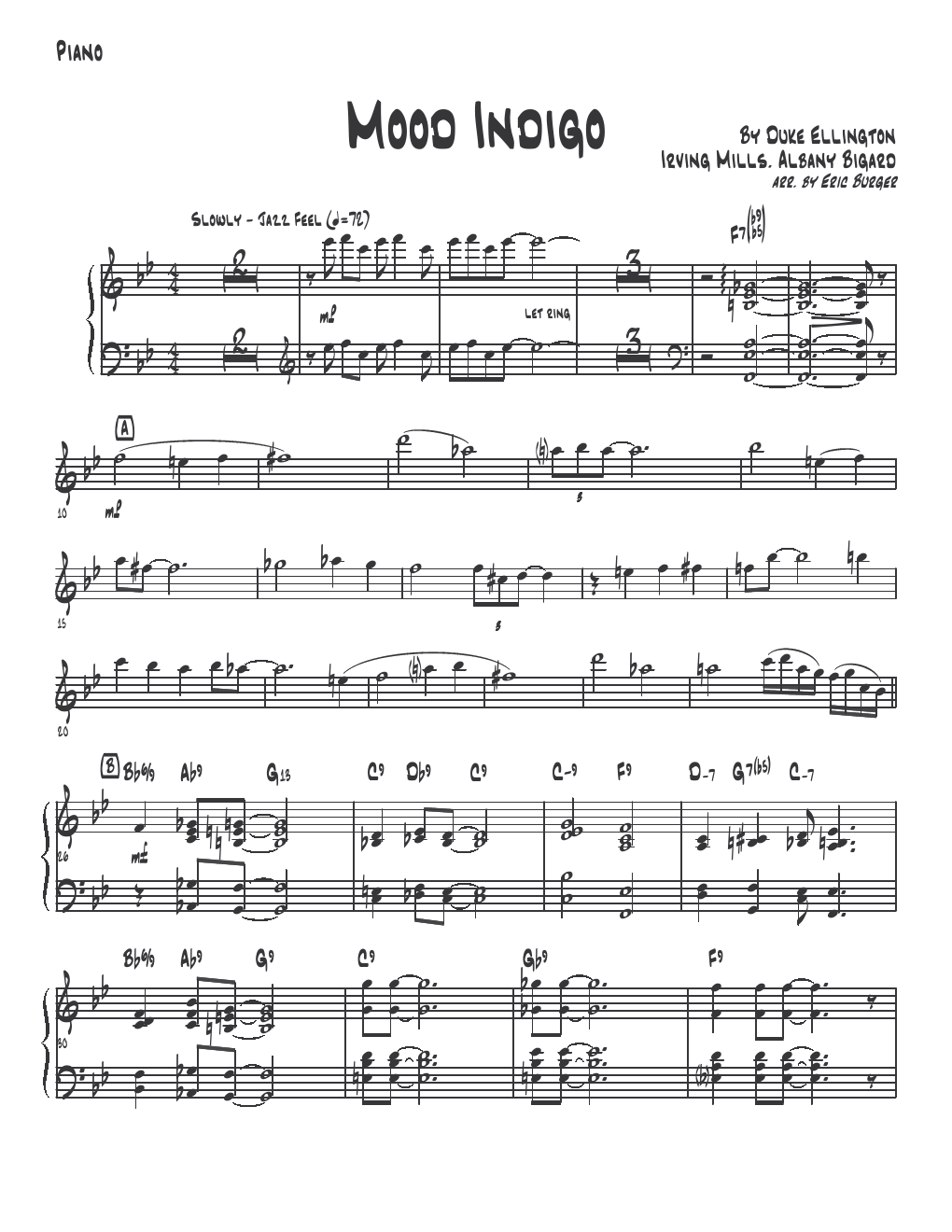
Mood Indigo Score and parts (comp. Duke Ellington)
Composed by Duke Ellington, Barney Bigard
Arranged by Unknown Arranger
- Ensemble: Small Ensemble
- Style: Swing
- Pages: 10
- Difficulty: easy
- Content: Sheet Music
- Format: PDF Download (Instant)
- Price: $12.99
Duke Ellington’s timeless composition, "Mood Indigo," stands as a cornerstone of the jazz repertoire, first recorded in 1930 and quickly becoming synonymous with the early big band era. Co-written with Barney Bigard, this piece epitomizes the "jungle sound" and sophisticated harmonies that defined Ellington’s groundbreaking work. Its melancholic yet deeply soulful character, often described as a "mood piece," made it an instant classic and a staple in the libraries of jazz orchestras worldwide. The original recording famously featured a unique three-voice front line of muted trumpet, muted trombone, and clarinet, creating an ethereal, almost haunting timbre that was revolutionary for its time and continues to captivate listeners. This small ensemble arrangement of "Mood Indigo" masterfully captures the original's distinctive atmosphere while adapting it for a more intimate setting. The musical character is a deliberate medium-slow swing, maintaining the original's contemplative and slightly mournful mood. The arrangement is primarily set in the key of A-flat major, allowing for rich, warm voicings that enhance its reflective quality. The energy is subdued and introspective, building subtly through the piece rather than relying on overt power. It evokes a sense of nostalgic longing and sophisticated melancholy, making it an excellent choice for ensembles looking to explore emotional depth. Unknown Arranger demonstrates a profound respect for Ellington's original vision, evident in the careful preservation of the iconic melodic lines and harmonic structures. The arrangement opens with the classic three-voice melody, often distributed among the lead instruments (e.g., trumpet, trombone, clarinet/alto sax), replicating the original's famous muted sound. There are carefully crafted soli sections that allow different instrument groups to shine, building texture and dynamic contrast without sacrificing the overall mood. While specific to this small ensemble configuration, the arranger skillfully employs voicings that hint at the larger orchestral sound, utilizing close harmony and strategic instrument pairings to create a lush, full sound. The arrangement features an open solo section over the standard "Mood Indigo" changes, providing ample opportunity for improvisation, typically by a melodic instrument like trumpet or alto saxophone, followed by a return to the head with nuanced reharmonizations. Performing this arrangement is a rewarding experience for intermediate to advanced small ensembles. The primary technical challenge lies in achieving the precise blend and balance required for the delicate voicings, particularly in the opening and closing statements of the theme. Articulation and dynamic control are paramount to conveying the intended mood, demanding careful attention to subtle phrasing and breath support. The rewarding aspect comes from successfully recreating the iconic "Mood Indigo" sound and feeling, allowing musicians to delve into one of jazz's most emotionally resonant compositions. It is ideally suited for college-level jazz combos, advanced high school ensembles, or community jazz groups seeking a challenging yet deeply satisfying addition to their repertoire. Conductors should emphasize a medium-slow swing feel, ensuring the rhythm section lays down a solid, unhurried foundation without dragging. The tempo should be around 60-70 BPM, allowing space for the melody to breathe. The primary technical challenge for the horn players is achieving a unified, blended sound, particularly in the initial three-voice statement. Encourage careful listening across the section for intonation and balance. Mutes (cup, straight, or plunger as indicated) are crucial for replicating the authentic "Mood Indigo" timbre; practice with mutes to ensure consistent tone quality. Dynamics should be carefully observed, with a focus on subtle crescendos and decrescendos to build and release tension. Rehearsal should prioritize section blend, articulation clarity, and emotional nuance over sheer technical speed. Q: What instruments are included in this "Mood Indigo" arrangement? A: This small ensemble arrangement typically includes parts for Trumpet, Alto Saxophone, Tenor Saxophone, Trombone, Piano, Bass, and Drums, along with a full score. Q: What is the difficulty level of this arrangement? A: This arrangement is rated as Intermediate to Advanced. It requires proficient sight-reading, good intonation, and a developed sense of ensemble playing and musicality, making it suitable for college or advanced high school jazz ensembles. Q: What musical style and historical context does this arrangement represent? A: This arrangement is in the Swing style, specifically evoking the sophisticated "jungle sound" of Duke Ellington's early big band era from the 1930s, known for its melancholic and atmospheric qualities. Q: What makes this particular arrangement of "Mood Indigo" unique? A: This arrangement is distinctive for its faithful yet adaptable small ensemble treatment of Ellington's original, preserving the iconic three-voice melodic voicings and harmonic integrity while providing opportunities for improvisation within a compact instrumentation. Q: What is the estimated performance duration and recommended tempo for this piece? A: The estimated performance duration is approximately 3-4 minutes, depending on the length of improvised solos. The recommended tempo is a medium-slow swing, around 60-70 beats per minute.
Musicians Also Search For
Mood Indigo Score and parts Unknown Arranger PDF • Mood Indigo Score and parts Unknown Arranger sheet music • Mood Indigo Score and parts arranged by Unknown Arranger • Unknown Arranger small ensemble charts • Unknown Arranger jazz arrangements PDF • Mood Indigo Score and parts Duke Ellington, Barney Bigard sheet music • Mood Indigo Score and parts Duke Ellington, Barney Bigard small ensemble arrangement • Duke Ellington, Barney Bigard small ensemble charts • Mood Indigo Score and parts small ensemble arrangement • Mood Indigo Score and parts small ensemble PDF download • Mood Indigo Score and parts jazz ensemble sheet music • small ensemble sheet music instant download • Mood Indigo Score and parts sheet music with parts • Mood Indigo Score and parts Swing chart • Swing small ensemble arrangements • buy Mood Indigo Score and parts sheet music online • download Mood Indigo Score and parts PDF • Mood Indigo Score and parts jazz chart • best Unknown Arranger small ensemble arrangements • Duke Ellington, Barney Bigard songs arranged by Unknown Arranger • Mood Indigo Score and parts printable sheet music • small ensemble repertoire PDF