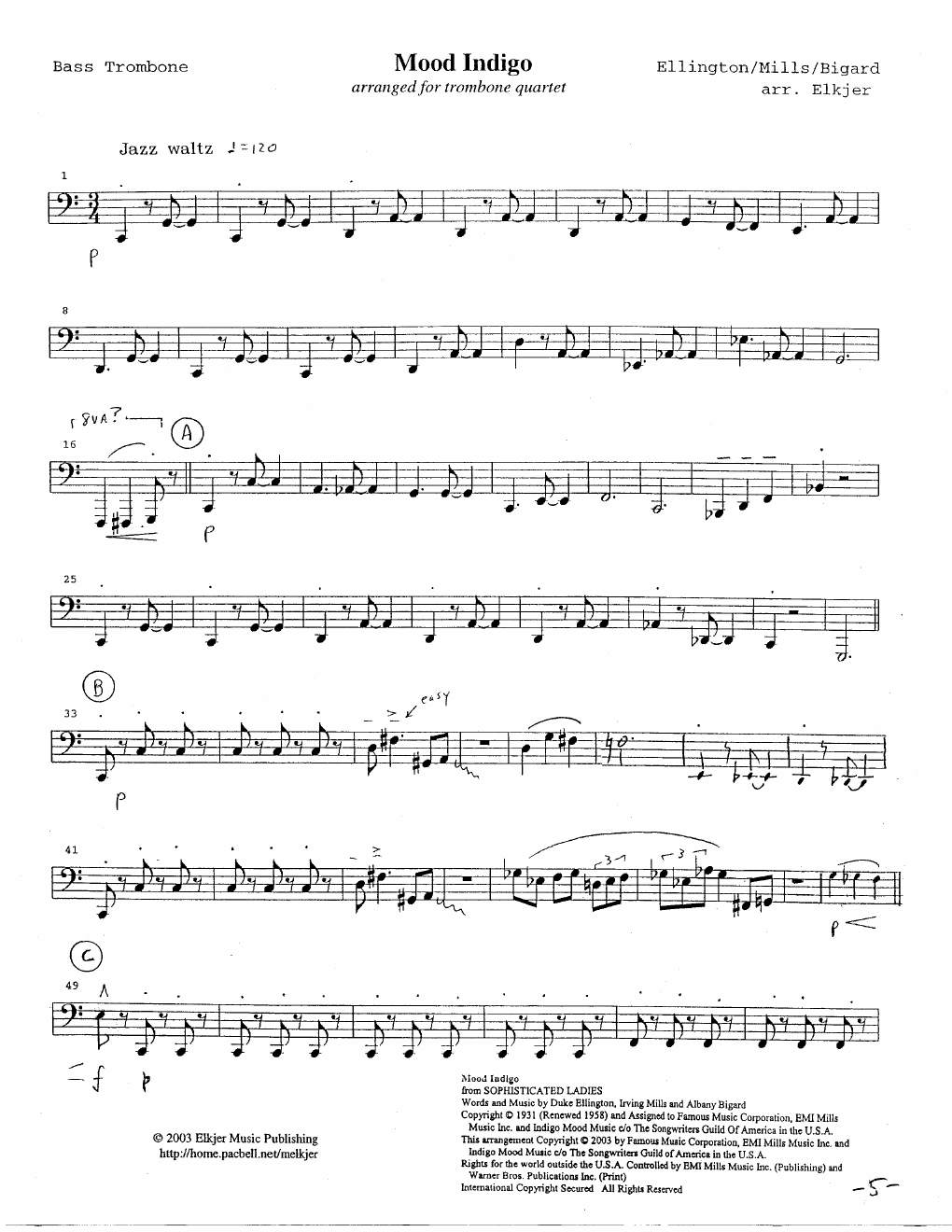
Mood Indigo Quartet TRB. (Elkjer)
Composed by Duke Ellington, Irving Mills, Barney Bigard
Arranged by Elkjer
- Ensemble: Small Ensemble
- Style: Jazz Standard
- Pages: 8
- Difficulty: easy
- Content: Sheet Music
- Format: PDF Download (Instant)
- Price: $12.99
Duke Ellington's "Mood Indigo," co-composed with Irving Mills and Barney Bigard, stands as one of the most iconic and enduring jazz standards, first recorded in 1930. This seminal work emerged from the vibrant Harlem Renaissance, a period of profound cultural and artistic innovation, and quickly became synonymous with Ellington's pioneering sound. Its distinctive, melancholic melody and innovative voicing, particularly the use of muted brass and low-register clarinet, instantly set it apart, establishing a new sonic palette that profoundly influenced subsequent jazz orchestration. The original recording, featuring Arthur Whetsol on trumpet, Joe Nanton on trombone, and Barney Bigard on clarinet, showcased a hauntingly beautiful, almost somber mood that captivated audiences and cemented its status as a timeless classic, beloved for its sophisticated simplicity and emotional depth. Elkjer's quartet arrangement of "Mood Indigo" for trombone (TRB.) masterfully reinterprets this classic, focusing on the intimate yet rich textures achievable within a small ensemble. The arrangement maintains the original's characteristic slow, reflective ballad tempo, emphasizing the piece's inherent melancholic beauty and sophisticated harmonic language. Elkjer is renowned for his ability to distill the essence of big band charts into accessible yet musically compelling small group settings, often employing inventive voicings that preserve the original's integrity while offering fresh perspectives. This particular arrangement likely explores close voicings and countermelodies that highlight the trombone's lyrical capabilities, allowing the instrument to sing the melody with warmth and expression, supported by a nuanced harmonic framework. The mood remains introspective and soulful, evoking the smoky, late-night atmosphere of its origins. The arrangement features the trombone carrying the primary melodic statements, often in a lyrical, expressive manner that demands a warm tone and precise phrasing. While the core melody is well-defined, Elkjer's approach often includes opportunities for subtle improvisation or embellishment, allowing the performers to infuse their personal interpretation into the standard. Technical challenges will center around maintaining a consistent, breathy legato line, navigating the piece's rich, often extended harmonies with accuracy, and achieving a cohesive blend within the quartet. The reward lies in performing a piece of jazz history with a fresh, intimate perspective, allowing each musician's voice to contribute significantly to the overall tapestry. Specific musical moments, such as the interplay between the trombone and supporting voices, are crafted to evoke the original's haunting beauty. This arrangement is ideally suited for college-level ensembles, community jazz groups with experienced players, and professional small ensembles seeking a sophisticated and emotionally resonant addition to their repertoire. Its demands for nuanced phrasing, harmonic awareness, and ensemble cohesion make it an excellent vehicle for developing musical maturity and expressive performance. The small ensemble format fosters a deep level of musical communication and listening, making it a rewarding experience for musicians who appreciate the subtleties of jazz ballad playing and the historical significance of Duke Ellington's enduring legacy. Approaching "Mood Indigo Quartet TRB. (Elkjer)" requires a deep commitment to lyrical phrasing and ensemble blend. The tempo should be a slow, reflective ballad (approximately quarter note = 50-60 BPM), emphasizing the melancholic and introspective mood. Conductors should encourage musicians to focus on long, sustained lines, avoiding any sense of rush. Technical challenges include precise intonation within the close voicings and maintaining a consistent, warm tone throughout, especially in the lower registers. The trombone, often carrying the melody, should aim for a vocal quality. Encourage subtle dynamic shading to enhance the emotional arc of the piece. Rehearsal tips include isolating harmonic passages to ensure accurate voicings and practicing the balance between the lead voice and the accompanying instruments to achieve a seamless, integrated sound. Consider using plunger mutes for specific brass parts to evoke the original Ellingtonian texture, if indicated in the parts. Q: What instruments are included in the "Mood Indigo Quartet TRB. (Elkjer)" arrangement? A: This arrangement is specifically designed for a jazz quartet featuring a lead trombone (TRB.), with accompanying parts typically including piano, bass, and drums, though specific instrumentation may vary slightly depending on the exact charting. Q: What is the difficulty level of this arrangement? A: This arrangement is considered intermediate to advanced, suitable for college-level ensembles, experienced community groups, and professional musicians due to its demands for nuanced phrasing, precise intonation, and sophisticated harmonic understanding. Q: What style and historical context does "Mood Indigo" represent? A: "Mood Indigo" is a quintessential jazz standard from the early 1930s, representing the sophisticated and innovative orchestral jazz style pioneered by Duke Ellington during the Harlem Renaissance, known for its melancholic mood and unique voicings. Q: What makes Elkjer's arrangement of "Mood Indigo" unique? A: Elkjer's arrangement is unique in its ability to distill the rich textures of the original big band piece into an intimate quartet setting, offering fresh voicings and countermelodies that highlight the trombone's lyrical capabilities while preserving the original's emotional depth. Q: What is the typical performance duration or tempo for this arrangement? A: As a slow ballad, "Mood Indigo Quartet TRB. (Elkjer)" typically has a performance duration of approximately 3-5 minutes, depending on any improvised sections, and should be played at a reflective tempo of around quarter note = 50-60 BPM.
Musicians Also Search For
Mood Indigo Quartet TRB. Elkjer PDF • Mood Indigo Quartet TRB. Elkjer sheet music • Mood Indigo Quartet TRB. arranged by Elkjer • Elkjer small ensemble charts • Elkjer jazz arrangements PDF • Mood Indigo Quartet TRB. Duke Ellington, Irving Mills, Barney Bigard sheet music • Mood Indigo Quartet TRB. Duke Ellington, Irving Mills, Barney Bigard small ensemble arrangement • Duke Ellington, Irving Mills, Barney Bigard small ensemble charts • Mood Indigo Quartet TRB. small ensemble arrangement • Mood Indigo Quartet TRB. small ensemble PDF download • Mood Indigo Quartet TRB. jazz ensemble sheet music • small ensemble sheet music instant download • Mood Indigo Quartet TRB. sheet music with parts • Mood Indigo Quartet TRB. Jazz Standard chart • Jazz Standard small ensemble arrangements • buy Mood Indigo Quartet TRB. sheet music online • download Mood Indigo Quartet TRB. PDF • Mood Indigo Quartet TRB. jazz chart • best Elkjer small ensemble arrangements • Duke Ellington, Irving Mills, Barney Bigard songs arranged by Elkjer • Mood Indigo Quartet TRB. printable sheet music • small ensemble repertoire PDF