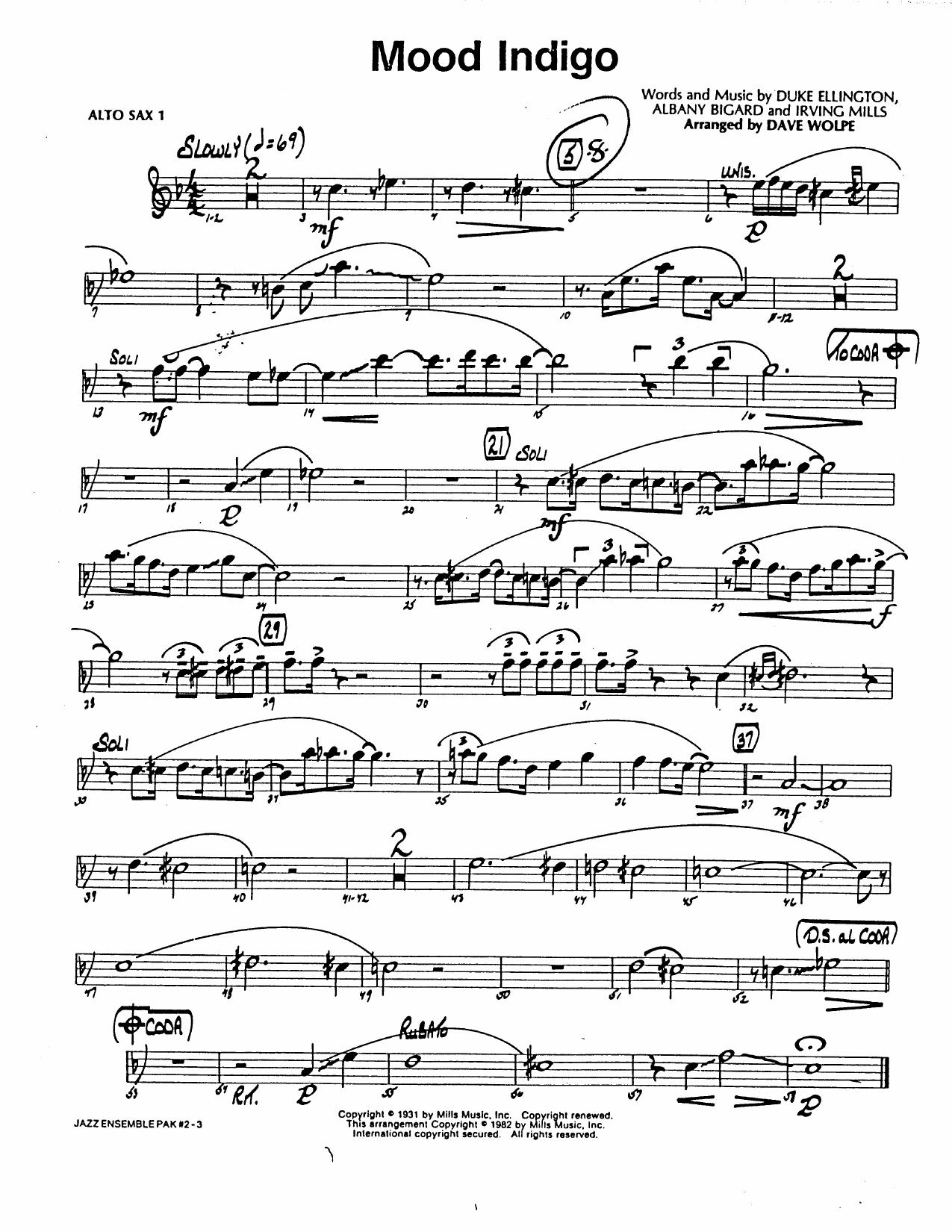
Mood Indigo (D.Wolpe) sheet music preview

Mood Indigo (D.Wolpe)

Composed by Duke Ellington

Arranged by Dave Wolpe

  • Ensemble: Big Band
  • Pages: 23
  • Instruments (17): Alto Sax 1, Alto Sax 2, Tenor Sax 1, Tenor Sax 2, Baritone Sax, Trumpet 1, Trumpet 2, Trumpet 3, Trumpet 4, Trombone 1, Trombone 2, Trombone 3, Trombone 4, Guitar, Piano, Bass, Drums
  • Difficulty: medium
  • Content: Individual Parts
  • Format: PDF Download (Instant)
  • Price: $24.99

Duke Ellington’s timeless 1930 classic "Mood Indigo" stands as a towering pillar of the American jazz canon, capturing the moody, nocturnal sophistication of the early Harlem Renaissance and the innovative textural palette of the Ellington Orchestra. Originally recorded under the title "Dreamy Blues" for a radio broadcast before acquiring its iconic lyrics and title, Ellington's masterpiece famously inverted traditional big band instrumentation by assigning the melody to a muted trombone, low-register clarinet, and high-register muted trumpet. This haunting, upside-down voicing created an entirely new atmospheric color that fascinated listeners and defined the foundational aesthetic of the swing era. As the piece transitioned into an undisputed jazz standard, it was reinterpreted by countless luminaries, yet the core DNA of its melancholy, evocative harmony has remained a masterclass in economy and emotional resonance. Master arranger Dave Wolpe approaches this legendary canvas with a deep reverence for Ellingtonian tradition while seamlessly translating it into a lush, accessible framework for contemporary big band forces. Delivered at a relaxed, sultry slow-swing tempo, the arrangement opens with the characteristic close-interval voicings that evoke the original Cotton Club ambiance, immediately establishing a smoky, reflective mood. Wolpe balances rich, sophisticated harmonic extensions with transparent scoring, allowing the ensemble to breathe. The arrangement builds organically from whispered, intimate ensemble passages into a warm, expressive middle section that highlights dynamic contrast, avoiding heavy-handed modernisms in favor of a classic, tasteful swing architecture that honors the Ellington idiom at every turn. The melody is primarily carried by the saxophone section and muted brass, requiring a high degree of tonal control, subtle vibrato, and blend to achieve the required vocal quality. Trumpets and trombones utilize standard mutes (straight and cup) to replicate that signature period timbre, while the rhythm section must maintain an unhurried, feather-light pocket that propels the chart without ever rushing the beat. Featured solo space allows a soloist to step forward and stretch out over a supportive, lush background accompaniment that utilizes classic block-chord writing. The primary technical challenges lie not in blazing fingerwork, but in intonation, breath support during extended slow phrases, and achieving a unified stylistic approach across all sections. Advanced high school ensembles, collegiate jazz orchestras, and professional community bands will find this arrangement an exceptionally rewarding addition to their repertoire. It provides an ideal vehicle for teaching young musicians the subtleties of stylistic phrasing, balance, and emotional restraint—skills that are frequently overshadowed by up-tempo burning charts. For more seasoned groups, it offers a wonderful opportunity to focus on pure tone production, dynamic nuance, and historical interpretation, making it a standout programming choice for formal concerts, festival adjudications, and retrospective jazz showcases. Achieving success with this Dave Wolpe arrangement of "Mood Indigo" hinges entirely on restraint, blend, and deep stylistic commitment. The tempo must remain relaxed and unhurried; dragging slightly is preferable to rushing, as the entire emotional weight of the chart depends on a laid-back, sultry swing feel. Conductors should pay meticulous attention to section intonation, particularly during the dense, close-voiced harmonic passages where minor pitch discrepancies become glaringly obvious. Trumpets and trombones must utilize the specified mutes consistently to maintain the authentic, dry color demanded by the Ellingtonian tradition. Saxophones should focus on a warm, breathy sub-tone, especially in the lower registers, blending seamlessly with the muted brass. Rehearsals should begin by isolating the slow, ballad-like background figures behind the soloist, ensuring the accompanying horns never overpower the lead voice. Emphasize subtle dynamic swells and decay on sustained notes to give the chart a living, breathing vocal quality. Q: What specific instruments and parts are included in this arrangement? A: Scored for a standard 17-instrument big band, the arrangement includes Alto Saxophone 1, Alto Saxophone 2, Tenor Saxophone 1, Tenor Saxophone 2, Baritone Saxophone, 4 Trumpets, 4 Trombones, Piano, Guitar, Bass, and Drum Set. Q: What is the difficulty level of this Dave Wolpe chart? A: This arrangement is graded as medium-easy to medium, making it technically accessible for proficient high school bands while still musically rich enough to challenge collegiate and community ensembles in the areas of tone, blend, and stylistic interpretation. Q: What is the historical style and musical context of the piece? A: Based on Duke Ellington’s iconic 1930 composition, this chart is set in a slow, smoky swing style that pays direct homage to the early Harlem Renaissance and the unique inverted-voicing textures of the original Ellington Orchestra. Q: What makes this specific arrangement by Dave Wolpe unique? A: Wolpe successfully bridges the gap between vintage Ellingtonian texture and modern big band accessibility, utilizing lush harmonic voicings and transparent scoring that allow developing ensembles to capture an authentic period sound without overwhelming technical demands. Q: What is the performance duration and tempo feel of the piece? A: The arrangement is performed at a relaxed, sultry slow-swing tempo (around 72 to 80 BPM) and typically runs between 3 and 4 minutes in duration, depending on the length of the improvised solo section.

Questions and answers

What is included in the Mood Indigo (D.Wolpe) PDF?
The verified current file contains individual parts across 23 pages.
How many instruments or parts are listed for Mood Indigo (D.Wolpe)?
The verified instrumentation list contains 17 entries for this Big Band arrangement.
Who is credited for Mood Indigo (D.Wolpe)?
Composer: Duke Ellington. Arranger: Dave Wolpe.
What difficulty is listed for Mood Indigo (D.Wolpe)?
The verified difficulty level is medium.
Can I preview Mood Indigo (D.Wolpe) before buying?
Yes. The product page provides a preview generated from the current PDF file.
How is Mood Indigo (D.Wolpe) delivered?
After successful payment, the digital PDF is made available for download. The displayed price is $24.99.

Musicians Also Search For

Mood Indigo Dave Wolpe PDFMood Indigo Dave Wolpe sheet musicMood Indigo arranged by Dave WolpeDave Wolpe big band chartsDave Wolpe jazz arrangements PDFMood Indigo Duke Ellington sheet musicMood Indigo Duke Ellington big band arrangementsDuke Ellington big band chartsMood Indigo big band arrangementsMood Indigo big band PDF downloadMood Indigo jazz sheet musicbig band sheet music downloadMood Indigo individual parts downloadMood Indigo sheet music PDFbuy Mood Indigo sheet musicdownload Mood Indigo PDFMood Indigo jazz chartsbest Dave Wolpe big band arrangementsDuke Ellington arranged by Dave WolpeMood Indigo printable sheet musicbig band repertoire PDF

All arrangements by Dave Wolpe All Duke Ellington sheet music