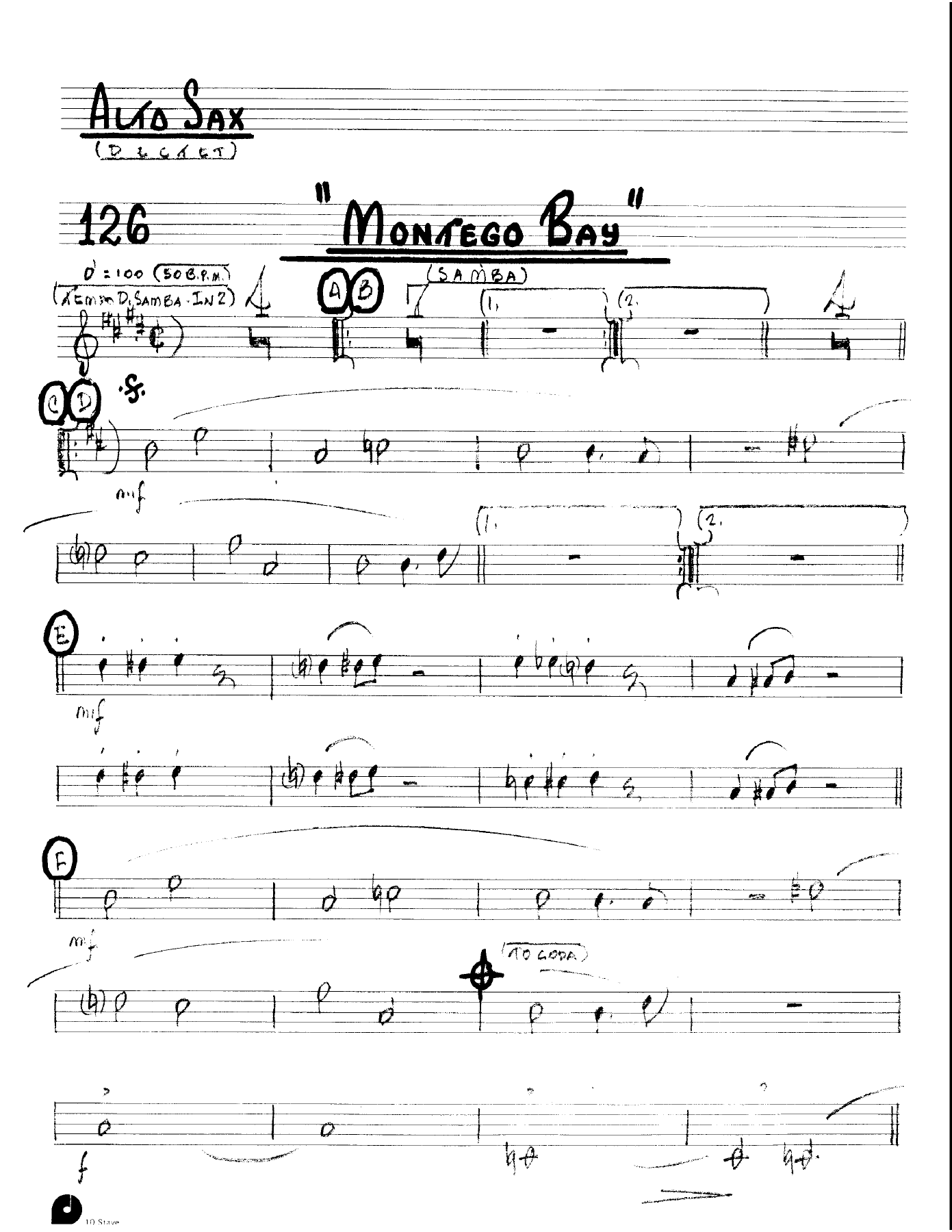
Montego Bay (Kenton Dectet #126)
Composed by Traditional
Arranged by Stan Kenton Dected 176
- Ensemble: Small Ensemble
- Style: Jazz Standard
- Pages: 28
- Instruments (9): Alto Sax, Tenor Sax, Baritone Sax, Trumpet 1, Trumpet 2, Trombone, Piano, Bass, Drums
- Difficulty: easy
- Content: Individual Parts
- Format: PDF Download (Instant)
- Price: $12.99
The vibrant, infectious spirit of the Caribbean finds its quintessential jazz expression in "Montego Bay," a piece that, despite its traditional origins, became synonymous with the golden age of jazz big bands and small ensembles. While the original composer remains uncredited, the melody's evocative charm and rhythmic possibilities solidified its status as a jazz standard, particularly after its popularization in the mid-20th century. It embodies the era's fascination with Latin-infused rhythms, skillfully blending them with the sophisticated harmonic language of jazz. This particular arrangement captures the essence of a bygone era, offering a glimpse into the musical landscape where global influences began to profoundly shape American popular music. Stan Kenton Dectet 176's arrangement of "Montego Bay" is a masterclass in small ensemble orchestration, presenting the piece with a medium Latin groove that pulsates with understated energy. Set primarily in C minor, the arrangement navigates through moments of melancholic beauty and spirited rhythmic interplay. The overall mood is one of sophisticated cool, tinged with a tropical warmth, inviting both performers and listeners into its captivating sound world. The melodic lines are gracefully intertwined, creating a rich tapestry of sound that is both intricate and immediately accessible. The arrangement evokes images of moonlit nights and gentle ocean breezes, a testament to its enduring appeal and the arranger's keen understanding of its inherent character. Kenton Dectet 176's distinctive approach is immediately evident in the sophisticated voicings and the thoughtful interplay between the ensemble's voices. Rather than relying on bombastic shout choruses, the arrangement builds its intensity through layered textures and contrapuntal lines, showcasing the individual strengths of each instrument. The melody is initially presented by the trumpet, establishing a clear and confident lead, before being passed to the alto saxophone and trombone in a series of artful exchanges. The arrangement features ample solo space, allowing improvisers to explore the modal possibilities within the Latin framework. Technical challenges include precise rhythmic execution, particularly in the syncopated accompaniment figures, and maintaining a consistent, relaxed Latin feel. The rewarding aspect lies in the ensemble's ability to coalesce into a cohesive unit, delivering a performance that is both technically polished and emotionally resonant. This arrangement is ideally suited for advanced high school, college, community, or professional jazz ensembles. Its demands for rhythmic precision, nuanced phrasing, and improvisational maturity make it an excellent vehicle for developing sophisticated ensemble playing and individual soloing skills. The scoring for a dectet (typically trumpet, trombone, alto saxophone, tenor saxophone, baritone saxophone, piano, bass, drums, and often guitar/vibes) provides a rich sonic palette while maintaining the agility of a smaller group. The thoughtful construction and elegant harmonic language ensure that "Montego Bay" will be a standout addition to any concert program, offering a refreshing alternative to traditional big band charts. Conductors should emphasize a relaxed yet precise medium Latin groove throughout, ensuring the rhythm section establishes a solid foundation without rushing. Key technical challenges include maintaining rhythmic accuracy in the syncopated horn lines and achieving a balanced blend within the intricate voicings. Encourage horn players to articulate clearly while maintaining a smooth, legato feel where indicated. The piano and bass should lock into a consistent montuno pattern, providing rhythmic and harmonic propulsion. Soloists should be encouraged to explore the modal qualities of the piece, focusing on melodic development rather than purely technical display. No special techniques like mutes or falls are explicitly required, but dynamic shaping and expressive phrasing are paramount. Rehearsals should focus initially on rhythmic clarity and ensemble blend before addressing improvisational sections. Q: What instruments/parts are included in this arrangement? A: This arrangement is scored for a dectet, typically including trumpet, trombone, alto saxophone, tenor saxophone, baritone saxophone, piano, bass, and drums, with additional parts often for guitar or vibraphone. Q: What is the difficulty level of "Montego Bay (Kenton Dectet #126)"? A: This arrangement is considered suitable for advanced high school, college, community, or professional jazz ensembles due to its demands for rhythmic precision, nuanced phrasing, and improvisational maturity. Q: What is the musical style and historical context of this arrangement? A: "Montego Bay" is presented as a jazz standard with a medium Latin groove, reflecting the mid-20th century's fascination with Latin-infused rhythms blended with sophisticated jazz harmony. Q: What makes Stan Kenton Dectet 176's arrangement of "Montego Bay" unique? A: The arrangement stands out for its sophisticated voicings, thoughtful interplay between instruments, and building intensity through layered textures and contrapuntal lines, rather than relying on traditional shout choruses. Q: What is the typical performance duration or tempo for this piece? A: The arrangement is intended to be performed at a medium Latin groove, and while specific duration can vary with improvised solos, a typical performance would range from 4 to 6 minutes.
Questions and answers
- What is included in the Montego Bay (Kenton Dectet #126) PDF?
- The verified current file contains individual parts across 28 pages.
- How many instruments or parts are listed for Montego Bay (Kenton Dectet #126)?
- The verified instrumentation list contains 9 entries for this Small Ensemble arrangement.
- Who is credited for Montego Bay (Kenton Dectet #126)?
- Composer: Traditional. Arranger: Stan Kenton Dected 176.
- What difficulty is listed for Montego Bay (Kenton Dectet #126)?
- The verified difficulty level is easy.
- What style is listed for Montego Bay (Kenton Dectet #126)?
- The catalog lists the style as Jazz Standard.
- Can I preview Montego Bay (Kenton Dectet #126) before buying?
- Yes. The product page provides a preview generated from the current PDF file.
- How is Montego Bay (Kenton Dectet #126) delivered?
- After successful payment, the digital PDF is made available for download. The displayed price is $12.99.
Musicians Also Search For
Montego Bay Stan Kenton Dected 176 PDF • Montego Bay Stan Kenton Dected 176 sheet music • Montego Bay arranged by Stan Kenton Dected 176 • Stan Kenton Dected 176 small ensemble charts • Stan Kenton Dected 176 jazz arrangements PDF • Montego Bay Traditional sheet music • Montego Bay Traditional small ensemble arrangements • Traditional small ensemble charts • Montego Bay small ensemble arrangements • Montego Bay small ensemble PDF download • Montego Bay jazz sheet music • small ensemble sheet music download • Montego Bay individual parts download • Montego Bay sheet music PDF • Montego Bay Jazz Standard charts • Jazz Standard small ensemble arrangements • buy Montego Bay sheet music • download Montego Bay PDF • Montego Bay jazz charts • best Stan Kenton Dected 176 small ensemble arrangements • Traditional arranged by Stan Kenton Dected 176 • Montego Bay printable sheet music • small ensemble repertoire PDF