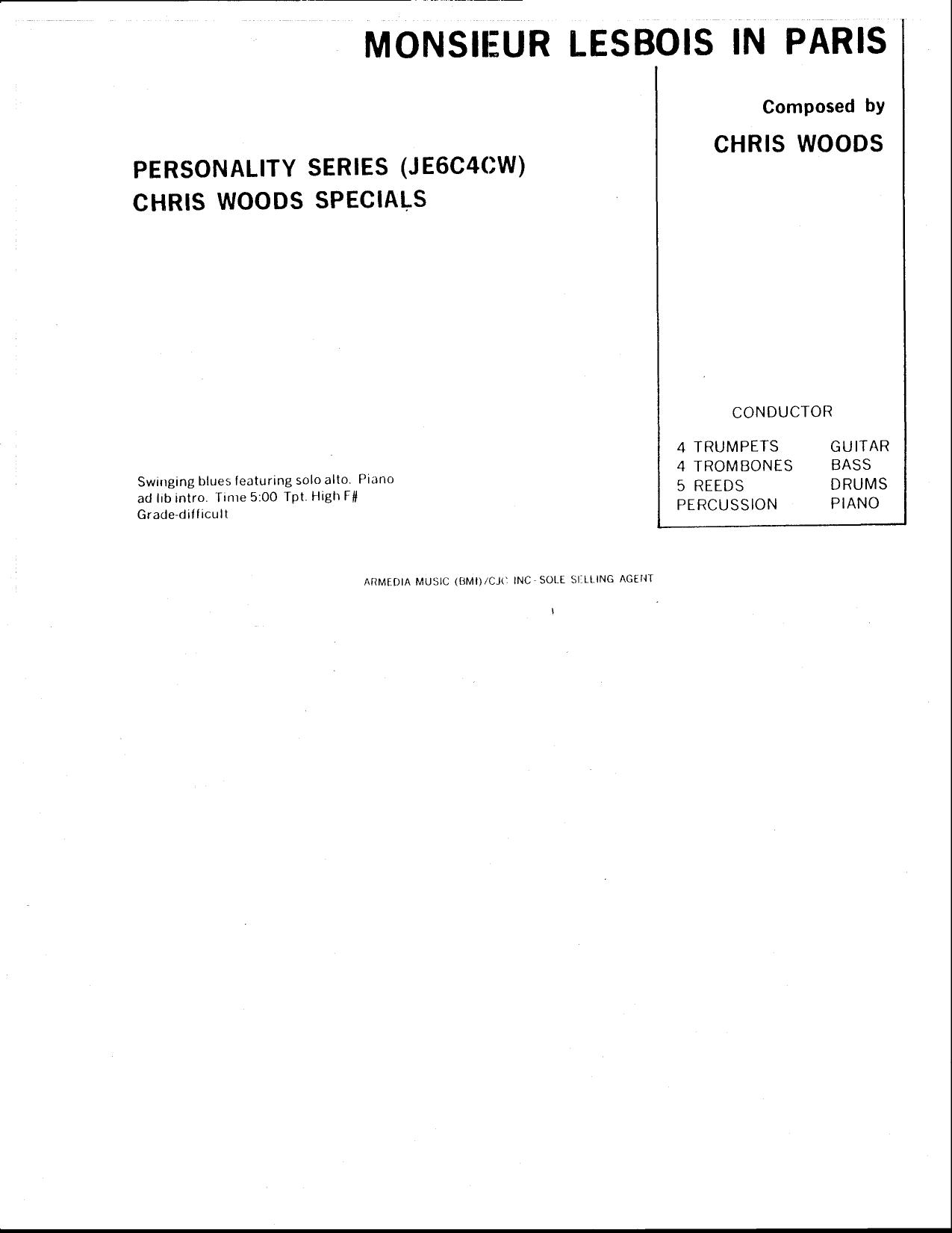
Monsieur Lesbois In Paris (C.Woods) sheet music preview

Monsieur Lesbois In Paris (C.Woods)

Composed by C. Woods

Arranged by C.Woods

  • Ensemble: Big Band
  • Style: Jazz Standard
  • Pages: 61
  • Instruments (18): Solo Alto Sax, 1st Alto Sax, 2nd Alto Sax, 1st Tenor Sax, 2nd Tenor Sax, 5th Baritone Sax, 1st Trumpet, 2nd Trumpet, 3rd Trumpet, 4th Trumpet, 1st Trombone, 2nd Trombone, 3rd Trombone, 4th Bass Trombone, Bass, Drums, Piano, Guitar
  • Difficulty: advanced
  • Content: Individual Parts
  • Format: PDF Download (Instant)
  • Price: $24.99

Bebop and post-bop idioms of the mid-to-late 20th century find a vibrant, sophisticated vehicle in "Monsieur Lesbois In Paris," a compelling composition originally brought to life by the brilliant saxophonist and composer C. Woods. Capturing the cosmopolitan energy, intellectual cool, and relentless momentum of the European jazz scene during its post-war expansion, this piece bridges American harmonic sophistication with a distinct continental flair. While bearing the DNA of classic urban jazz sketches, the work functions as an adventurous excursion through shifting modal landscapes and driving bebop changes, earning its reputation as a sophisticated staple for adventurous ensembles looking to stretch their stylistic boundaries beyond standard repertoire. Propelled by an infectious, driving medium-up swing groove in 4/4, the musical character of "Monsieur Lesbois In Paris" balances urbane sophistication with bursts of high-octane exhilaration. The piece opens with an enigmatic, modal-tinged vamp that quickly gives way to a labyrinthine head, establishing a mood that is simultaneously playful, mysterious, and relentlessly swinging. C.Woods employs clever chromatic mediant shifts and rich upper-structure extensions that evoke the smoky ambiance of Parisian left-bank clubs while retaining the hard-driving rhythmic grid of New York bop. The emotional arc moves effortlessly from sultry, whispered unison lines in the lower reeds to explosive, brass-heavy climaxes that demand absolute precision and rhythmic agility from the entire ensemble. In crafting this big band adaptation, C.Woods maintains the intricate, linear counterpoint of the original small-group conception while maximizing the coloristic palette of a 17-piece jazz orchestra. The arrangement features dense, contemporary block-voicing techniques for the saxophone soli, recalling the golden eras of the vanguard big bands, contrasted with angular, punchy shout choruses that utilize wide intervallic leaps in the brass. Rather than relying on simple tutti-vs-solo dynamics, C.Woods weaves independent lines throughout the inner voices of the horn sections, ensuring that every chair remains actively engaged. The arrangement highlights featured blowing changes for both alto saxophone and trumpet, anchored by a rhythm section part that demands a nimble, conversational approach to comping behind the soloists. Clocking in as a substantial concert or festival chart, this arrangement is best suited for advanced collegiate ensembles, top-tier high school jazz bands with exceptional section leaders, and professional community big bands. The technical demands—ranging from rapid-fire unison bebop lines in the woodwinds to extended range requirements for the lead trumpet—make it an exceptional showcase piece for festival adjudication or headline performances. Performers will find immense gratification in navigating the intricate harmonic turnarounds and the sheer kinetic energy of the final climactic chorus, which resolves on a brilliantly colored extended chord that lingers in the room long after the final cymbal crash. Navigating "Monsieur Lesbois In Paris" successfully requires a disciplined approach to articulation and time feel. The tempo should remain locked at a brisk medium-up swing (approx. Quarter note = 208), avoiding the trap of rushing the triplets during the head. Conductors should emphasize a lightweight, horizontal swing eighth-note concept, ensuring that the heavy brass stabs do not bog down the forward momentum of the rhythm section. Key technical challenges lie in the intricate, chromatic unison lines shared between the alto saxophones and the lead trumpet; these passages must be meticulously cleaned up at slower tempos before attempting full speed. Dynamics are critical—ensure the background figures behind the soloists remain at a strict mezzo-piano so the improvised lines breathe naturally. Saxophones should utilize a dry, focused tone without excessive vibrato to maintain the modern, urban aesthetic, while the brass section should employ controlled, bright articulations with minimal use of heavy falls or doits unless specifically marked in the score. Q: What instruments and parts are included in this 17-instrument arrangement? A: The instrumentation comprises a standard 17-piece big band layout: 5 saxophones (2 altos, 2 tenors, 1 baritone), 4 trumpets, 4 trombones, and a 4-piece rhythm section consisting of piano, guitar, bass, and drums, supported by a comprehensive 61-page conductor score. Q: What is the difficulty level of this arrangement? A: This arrangement is graded as advanced, making it ideal for collegiate jazz orchestras, professional big bands, and elite high school ensembles with strong section leaders and confident improvisers. Q: What is the historical style and background of the piece? A: Composed in the mid-to-late 20th century jazz tradition, the piece reflects the sophisticated, modal-infused bebop style championed by C.Woods, capturing the sophisticated cross-cultural exchange between American jazz artists and European bohemian culture. Q: What makes C.Woods's arrangement unique for a big band? A: The arrangement stands out through its sophisticated use of chromatic modal shifts, intricate linear counterpoint within the saxophone soli, and dense upper-structure harmonic voicings that successfully translate a small-group aesthetic into a massive orchestral canvas. Q: What is the performance duration and recommended tempo for the piece? A: The arrangement is designed as a substantial festival or concert work, performed at a brisk medium-up swing tempo of approximately quarter note = 208, with a total duration of roughly 5 to 6 minutes depending on solo choruses.

Questions and answers

What is included in the Monsieur Lesbois In Paris (C.Woods) PDF?
The verified current file contains a conductor score and individual parts across 61 pages.
How many instruments or parts are listed for Monsieur Lesbois In Paris (C.Woods)?
The verified instrumentation list contains 18 entries for this Big Band arrangement.
Who is credited for Monsieur Lesbois In Paris (C.Woods)?
Composer: C. Woods. Arranger: C.Woods.
What difficulty is listed for Monsieur Lesbois In Paris (C.Woods)?
The verified difficulty level is advanced.
What style is listed for Monsieur Lesbois In Paris (C.Woods)?
The catalog lists the style as Jazz Standard.
Can I preview Monsieur Lesbois In Paris (C.Woods) before buying?
Yes. The product page provides a preview generated from the current PDF file.
How is Monsieur Lesbois In Paris (C.Woods) delivered?
After successful payment, the digital PDF is made available for download. The displayed price is $24.99.

Musicians Also Search For

Monsieur Lesbois In Paris C.Woods PDFMonsieur Lesbois In Paris C.Woods sheet musicMonsieur Lesbois In Paris arranged by C.WoodsC.Woods big band chartsC.Woods jazz arrangements PDFMonsieur Lesbois In Paris C. Woods sheet musicMonsieur Lesbois In Paris C. Woods big band arrangementsC. Woods big band chartsMonsieur Lesbois In Paris big band arrangementsMonsieur Lesbois In Paris big band PDF downloadMonsieur Lesbois In Paris jazz sheet musicbig band sheet music downloadMonsieur Lesbois In Paris conductor score PDFMonsieur Lesbois In Paris individual parts downloadMonsieur Lesbois In Paris sheet music PDFMonsieur Lesbois In Paris Jazz Standard chartsJazz Standard big band arrangementsbuy Monsieur Lesbois In Paris sheet musicdownload Monsieur Lesbois In Paris PDFMonsieur Lesbois In Paris jazz chartsbest C.Woods big band arrangementsC. Woods arranged by C.WoodsMonsieur Lesbois In Paris printable sheet musicbig band repertoire PDF

All arrangements by C.Woods All C. Woods sheet music