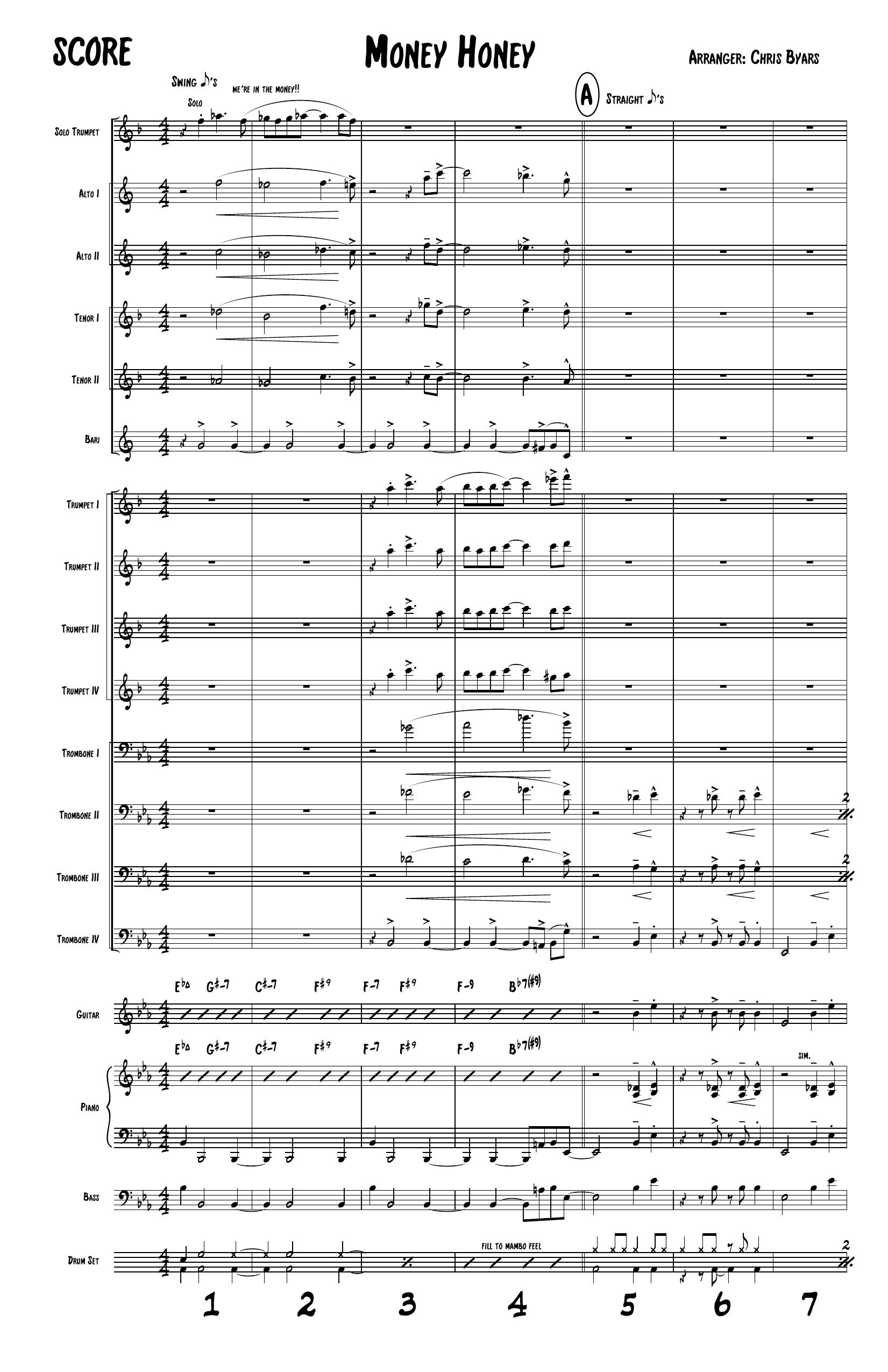
Money Honey (C.Byars) sheet music preview

Money Honey (C.Byars)

Composed by Jesse Stone

Arranged by C.Byars

  • Ensemble: Big Band
  • Style: Jazz Standard
  • Pages: 22
  • Instruments (18): Solo Trumpet (doubles Clarinet), Alto Saxophone I, Alto Saxophone II, Tenor Saxophone I, Tenor Saxophone II, Baritone Saxophone, Trumpet I, Trumpet II, Trumpet III, Trumpet IV, Trombone I, Trombone II, Trombone III, Trombone IV, Guitar, Piano, Bass, Drum Set
  • Difficulty: medium
  • Content: Individual Parts
  • Format: PDF Download (Instant)
  • Price: $24.99

Jesse Stone’s rhythm-and-blues masterpiece "Money Honey," originally made famous by Clyde McPhatter and The Drifters in 1953, occupies a pivotal intersection where jump blues met the burgeoning Atlantic Records-driven R&B explosion that heavily influenced early rock and roll. While written as a vocal shouter, the underlying harmonic framework and infectious blues-based groove have long made it a fertile playground for jazz arrangers seeking to bridge the gap between traditional swing, early rhythm and blues, and hard bop sensibilities. Grooving with an infectious medium-tempo shuffle feel in a flat concert key, this chart captures an exuberant, danceable energy driven by a relentless walking bassline and crisp backbeat punctuation from the rhythm section. The mood is celebratory, gritty, and swinging, evoking the smoky atmosphere of a 1950s Harlem or 52nd Street club where jazz and R&B freely intermingled. C.Byars utilizes a vibrant harmonic palette that respects the raw blues roots of Stone’s composition while injecting sophisticated jazz voicings, clever dynamic shifts, and razor-sharp ensemble writing that elevates the tune beyond a simple nostalgic throwback. Byars places a unique spotlight on a featured Solo Clarinet, an inspired choice that breaks away from standard big band orchestration to evoke the classic small-group swing era of Benny Goodman or Barney Bigard, yet modernizes the concept within a full 18-piece big band setting. The arrangement features tightly knit saxophone solis—showcasing Alto Saxes 1 and 2 alongside the Tenors—that trade off with punchy, brass-heavy interjections. The dynamic architecture builds steadily toward a high-energy shout chorus, where the ensemble layers blues-drenched riffs against the soaring clarinet lead before resolving into a roaring, high-spirited coda. Advanced high school ensembles with strong section players, collegiate jazz orchestras, and professional repertory bands will find this chart exceptionally rewarding. While the technical demands on the rhythm and horn sections require good stylistic flexibility and clean articulation rather than extreme altissimo registers, the key to success lies in achieving an authentic, relaxed swing-shuffle pocket. The inclusion of a dedicated conductor's score alongside the 22 pages of meticulously edited parts ensures that directors have total clarity in balancing the unique solo clarinet voice against the brass and reed background figures. Achieving an authentic performance of this arrangement hinges on establishing a relaxed yet driving medium-shuffle groove. The rhythm section must lock in tightly; the drummer should emphasize a bouncy triplet feel on the ride cymbal with crisp hi-hat chicks on beats two and four, avoiding any stiffness that would kill the blues momentum. The bass player needs to maintain a smooth, connected quarter-note pulse that breathes with the horns. Technically, the primary challenge lies in stylistic unity between the featured solo clarinet and the surrounding saxophones. The clarinetist should adopt a warm, projecting tone capable of cutting through full ensemble backgrounds without forcing the register. Brass players must execute dynamic contrasts cleanly, utilizing controlled plunger or cup mutes where indicated to add vintage color without sacrificing intonation. During rehearsals, directors should isolate the saxophone soli to ensure flawless blend and articulation before integrating the rhythm section. Pay close attention to the placement of short, accented notes in the brass; they must "bark" without being harsh, maintaining the playful, swaggering character intrinsic to Stone's timeless melody. Q: What instruments and parts are included in this big band arrangement? A: The chart is scored for a standard 18-instrument big band plus a featured Solo Clarinet, comprising 5 saxophones (Solo Clarinet, Alto Sax 1, Alto Sax 2, Tenor Sax 1, Tenor Sax 2), standard brass configurations, and a full rhythm section, backed by a comprehensive conductor score. Q: What is the difficulty level of this C.Byars arrangement? A: This arrangement is graded as medium-advanced, making it ideal for skilled high school, collegiate, and professional big bands that possess strong section cohesion and stylistic versatility in blues and swing idioms. Q: What is the historical style and background of "Money Honey"? A: Originally composed by Jesse Stone and famously recorded by Clyde McPhatter and The Drifters in 1953, this piece is a classic rhythm-and-blues standard that bridges early rock-and-roll energy with sophisticated jazz arranging traditions. Q: What makes this particular arrangement by C.Byars unique? A: Byars replaces the traditional alto or tenor saxophone lead voice with a prominent Solo Clarinet, infusing the 18-piece big band texture with a distinct small-group swing flavor reminiscent of Benny Goodman while retaining modern jazz-blues harmonies. Q: What is the recommended tempo and performance duration for this piece? A: The chart is set in a medium-tempo shuffle groove (approximately 120-126 BPM) and typically runs around 3.5 to 4 minutes in duration, depending on the length of the improvised clarinet solo choruses.

Questions and answers

What is included in the Money Honey (C.Byars) PDF?
The verified current file contains a conductor score across 22 pages.
How many instruments or parts are listed for Money Honey (C.Byars)?
The verified instrumentation list contains 18 entries for this Big Band arrangement.
Who is credited for Money Honey (C.Byars)?
Composer: Jesse Stone. Arranger: C.Byars.
What difficulty is listed for Money Honey (C.Byars)?
The verified difficulty level is medium.
What style is listed for Money Honey (C.Byars)?
The catalog lists the style as Jazz Standard.
Can I preview Money Honey (C.Byars) before buying?
Yes. The product page provides a preview generated from the current PDF file.
How is Money Honey (C.Byars) delivered?
After successful payment, the digital PDF is made available for download. The displayed price is $24.99.

Musicians Also Search For

Money Honey C.Byars PDFMoney Honey C.Byars sheet musicMoney Honey arranged by C.ByarsC.Byars big band chartsC.Byars jazz arrangements PDFMoney Honey Jesse Stone sheet musicMoney Honey Jesse Stone big band arrangementsJesse Stone big band chartsMoney Honey big band arrangementsMoney Honey big band PDF downloadMoney Honey jazz sheet musicbig band sheet music downloadMoney Honey conductor score PDFMoney Honey sheet music PDFMoney Honey Jazz Standard chartsJazz Standard big band arrangementsbuy Money Honey sheet musicdownload Money Honey PDFMoney Honey jazz chartsbest C.Byars big band arrangementsJesse Stone arranged by C.ByarsMoney Honey printable sheet musicbig band repertoire PDF

All arrangements by C.Byars All Jesse Stone sheet music