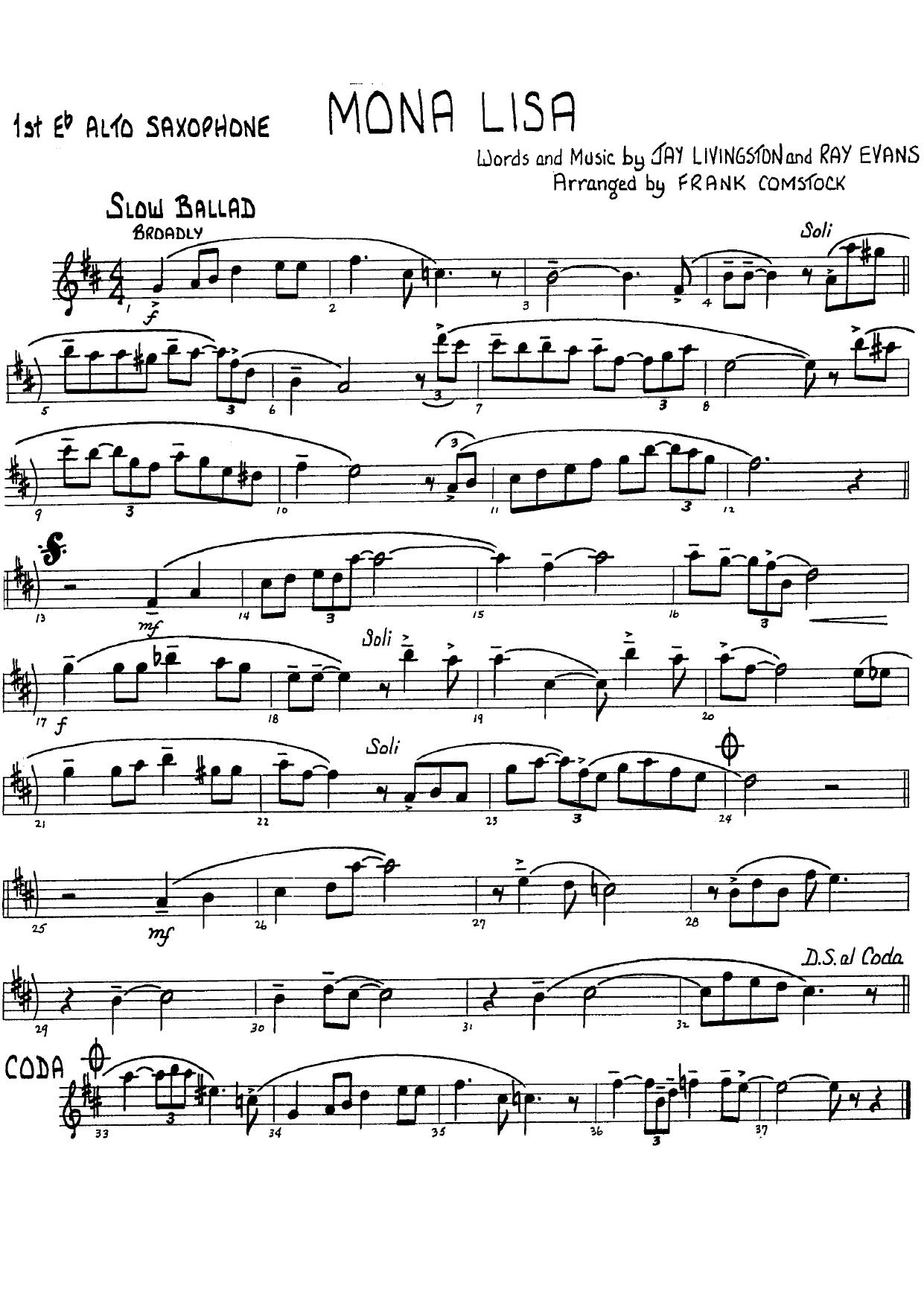
Mona Liza (F.Comstock) sheet music preview

Mona Liza (F.Comstock)

Composed by Jay Livingston

Arranged by Frank Comstock

  • Ensemble: Big Band
  • Pages: 21
  • Instruments (15): 1st Eb Alto Saxophone, 2nd Eb Alto Saxophone, 1st Bb Tenor Saxophone, 2nd Bb Tenor Saxophone (Optional), Eb Baritone Saxophone (Optional), 1st Bb Trumpet, 2nd Bb Trumpet, 3rd Bb Trumpet (Optional), 1st Trombone, 2nd Trombone (Optional), 3rd Trombone (Optional), Piano, Guitar, Bass, Drums
  • Difficulty: medium
  • Content: Individual Parts
  • Format: PDF Download (Instant)
  • Price: $24.99

Jay Livingston and Ray Evans penned "Mona Lisa" in 1950 for the Paramount Pictures film *Captain Carey, U.S.A.*, capturing an Academy Award for Best Original Song. While Nat King Cole’s iconic vocal recording permanently etched the melody into the American songbook, the tune's sophisticated harmonic framework quickly attracted the attention of jazz instrumental arrangers. Emerging from the post-war transition era where lush cinematic orchestration met the emerging cool and West Coast jazz movements, the composition offered a versatile canvas for clever reharmonization and textural exploration. Frank Comstock’s masterful treatment reimagines the classic tune through a sophisticated, mid-century West Coast big band lens. Unfolding at a relaxed, sophisticated medium-swing tempo, the arrangement balances a warm, smoky late-night atmosphere with crisp, inventive counterpoint. Comstock utilizes rich, extended block-chord voicings in the horn sections that evoke the lush harmonic vocabulary of the 1950s studio television and recording scene. The mood shifts fluidly between introspective, lyrical statements of the theme and buoyant, swinging interludes that maintain an undercurrent of elegance and subtle momentum. Comstock’s distinct arranging style shines through the meticulous voice-leading and clever interplay between the rhythm section and the horn tiers. Rather than relying on a heavy, bombastic shout chorus, Comstock constructs a transparent texture where the eight instruments—comprising a tightly knit horn section of alto, tenor, and baritone saxophones, trumpet, and trombone, supported by a full rhythm section—interlock like gears in a fine timepiece. The melody is shared dynamically across the frontline, allowing both the trumpet and alto saxophone to take lead roles while the remaining voices provide lush harmonic cushions and linear counter-melodies. Subtle dynamic shadings, interwoven with crisp articulation contrasts, give the chart its distinctive bounce and harmonic depth. Advanced high school, collegiate, and professional jazz ensembles will find this 21-page arrangement an exceptional vehicle for developing ensemble blend, intonation, and stylistic subtlety. While the individual technical demands avoid breakneck speeds, the true challenge lies in achieving a unified articulation style and maintaining immaculate balance across the compact instrumentation. Performers and audiences alike will appreciate the clever harmonic turnarounds and the elegant pacing of the chart, making it a standout selection for concert programs, festival adjudication, or sophisticated club dates seeking a masterclass in mid-century jazz arranging. Success with Frank Comstock’s arrangement of "Mona Lisa" hinges on achieving a relaxed, unhurried medium-swing feel that avoids rushing the quarter-note pulse. The conductor should emphasize a lightweight, horizontal phrasing approach, ensuring that eighth notes are swung evenly and never pushed into an aggressive bebop triplet feel. Pay close attention to the dynamic markings in the saxophones; the rich, close-position voicings require exceptional intonation and a velvety blend to let the inner voices bloom without masking the lead trumpet or alto. Articulations must be uniform across the entire ensemble, keeping short notes crisp and accented notes full-bodied rather than harsh. Rehearsals should initially isolate the rhythm section to lock in the steady, driving swing groove before layering the horns. Directors should encourage soloists and lead players to emulate the lyrical phrasing of a classic vocal interpretation while maintaining the forward momentum inherent in Comstock's clever harmonic counterlines. Q: What specific instruments and parts are included in this arrangement? A: This chart is scored for an eight-instrument ensemble featuring Alto Saxophone, Tenor Saxophone, Baritone Saxophone, Trumpet, and Trombone, complemented by a complete rhythm section (piano, bass, and drums) spanning 21 total pages of music. Q: What is the difficulty level of this arrangement? A: This arrangement is well-suited for advanced high school, collegiate, and professional jazz ensembles that possess strong reading skills, refined intonation, and the stylistic maturity required for subtle West Coast swing. Q: What is the historical context and musical style of this piece? A: Originally composed by Jay Livingston as an Academy Award-winning song in 1950 and famously popularized by Nat King Cole, this arrangement reinterprets the tune in a sophisticated, mid-century West Coast cool and medium-swing jazz style. Q: What makes Frank Comstock's arrangement unique? A: Comstock stands apart through his use of transparent, intricate harmonic voicings and clever linear counterpoint, favoring a sophisticated, late-night cinematic ambiance over a traditional heavy shout chorus. Q: What is the recommended tempo and performance duration for this arrangement? A: The piece is designed to be performed at a relaxed, steady medium-swing tempo (approximately quarter note = 112–120 BPM), yielding a performance duration of roughly 3 to 4 minutes depending on the chosen phrasing and optional solo extensions.

Questions and answers

What is included in the Mona Liza (F.Comstock) PDF?
The verified current file contains a conductor score and individual parts across 21 pages.
How many instruments or parts are listed for Mona Liza (F.Comstock)?
The verified instrumentation list contains 15 entries for this Big Band arrangement.
Who is credited for Mona Liza (F.Comstock)?
Composer: Jay Livingston. Arranger: Frank Comstock.
What difficulty is listed for Mona Liza (F.Comstock)?
The verified difficulty level is medium.
Can I preview Mona Liza (F.Comstock) before buying?
Yes. The product page provides a preview generated from the current PDF file.
How is Mona Liza (F.Comstock) delivered?
After successful payment, the digital PDF is made available for download. The displayed price is $24.99.

Musicians Also Search For

Mona Liza Frank Comstock PDFMona Liza Frank Comstock sheet musicMona Liza arranged by Frank ComstockFrank Comstock big band chartsFrank Comstock jazz arrangements PDFMona Liza Jay Livingston sheet musicMona Liza Jay Livingston big band arrangementsJay Livingston big band chartsMona Liza big band arrangementsMona Liza big band PDF downloadMona Liza jazz sheet musicbig band sheet music downloadMona Liza conductor score PDFMona Liza individual parts downloadMona Liza sheet music PDFbuy Mona Liza sheet musicdownload Mona Liza PDFMona Liza jazz chartsbest Frank Comstock big band arrangementsJay Livingston arranged by Frank ComstockMona Liza printable sheet musicbig band repertoire PDF

All arrangements by Frank Comstock All Jay Livingston sheet music