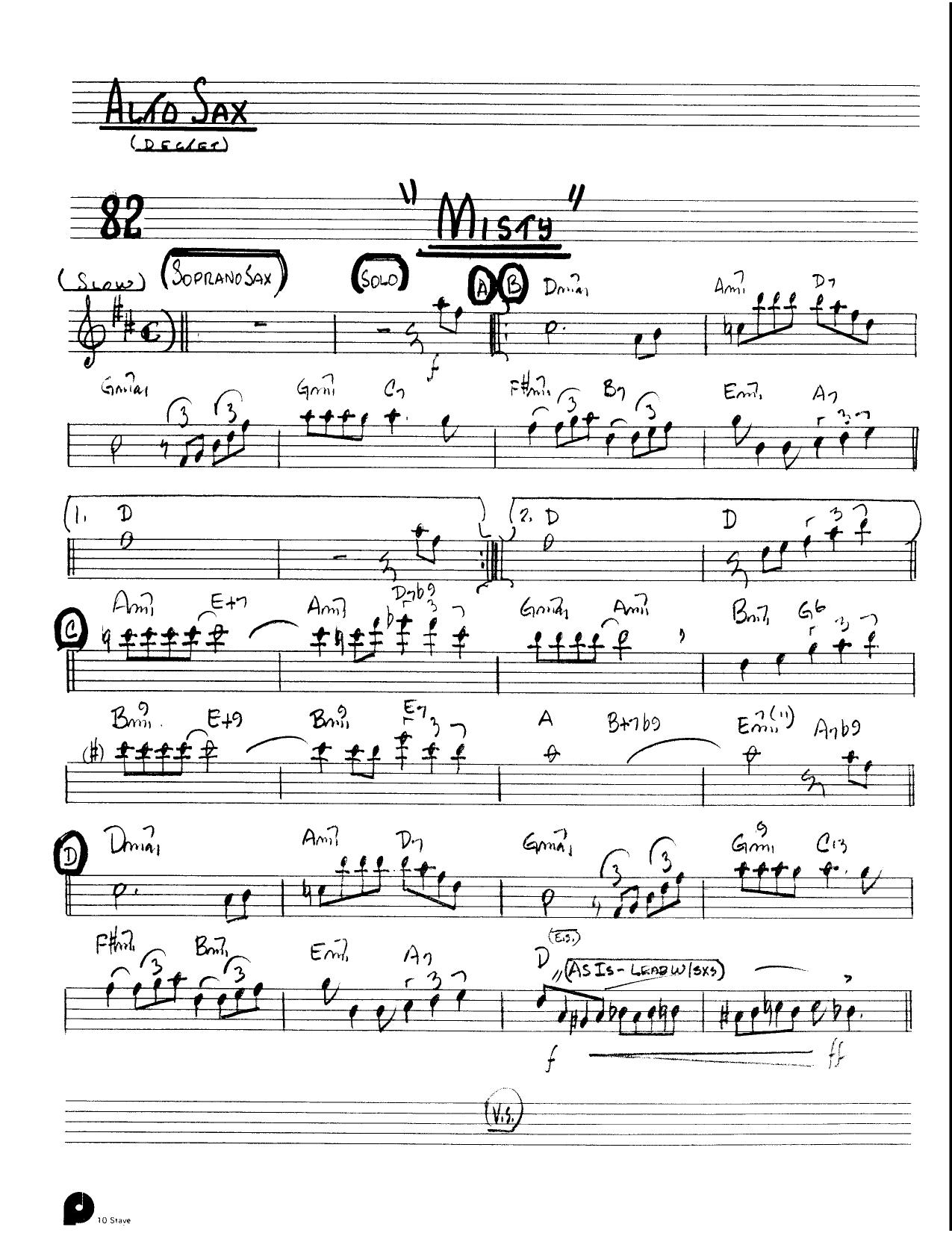
Misty (Kenton Dectet #82)
Composed by Erroll Garner
Arranged by SopSx
- Ensemble: Small Ensemble
- Style: Ballad
- Pages: 18
- Instruments (9): Alto Sax (doubling Soprano Sax), Tenor Sax, Baritone Sax, Trumpet 1, Trumpet 2, Trombone, Piano, Bass, Drums
- Difficulty: easy
- Content: Individual Parts
- Format: PDF Download (Instant)
- Price: $12.99
"Misty," composed by the legendary pianist Erroll Garner in 1954, stands as one of the most cherished and enduring jazz ballads of all time. Originally conceived as an instrumental piece during a flight, reportedly inspired by the clouds, its lyrical, stepwise melody and sophisticated harmonic progression quickly cemented its status as a jazz standard. Garner, known for his distinctive piano style and inability to read or write music, committed the tune to memory before recording it for his 1954 album, *Contrasts*. The addition of lyrics by Johnny Burke in 1955 further propelled its popularity, making it a crossover hit for Johnny Mathis in 1959. "Misty" represents the pinnacle of the post-swing era jazz ballad, showcasing rich harmonies, expressive melodic lines, and ample space for improvisation, a tradition embraced by countless jazz luminaries from Sarah Vaughan to Frank Sinatra. Its timeless appeal lies in its romantic mood and its capacity to evoke deep emotional resonance, a hallmark of the jazz ballad style characterized by slow tempos, lyrical phrasing, and emotional nuance. SopSx's arrangement, titled "Misty (Kenton Dectet #82)," reimagines this classic ballad for a small ensemble, drawing inspiration from the lush, yet precise, orchestrations of the Stan Kenton Orchestra's "Adventures in Jazz" era. While the original Kenton recording of "Misty" featured a mellophonium solo, this arrangement by SopSx captures the essence of that distinctive sound world within a more compact instrumentation. The musical character is one of profound lyricism and expressive depth, maintaining the original key of E-flat major, which allows for a warm, resonant timbre across the ensemble. The arrangement unfolds at a slow ballad tempo, emphasizing sustained lines and carefully crafted voicings that highlight the piece's inherent beauty. SopSx's approach to this style typically involves rich, extended harmonies and thoughtful counterpoint, ensuring that each voice contributes meaningfully to the overall texture without overwhelming the delicate nature of the ballad. The arrangement features the iconic melody initially carried by a lead voice, often a saxophone or trumpet, allowing for a clear and poignant presentation of Garner's original theme. Subsequent sections introduce subtle reharmonizations and intricate soli passages, where the ensemble moves together in harmonized lines, creating a cohesive and powerful statement. While specific featured solos are indicated, the flexibility of the small ensemble format allows for different instrumentalists to shine, offering opportunities for expressive improvisation over the familiar AABA form. Technical challenges include maintaining precise intonation and blend within the close voicings, as well as executing the expressive nuances required for a compelling ballad performance. The reward lies in the collective creation of a deeply moving musical experience, where the ensemble's sensitivity and musicality are paramount. This arrangement is ideally suited for college, community, or semi-professional jazz ensembles seeking to explore sophisticated ballad playing within a small, flexible setting. Its detailed scoring and interpretive depth make it a valuable addition to any ensemble's repertoire, fostering both individual expression and collective musicality. This arrangement of "Misty" requires a meticulous approach to blend, balance, and expressive phrasing. The slow ballad tempo (around 60-70 BPM) demands exceptional control and sustained breath support, particularly for wind players. Conductors should emphasize a relaxed, unhurried feel, allowing the harmonic richness to unfold naturally rather than pushing the tempo. Intonation is critical, especially in the close voicings of the soli sections; encourage musicians to listen across the ensemble and adjust pitch constantly. Dynamic contrast should be subtle but present, building gently through phrases and receding gracefully. No special techniques like plunger mutes or extreme effects are explicitly required, allowing the focus to remain on pure tone and lyrical delivery. Rehearsal tips include isolating challenging soli passages to ensure rhythmic precision and harmonic clarity, and encouraging soloists to internalize the melody and harmonic progression deeply to deliver an authentic and heartfelt improvisation. **Q: What instruments are included in this arrangement?** A: This arrangement is scored for a small ensemble (dectet), typically including a saxophone section (e.g., Alto, Tenor, Bari), a brass section (e.g., 2 Trumpets, Trombone), and a rhythm section (Piano, Bass, Drums, Guitar). The specific instrumentation reflects the "Kenton Dectet" style. **Q: What is the difficulty level of "Misty (Kenton Dectet #82)"?** A: This arrangement is considered medium-advanced, suitable for college, advanced high school, community, or semi-professional jazz ensembles. It requires strong instrumental proficiency, advanced harmonic understanding, and a developed sense of musicality for expressive ballad playing. **Q: What is the musical style and historical context of this arrangement?** A: This is a jazz ballad arrangement of Erroll Garner's "Misty," a classic jazz standard composed in 1954. SopSx's treatment draws inspiration from the sophisticated, lush orchestrations characteristic of the Stan Kenton Orchestra's small group recordings, placing it firmly within the post-swing, modern jazz ballad tradition. **Q: What makes SopSx's arrangement of "Misty" unique?** A: SopSx's arrangement distinguishes itself through its intricate voicings, rich harmonic language, and thoughtful soli sections that evoke the Stan Kenton sound within a small ensemble format. It offers a fresh yet respectful interpretation of a beloved standard, providing both challenge and reward for performers. **Q: What is the typical performance duration and tempo for this piece?** A: As a slow ballad, the performance duration typically ranges from 4 to 6 minutes, depending on the length of improvised solos. The tempo should be maintained at a relaxed and expressive pace, generally between 60-70 beats per minute.
Questions and answers
- What is included in the Misty (Kenton Dectet #82) PDF?
- The verified current file contains individual parts across 18 pages.
- How many instruments or parts are listed for Misty (Kenton Dectet #82)?
- The verified instrumentation list contains 9 entries for this Small Ensemble arrangement.
- Who is credited for Misty (Kenton Dectet #82)?
- Composer: Erroll Garner. Arranger: SopSx.
- What difficulty is listed for Misty (Kenton Dectet #82)?
- The verified difficulty level is easy.
- What style is listed for Misty (Kenton Dectet #82)?
- The catalog lists the style as Ballad.
- Can I preview Misty (Kenton Dectet #82) before buying?
- Yes. The product page provides a preview generated from the current PDF file.
- How is Misty (Kenton Dectet #82) delivered?
- After successful payment, the digital PDF is made available for download. The displayed price is $12.99.
Musicians Also Search For
Misty SopSx PDF • Misty SopSx sheet music • Misty arranged by SopSx • SopSx small ensemble charts • SopSx jazz arrangements PDF • Misty Erroll Garner sheet music • Misty Erroll Garner small ensemble arrangements • Erroll Garner small ensemble charts • Misty small ensemble arrangements • Misty small ensemble PDF download • Misty jazz sheet music • small ensemble sheet music download • Misty individual parts download • Misty sheet music PDF • Misty Ballad charts • Ballad small ensemble arrangements • buy Misty sheet music • download Misty PDF • Misty jazz charts • best SopSx small ensemble arrangements • Erroll Garner arranged by SopSx • Misty printable sheet music • small ensemble repertoire PDF