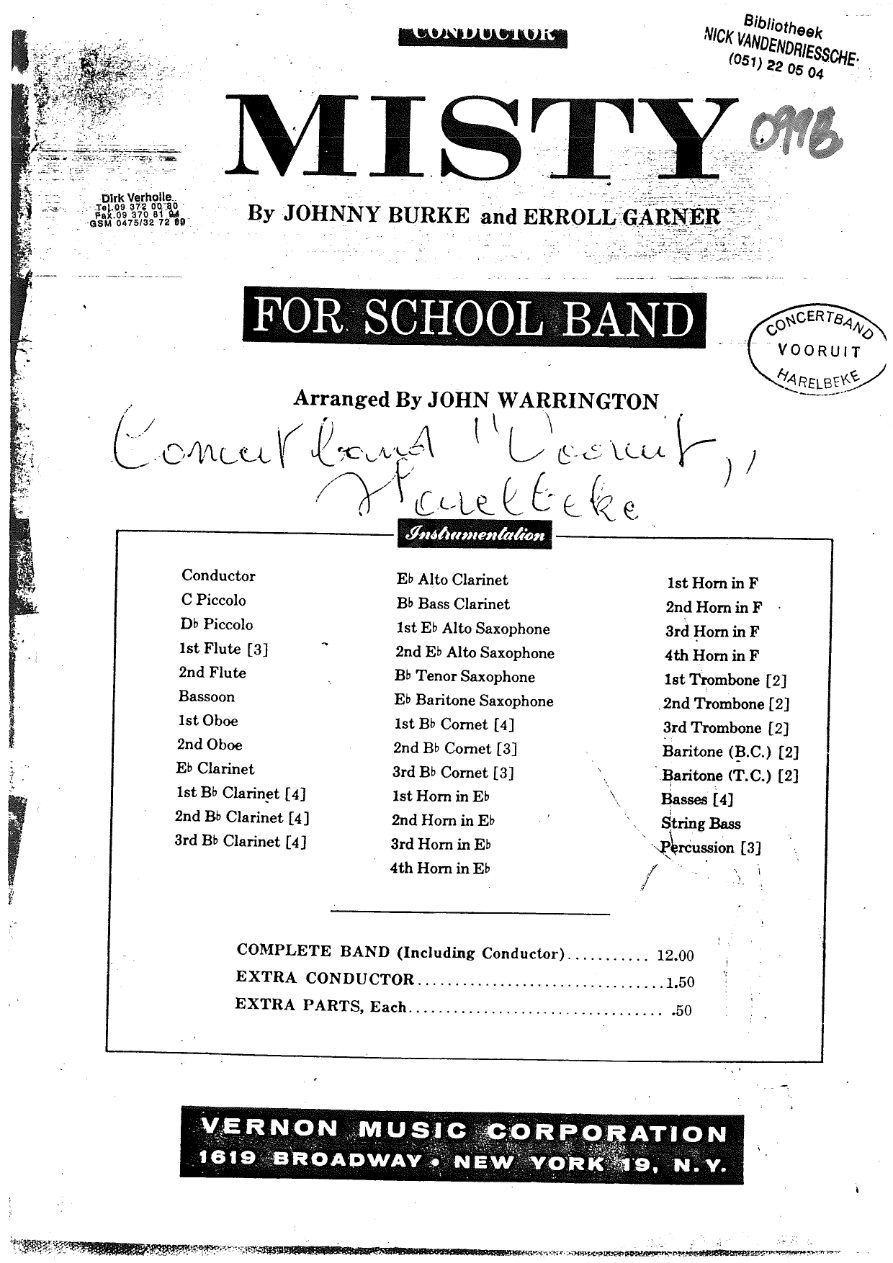
Misty (J.Warrington)
Composed by Erroll Garner
Arranged by Johnny Warrington
- Ensemble: Concert Band
- Style: Ballad
- Pages: 60
- Instruments (35): Db Piccolo, C Piccolo, 1st Flute in C, 2nd Flute in C, 1st Oboe, 2nd Oboe, Bassoon, Eb Clarinet, 1st Bb Clarinet, 2nd Bb Clarinet, 3rd Bb Clarinet, Eb Alto Clarinet, Bb Bass Clarinet, 1st Eb Alto Saxophone, 2nd Eb Alto Saxophone, Bb Tenor Saxophone, Eb Baritone Saxophone, 1st Bb Cornet, 2nd Bb Cornet, 3rd Bb Cornet, 1st Horn in F, 2nd Horn in F, 3rd Horn in F, 4th Horn in F, 1st Horn in Eb, 2nd Horn in Eb, 3rd Horn in Eb, 4th Horn in Eb, Baritone (T.C.), 1st Trombone, 2nd Trombone, 3rd Trombone, Basses, String Bass, Drums
- Difficulty: medium
- Content: Individual Parts
- Format: PDF Download (Instant)
- Price: $22.99
Erroll Garner's iconic ballad, "Misty," composed in 1954, stands as a cornerstone of the jazz repertoire, embodying the lush romanticism and sophisticated harmonic language of the mid-20th century jazz era. Originally an instrumental piano piece, its unforgettable melody and rich chord changes quickly propelled it to jazz standard status. Johnny Burke later added lyrics, further cementing its place in popular culture, most notably through Johnny Mathis's definitive vocal rendition. "Misty" is celebrated for its elegant, flowing melodic lines, often characterized by Garner's signature "four-on-the-floor" left-hand rhythm, creating a sense of gentle propulsion beneath the soaring right-hand improvisations. It evokes a timeless sense of longing, tenderness, and sophisticated beauty, making it a perennial favorite for both performers and audiences. Johnny Warrington's arrangement of "Misty" for concert band masterfully translates the intimate, expressive quality of the original into a full orchestral setting while retaining its essential character. This arrangement is set in the key of E-flat major, providing a warm, resonant timbre well-suited to the concert band's brass and woodwind sections. Warrington, renowned for his ability to craft accessible yet musically rich arrangements, approaches "Misty" with a focus on lush, sustained harmonies and carefully sculpted melodic lines. The tempo is a slow, expressive ballad feel, typically around quarter note = 60-66, emphasizing rubato and lyrical phrasing. The arrangement opens with a delicate woodwind choir presenting the main theme, establishing the tender mood before the full ensemble gradually builds in texture and intensity. Warrington's distinctive arranging style is evident in his intelligent use of voicings, particularly in the brass and saxophone sections, which provide a rich harmonic bed without overpowering the melody. While there isn't a traditional improvised solo section, Warrington features various instrument groups carrying the melody throughout, allowing different sections of the band to shine. The primary melody is passed between alto saxophone, trumpet, and flute, often supported by sustained chords in the low brass and clarinets. There are moments of subtle counterpoint and dynamic swells that enhance the emotional arc of the piece. The technical challenges lie primarily in achieving a unified, expressive legato, precise intonation within sustained chords, and maintaining a consistent, flowing ballad tempo with appropriate rubato. The reward for performers is the opportunity to delve into deep musical expression and deliver a beloved standard with the full, resonant sound of a concert band. This arrangement is ideally suited for high school, college, and community concert bands seeking a sophisticated yet approachable ballad that showcases their lyrical capabilities. Conductors should emphasize a unified, expressive legato throughout this arrangement, particularly in the melodic lines and sustained harmonic passages. The tempo should be a slow, deliberate ballad, around quarter note = 60-66, allowing ample space for phrasing and dynamic nuance. Encourage musicians to listen across sections for blend and balance, ensuring that the melody always sings above the accompaniment. Intonation within sustained chords, especially in the brass and woodwind choirs, is paramount; consider slow, sectional rehearsals for these moments. Dynamics should be carefully observed, with smooth crescendos and decrescendos to build and release tension. While no special techniques like plunger mutes or falls are explicitly notated, encourage a warm, vocal-like tone from all wind players. Rehearsal time should also focus on rhythmic precision in the accompaniment figures, ensuring they support rather than detract from the flowing melody. Q: What instruments and parts are included in the "Misty (J.Warrington)" concert band arrangement? A: This comprehensive arrangement includes a full set of parts for standard concert band instrumentation, typically encompassing flutes, oboe, bassoon, clarinets (Bb, Alto, Bass), alto/tenor/baritone saxophones, trumpets, French horns, trombones, euphonium, tuba, and percussion (including timpani and mallet instruments). Q: What is the difficulty level of this arrangement? A: This arrangement is rated as Medium-Easy to Medium. While harmonically rich, the technical demands are moderate, focusing more on expressive playing, blend, intonation, and lyrical phrasing rather than rapid technical passages. It is suitable for advanced high school, college, and community concert bands. Q: What musical style and historical context does this arrangement represent? A: This arrangement captures the essence of a classic jazz ballad from the mid-20th century, specifically Erroll Garner's "Misty" (1954). It embodies a lush, romantic, and harmonically sophisticated style characteristic of the era's popular jazz standards. Q: What makes Johnny Warrington's arrangement of "Misty" unique for concert band? A: Warrington's signature approach lies in his ability to translate the intimate piano ballad to a full concert band with lush, accessible voicings. He skillfully passes the melody among various sections, creating a rich texture that highlights the band's full expressive range while maintaining the original's tender, flowing character. Q: What is the typical performance duration and tempo for this piece? A: The typical performance duration for this arrangement is approximately 3:30 to 4:00 minutes. It should be performed at a slow, expressive ballad tempo, generally around quarter note = 60-66, allowing for rubato and lyrical phrasing.
Questions and answers
- What is included in the Misty (J.Warrington) PDF?
- The verified current file contains a conductor score and individual parts across 60 pages.
- How many instruments or parts are listed for Misty (J.Warrington)?
- The verified instrumentation list contains 35 entries for this Concert Band arrangement.
- Who is credited for Misty (J.Warrington)?
- Composer: Erroll Garner. Arranger: Johnny Warrington.
- What difficulty is listed for Misty (J.Warrington)?
- The verified difficulty level is medium.
- What style is listed for Misty (J.Warrington)?
- The catalog lists the style as Ballad.
- Can I preview Misty (J.Warrington) before buying?
- Yes. The product page provides a preview generated from the current PDF file.
- How is Misty (J.Warrington) delivered?
- After successful payment, the digital PDF is made available for download. The displayed price is $22.99.
Musicians Also Search For
Misty Johnny Warrington PDF • Misty Johnny Warrington sheet music • Misty arranged by Johnny Warrington • Johnny Warrington concert band charts • Johnny Warrington jazz arrangements PDF • Misty Erroll Garner sheet music • Misty Erroll Garner concert band arrangements • Erroll Garner concert band charts • Misty concert band arrangements • Misty concert band PDF download • Misty jazz sheet music • concert band sheet music download • Misty conductor score PDF • Misty individual parts download • Misty sheet music PDF • Misty Ballad charts • Ballad concert band arrangements • buy Misty sheet music • download Misty PDF • Misty jazz charts • best Johnny Warrington concert band arrangements • Erroll Garner arranged by Johnny Warrington • Misty printable sheet music • concert band repertoire PDF