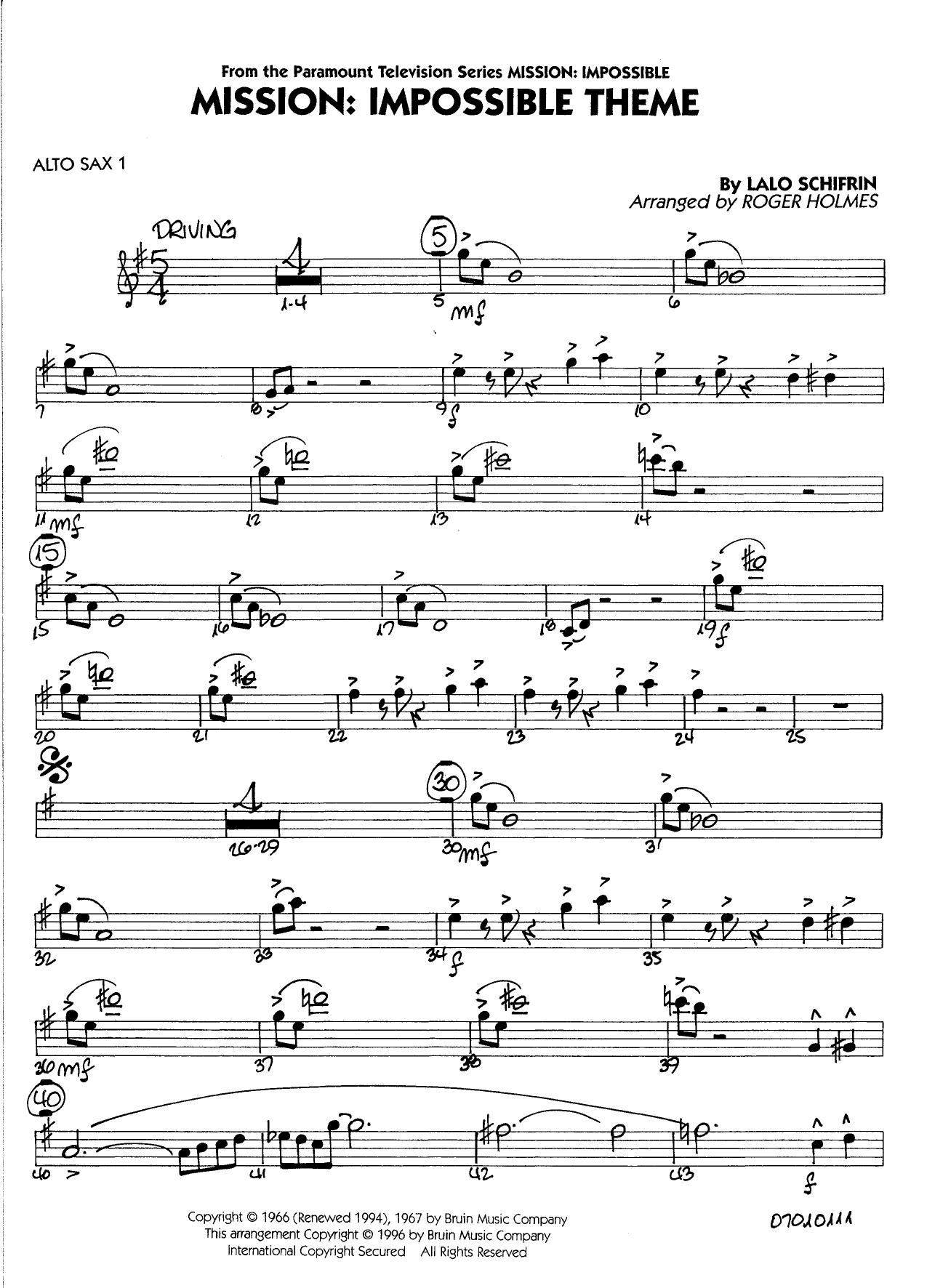
Mission Impossible (L.Schifrin) sheet music preview

Mission Impossible (L.Schifrin)

Composed by Lalo Schifrin

Arranged by L.Schifrin

  • Ensemble: Big Band
  • Style: Jazz Standard
  • Pages: 38
  • Instruments (18): Alto Sax 1, Alto Sax 2, Tenor Sax 1, Tenor Sax 2, Baritone Sax, Trumpet 1, Trumpet 2, Trumpet 3, Trumpet 4, Trombone 1, Trombone 2, Trombone 3, Trombone 4, Guitar, Bass, Drums, Aux. Percussion, Piano
  • Difficulty: medium
  • Content: Individual Parts
  • Format: PDF Download (Instant)
  • Price: $24.99

Lalo Schifrin’s iconic television theme, originally composed in 1966 for the groundbreaking spy-fi series *Mission: Impossible*, stands as one of the most brilliant fusions of cinematic tension and jazz-funk groove in media history. Built around an audacious and hypnotic 5/4 meter, Schifrin’s creation transcended the small screen to become a staple of the jazz and lounge repertoires, famously reinterpreted by artists like Lalo Schifrin himself, Quincy Jones, and the Clayton-Hamilton Jazz Orchestra. This arrangement captures the unmistakable cinematic pulse of the original masterwork, translating its high-stakes atmosphere into a hard-hitting big band format that immediately commands the listener's attention through relentless momentum and sophisticated rhythmic displacement. Propelled by a driving, suspenseful Afro-Cuban 6/8 and shifting 5/4 hybrid groove, this chart crackles with palpable urgency and cool, calculating energy. The arrangement opens with the unmistakable bassline pulse and syncopated percussion hits before unleashing the full brass section in tight, biting voicings. The harmonic landscape balances modal jazz tension with sharp, contemporary jazz-rock extensions, evoking a smoky, high-stakes espionage thriller. The mood oscillates between breathless, stealthy anticipation and explosive, brass-heavy crescendos that capture the danger and elegance of mid-century secret agent lore. Schifrin approaches his own composition with a masterclass in dynamic contrast and textural variety, steering clear of monotonous repetition. The arrangement utilizes lush saxophone solis that slink through the altered scale harmonies, contrasted by aggressive, punchy brass counterlines that answer the primary motifs. A meticulously crafted shout chorus builds layer upon layer of rhythmic complexity, utilizing stacked fourths and sharp accents to push the ensemble to its absolute peak before snapping back to the sultry primary theme. The arrangement showcases signature Schifrin devices, including rapid-fire unison lines between the reeds and upper brass, and clever metric modulations that make the asymmetrical time signatures feel entirely natural and danceable. Melodic duties are shared dynamically across the entire ensemble, ensuring that every section—from the anchor baritone saxophone and bass trombone to the soaring lead trumpet—gets a moment in the spotlight. The chart features designated solo space for tenor saxophone and trumpet, inviting improvisers to stretch out over modal vamps that reward both inside-bebop vocabulary and outside chromatic exploration. Technical challenges center primarily on the precise execution of the shifting asymmetric meters and maintaining clean articulation at a brisk tempo, making it an exceptionally rewarding centerpiece for advanced high school, collegiate, and professional big bands looking to electrify an audience. Navigating this arrangement successfully requires absolute rhythmic precision, particularly in handling the signature 5/4 meter. Conductors should ensure the rhythm section anchors the subdivision firmly (typically felt as 3+2 or 2+3), preventing the pulse from rushing during transitional interludes. The tempo should remain brisk and unyielding, maintaining a cool, urgent swagger rather than a frantic dash. Brass players must master crisp, clipped staccatos and controlled falls, while saxophones should focus on seamless, breath-supported legato lines during the unison soli passages. Rehearsal should begin by isolating the rhythm section to lock in the ostinato groove before layering in the horn sections. Pay close attention to dynamic markings: the contrast between the hushed, stealthy background figures and the roaring ensemble tuttis is what creates the cinematic tension central to Schifrin's vision. Q: What instruments and parts are included in this big band arrangement? A: This 18-instrument arrangement includes a full standard big band instrumentation featuring Alto Saxophone 1 & 2, Tenor Saxophone 1 & 2, Baritone Saxophone, Trumpets 1–4, Trombones 1–4, Guitar, Piano, Bass, and Drums, accompanied by a comprehensive 38-page conductor score. Q: What is the difficulty level of this arrangement? A: This chart is graded as advanced, making it ideal for collegiate ensembles, advanced high school jazz bands, and professional community big bands capable of navigating complex syncopation and asymmetric meters. Q: What style and historical context does this arrangement represent? A: It represents the mid-1960s television jazz-funk and cinematic jazz fusion era, capturing the sophisticated espionage aesthetic pioneered by composer Lalo Schifrin. Q: What makes this specific arrangement unique? A: It is arranged by the original composer, Lalo Schifrin, ensuring an authentic treatment that brilliantly balances the iconic 5/4 thematic material with sophisticated big band voicings and dynamic shout choruses. Q: What is the performance duration and recommended tempo feel? A: The arrangement runs approximately 4 to 5 minutes in duration and is performed at an urgent, driving tempo with a persistent, high-energy groove.

Questions and answers

What is included in the Mission Impossible (L.Schifrin) PDF?
The verified current file contains individual parts across 38 pages.
How many instruments or parts are listed for Mission Impossible (L.Schifrin)?
The verified instrumentation list contains 18 entries for this Big Band arrangement.
Who is credited for Mission Impossible (L.Schifrin)?
Composer: Lalo Schifrin. Arranger: L.Schifrin.
What difficulty is listed for Mission Impossible (L.Schifrin)?
The verified difficulty level is medium.
What style is listed for Mission Impossible (L.Schifrin)?
The catalog lists the style as Jazz Standard.
Can I preview Mission Impossible (L.Schifrin) before buying?
Yes. The product page provides a preview generated from the current PDF file.
How is Mission Impossible (L.Schifrin) delivered?
After successful payment, the digital PDF is made available for download. The displayed price is $24.99.

Musicians Also Search For

Mission Impossible L.Schifrin PDFMission Impossible L.Schifrin sheet musicMission Impossible arranged by L.SchifrinL.Schifrin big band chartsL.Schifrin jazz arrangements PDFMission Impossible Lalo Schifrin sheet musicMission Impossible Lalo Schifrin big band arrangementsLalo Schifrin big band chartsMission Impossible big band arrangementsMission Impossible big band PDF downloadMission Impossible jazz sheet musicbig band sheet music downloadMission Impossible individual parts downloadMission Impossible sheet music PDFMission Impossible Jazz Standard chartsJazz Standard big band arrangementsbuy Mission Impossible sheet musicdownload Mission Impossible PDFMission Impossible jazz chartsbest L.Schifrin big band arrangementsLalo Schifrin arranged by L.SchifrinMission Impossible printable sheet musicbig band repertoire PDF

All arrangements by L.Schifrin All Lalo Schifrin sheet music