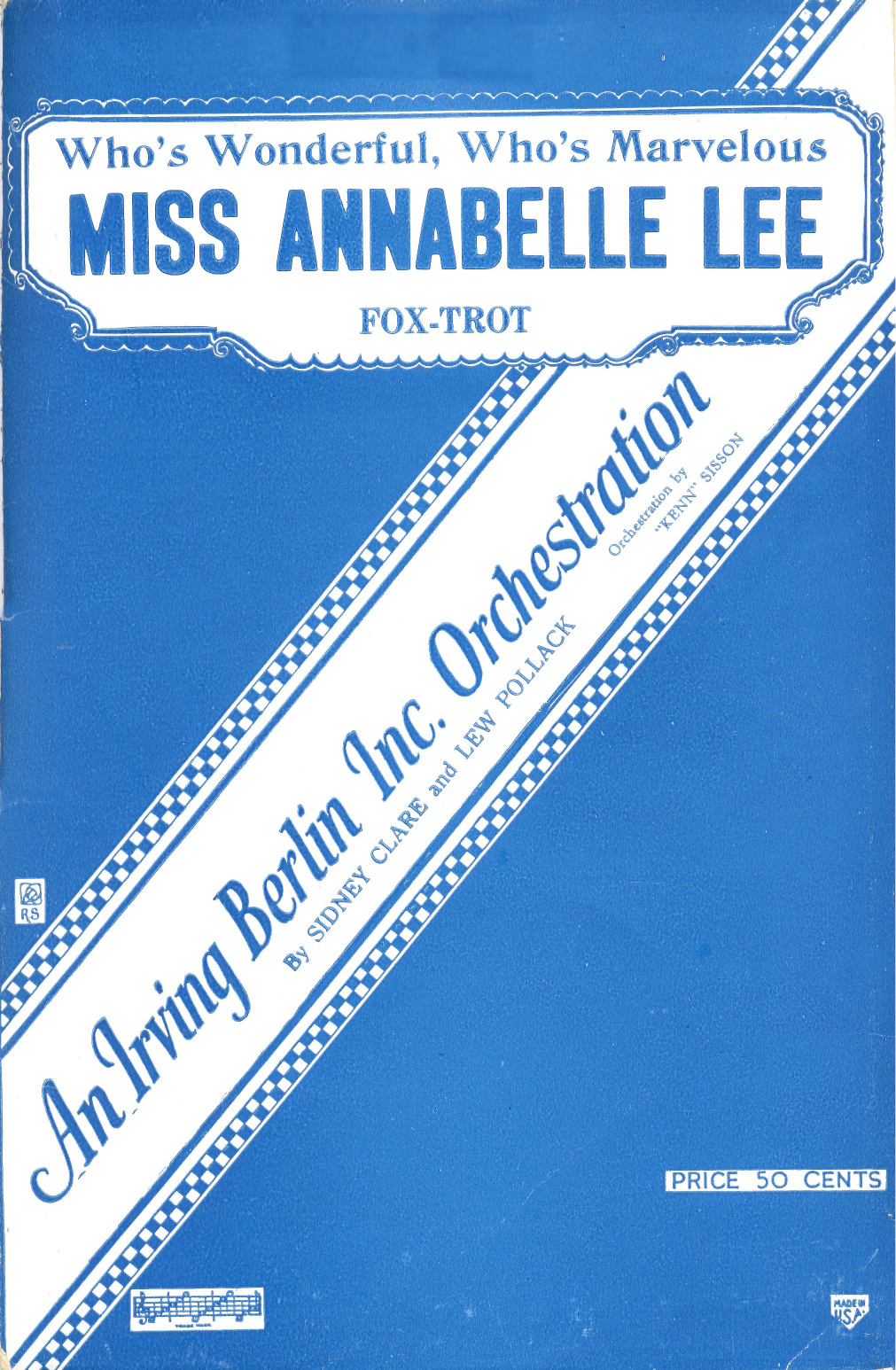
Miss Annabelle Lee (Clare-Pollack)
Composed by Sidney Clare
- Ensemble: Big Band Dance
- Style: Big Band Dance
- Pages: 37
- Instruments (17): 1st Clarinet in Bb, Flute, Horns in F, 1st Saxophone Eb Alto, 2nd Saxophone Bb Tenor, 3rd Saxophone Eb Alto, 1st Trumpet in Bb, 2nd Trumpet in Bb, Trombone, Piano, Bass, Tenor Banjo, Drums, 1st Violin, 2nd Violin, Viola, Cello
- Difficulty: medium
- Content: Individual Parts
- Format: PDF Download (Instant)
- Price: $24.99
"Miss Annabelle Lee," a delightful standard from the Tin Pan Alley era, emerges from the creative partnership of Sidney Clare and Lew Pollack. Originally published in 1927, this tune quickly became a staple of the burgeoning big band and dance orchestra scene, epitomizing the effervescent spirit of the Roaring Twenties. Its infectious melody and lighthearted lyrics captured the imagination of a generation, solidifying its place in the American songbook. While many early dance bands, including those led by Paul Whiteman and Ted Weems, featured the tune, it was the widespread popularity of its sheet music and early recordings that cemented its status as a beloved classic, reflecting the transition from smaller jazz ensembles to the more structured, yet still improvisational, big band sound. This particular arrangement, though by an unknown hand, masterfully captures the essence of the "Big Band Dance" style prevalent in the late 1920s and early 1930s. Set in a bright, medium-up swing tempo, likely around 180-200 BPM, the piece exudes a joyous and sophisticated energy. The arrangement maintains a clear, danceable 4/4 meter throughout, driven by a steady rhythm section foundation. The harmonic language is characteristic of the period, employing diatonic chords with occasional, tasteful extensions that add a touch of color without departing from the era's melodic focus. The overall mood is one of buoyant optimism and elegant fun, perfectly suited for a ballroom or a lively concert setting. The arranger's approach prioritizes clarity and ensemble cohesion, a hallmark of dance band charts from this period. The melody is predominantly carried by the alto saxophone and trumpet, often in unison or close harmony, creating a bright and articulate lead voice. There are well-crafted soli sections, particularly for the saxophones, which showcase tight ensemble playing and characteristic voicings that lean into the warm, blended sound of the reed section. The trombone provides harmonic support and counter-melodies, often adding a rich, brassy texture. While specific improvised solos are not explicitly notated in this type of arrangement, there are ample opportunities for a skilled pianist to embellish or for the band to feature a soloist over the provided chord changes during repeated sections. Performing this arrangement offers a rewarding journey into the foundational sounds of big band jazz. The technical demands are moderate, focusing more on precise articulation, blend, and rhythmic accuracy rather than extreme ranges or complex harmonic substitutions. The alto saxophone and trumpet parts require a strong sense of melodic phrasing and clear tone, while the rhythm section must maintain a consistent and driving swing feel. The ensemble will find satisfaction in achieving the tight, polished sound necessary for this style, particularly in the soli passages and the full ensemble sections. This arrangement is ideally suited for college-level jazz ensembles, community big bands, or advanced high school groups looking to explore authentic early big band repertoire and develop fundamental ensemble skills in a historically significant context. This arrangement of "Miss Annabelle Lee" thrives on a consistent, medium-up swing feel, ideally around 180-200 BPM. Emphasize a light, buoyant articulation, particularly in the brass, to avoid a heavy or plodding sound. The piano's role is crucial for establishing the rhythmic pulse and harmonic foundation; encourage a stride-like or light swing comping style. For the saxophone soli sections, focus on precise attacks and releases, ensuring a unified sound and blend across the section. The trumpet lead should be clear and melodic, never forced. Pay close attention to dynamics, with subtle swells and diminuendos adding shape to phrases. There are no specific extended techniques required, but a clean, unadorned tone is paramount. Rehearsal time should prioritize rhythmic precision, ensemble balance, and achieving a cohesive, danceable groove. Q: What instruments and parts are included in this arrangement? A: This arrangement includes parts for Alto Saxophone, Tenor Saxophone, Trumpet, Trombone, Piano, Bass, and Drums, totaling 7 instrumental parts. Q: What is the difficulty level of "Miss Annabelle Lee (Clare-Pollack)"? A: This arrangement is considered moderate in difficulty, making it appropriate for college-level jazz ensembles, community big bands, and advanced high school groups. It emphasizes ensemble precision and rhythmic accuracy over extreme technical demands. Q: What musical style and historical context does this arrangement represent? A: This arrangement is firmly rooted in the "Big Band Dance" style of the late 1920s and early 1930s, reflecting the popular dance orchestra sound of the era, characterized by its bright, medium-up swing feel and melodic clarity. Q: What makes this specific arrangement unique compared to other versions of "Miss Annabelle Lee"? A: This arrangement, while by an unknown arranger, authentically captures the period's sound with well-crafted soli sections, characteristic voicings for a 7-instrument ensemble, and a focus on ensemble cohesion, providing a faithful representation of early big band dance music. Q: What is the typical performance duration and tempo for this piece? A: While variable based on repeats, a typical performance duration would be around 3-4 minutes. The ideal tempo is a bright, medium-up swing, generally ranging from 180 to 200 beats per minute.
Questions and answers
- What is included in the Miss Annabelle Lee (Clare-Pollack) PDF?
- The verified current file contains individual parts across 37 pages.
- How many instruments or parts are listed for Miss Annabelle Lee (Clare-Pollack)?
- The verified instrumentation list contains 17 entries for this Big Band Dance arrangement.
- Who is credited for Miss Annabelle Lee (Clare-Pollack)?
- Composer: Sidney Clare.
- What difficulty is listed for Miss Annabelle Lee (Clare-Pollack)?
- The verified difficulty level is medium.
- What style is listed for Miss Annabelle Lee (Clare-Pollack)?
- The catalog lists the style as Big Band Dance.
- Can I preview Miss Annabelle Lee (Clare-Pollack) before buying?
- Yes. The product page provides a preview generated from the current PDF file.
- How is Miss Annabelle Lee (Clare-Pollack) delivered?
- After successful payment, the digital PDF is made available for download. The displayed price is $24.99.
Musicians Also Search For
Miss Annabelle Lee Sidney Clare sheet music • Miss Annabelle Lee Sidney Clare big band dance arrangements • Sidney Clare big band dance charts • Miss Annabelle Lee big band dance arrangements • Miss Annabelle Lee big band dance PDF download • Miss Annabelle Lee jazz sheet music • big band dance sheet music download • Miss Annabelle Lee individual parts download • Miss Annabelle Lee sheet music PDF • Miss Annabelle Lee Big Band Dance charts • Big Band Dance big band dance arrangements • buy Miss Annabelle Lee sheet music • download Miss Annabelle Lee PDF • Miss Annabelle Lee jazz charts • Miss Annabelle Lee printable sheet music • big band dance repertoire PDF