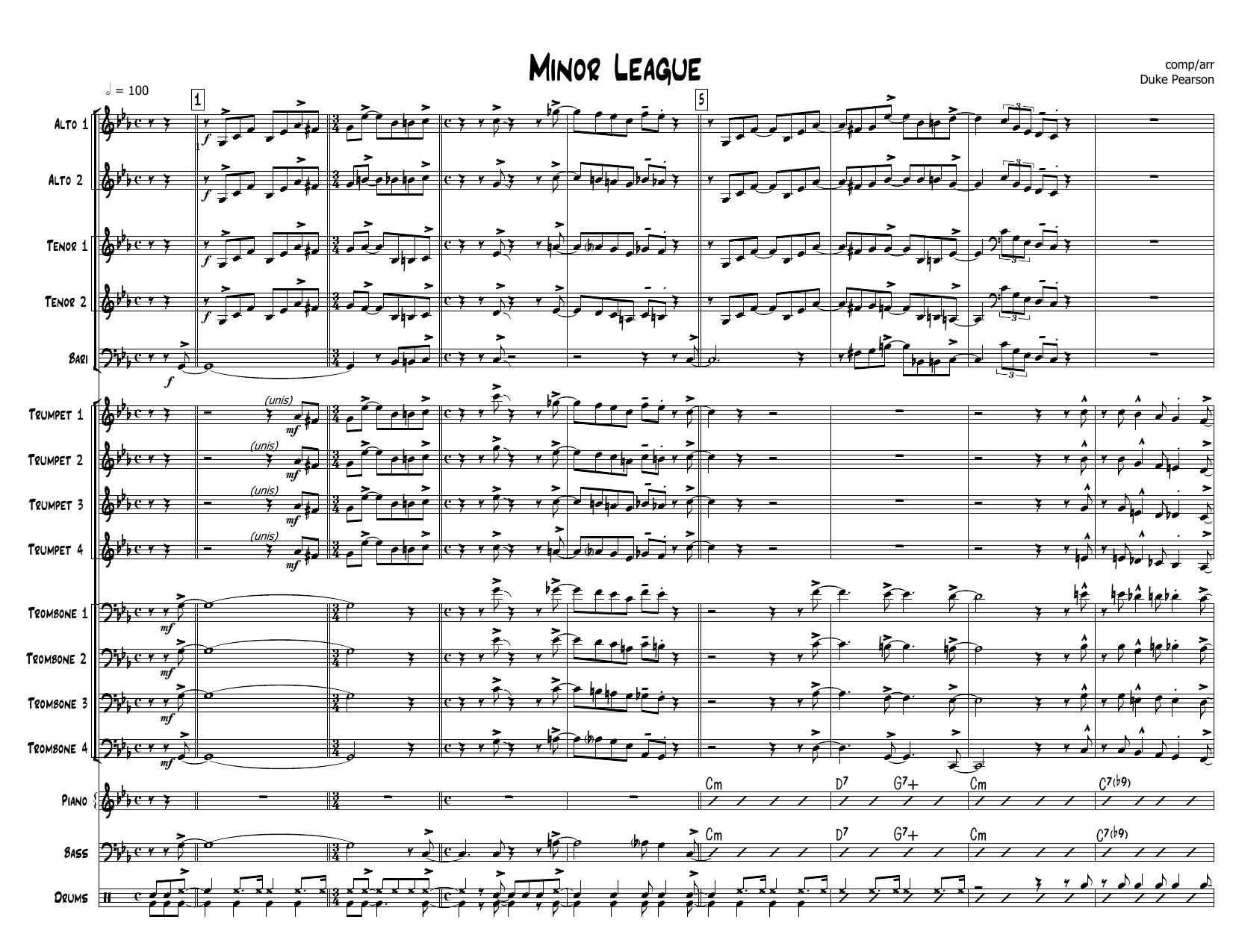
Minor League (D.Pearson)
Composed by D. Pearson
Arranged by D.Pearson
- Ensemble: Big Band
- Style: Jazz Standard
- Pages: 109
- Instruments (17): Alto Saxophone 1, Alto Saxophone 2, Tenor Saxophone 1, Tenor Saxophone 2, Baritone Saxophone, Trumpet 1, Trumpet 2, Trumpet 3, Trumpet 4, Trombone 1, Trombone 2, Trombone 3, Trombone 4, Piano, Guitar, Bass, Drums
- Difficulty: advanced
- Content: Individual Parts
- Format: PDF Download (Instant)
- Price: $24.99
Originally recorded in 1968 for Blue Note Records on the acclaimed album *Now Hear This*, "Minor League" stands as a premier example of late-1960s big band writing by pianist, composer, and arranger Duke Pearson. Operating at the intersection of hard bop and sophisticated large-ensemble modernism, Pearson’s ensemble featured heavyweights like Pepper Adams, Frank Foster, and Marvin Stamm, capturing an era where traditional swing mechanics were revitalized with contemporary modal colors, sharp harmonic edges, and relentless groove. This publication is meticulously sourced from Pearson’s original manuscript rather than a later transcription, ensuring complete authenticity in every line, dynamic marking, and harmonic cluster. Built upon a driving C minor blues framework, the musical character is defined by an energetic, up-tempo swing feel that demands immense precision and stamina. The mood is tense, sophisticated, and relentlessly swinging, moving between aggressive, punchy brass statements and intricate, winding woodwind lines. Pearson utilizes tight, modern voicings that evoke the cool sophistication of the Blue Note stable while maintaining the fiery propulsion expected of a top-tier big band chart. The interplay between sections creates a dynamic dialogue, where contrasting textures—from sparse, driving rhythm section accompaniment to dense, explosive ensemble tutti passages—keep performers and audiences thoroughly engaged from downbeat to final cutoff. Pearson’s arranging approach on this chart highlights his mastery of color and momentum. Rather than relying on predictable tutti blocks, he deploys inventive sectional interleaving, pitting crisp sax solis against biting, syncopated brass injections. The melodic material is shared fluidly across the ensemble, giving every section a chance to drive the narrative forward. Featured solo space includes structured slots for trombone, alto saxophone, and trumpet, alongside an optional open solo rotation over the C minor blues changes, allowing individual improvisers to stretch out within a sophisticated modern-jazz vocabulary. Tailored specifically for advanced collegiate, community, and professional big bands, this composition serves as an exceptional festival or competition showcase. Technical demands are high, characterized by swift tempos, complex harmonic extensions, and demanding upper-register requirements—including Trumpet 1 ascending to high G and Trombone 1 reaching high C. A rhythm section with a powerhouse, literate drummer is vital to anchor the shifting momentum and maintain the razor-sharp swing feel. Ensembles seeking a rigorous, historically significant, and profoundly rewarding challenge will find this masterwork an unforgettable addition to their repertoire. Conductors should approach "Minor League" with a brisk, authoritative up-tempo swing feel. The rhythm section acts as the primary engine; the drummer must possess exceptional reading skills and time-keeping precision, driving the ensemble without rushing the tempo, particularly during dynamic shifts between roaring shout choruses and restrained background figures. Technically, the primary hurdles lie in the swift execution of bebop-infused lines across the saxophone and brass sections. Ensure that articulation markings—specifically short, accented staccatos and controlled legatos—are uniform across all voices to maintain clarity at high speeds. Brass players must pace their endurance carefully due to the sustained upper-register writing (Lead Trumpet to high G, Lead Trombone to high C). While the original 1968 recording did not feature a guitar, an optional guitar part is provided to help lock in comping rhythm; if utilized, the guitarist should employ crisp, Freddie Green-style quarter-note pulsation or subtle chord fragments that complement the piano rather than cluttering the texture. Rehearsals should initially focus on sectional balance at a reduced tempo, gradually building up metronomic velocity while preserving clean articulation and dynamic contrast. Q: What instruments and parts are included in this big band arrangement? A: This 109-page publication includes a full conductor's score and a complete set of parts for 17 instruments: 2 alto saxophones, 2 tenor saxophones, 1 baritone saxophone (no saxophone doubles), 4 trumpets, 4 trombones (including bass trombone), piano, bass, drums, and an optional guitar part. Q: What is the difficulty level of this chart? A: This is an advanced (Grade 5) chart intended for collegiate, professional, or advanced high school big bands capable of handling demanding technical passages and extended brass ranges. Q: What is the musical style and historical background of the piece? A: Composed and arranged by Duke Pearson, "Minor League" is an up-tempo C minor blues that represents the sophisticated hard-bop big band sound popularized on Blue Note Records during the late 1960s. Q: What makes this specific edition unique compared to other big band charts? A: This arrangement is engraved directly from Duke Pearson's original autograph manuscript rather than being a secondary transcription, ensuring absolute authenticity to the historic 1968 Blue Note recording. Q: What are the solo and duration details for this arrangement? A: The chart features written or open solo opportunities for trombone, alto saxophone, and trumpet over a C minor blues progression, set at a brisk up-tempo swing groove.
Questions and answers
- What is included in the Minor League (D.Pearson) PDF?
- The verified current file contains a conductor score and individual parts across 109 pages.
- How many instruments or parts are listed for Minor League (D.Pearson)?
- The verified instrumentation list contains 17 entries for this Big Band arrangement.
- Who is credited for Minor League (D.Pearson)?
- Composer: D. Pearson. Arranger: D.Pearson.
- What difficulty is listed for Minor League (D.Pearson)?
- The verified difficulty level is advanced.
- What style is listed for Minor League (D.Pearson)?
- The catalog lists the style as Jazz Standard.
- Can I preview Minor League (D.Pearson) before buying?
- Yes. The product page provides a preview generated from the current PDF file.
- How is Minor League (D.Pearson) delivered?
- After successful payment, the digital PDF is made available for download. The displayed price is $24.99.
Musicians Also Search For
Minor League D.Pearson PDF • Minor League D.Pearson sheet music • Minor League arranged by D.Pearson • D.Pearson big band charts • D.Pearson jazz arrangements PDF • Minor League D. Pearson sheet music • Minor League D. Pearson big band arrangements • D. Pearson big band charts • Minor League big band arrangements • Minor League big band PDF download • Minor League jazz sheet music • big band sheet music download • Minor League conductor score PDF • Minor League individual parts download • Minor League sheet music PDF • Minor League Jazz Standard charts • Jazz Standard big band arrangements • buy Minor League sheet music • download Minor League PDF • Minor League jazz charts • best D.Pearson big band arrangements • D. Pearson arranged by D.Pearson • Minor League printable sheet music • big band repertoire PDF