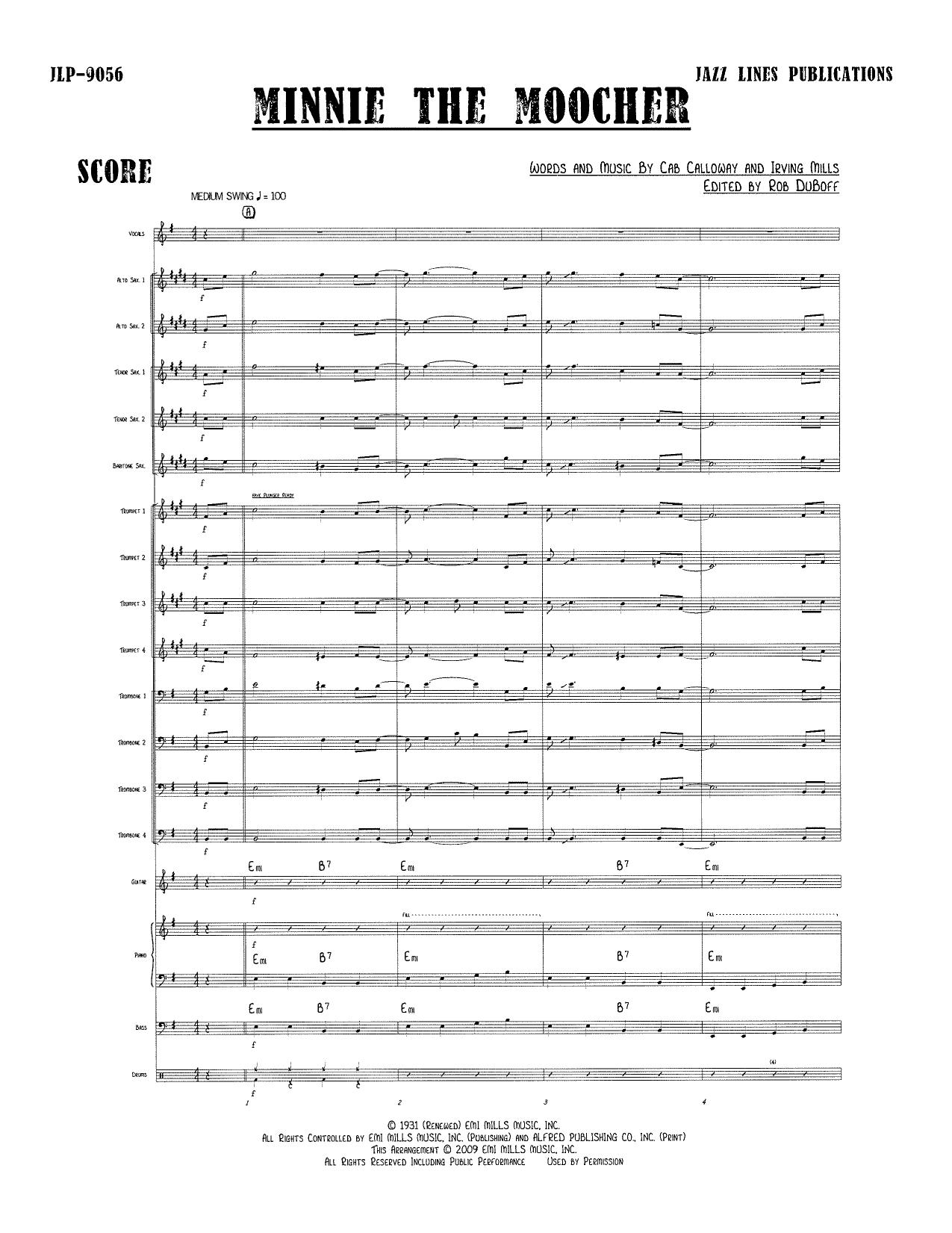
Minnie the Moocher (R.DuBoff)
Composed by Cab Calloway
Arranged by R.DuBoff
- Ensemble: Big Band
- Style: Jazz Standard
- Pages: 76
- Instruments (18): Vocals, Alto Saxophone 1, Alto Saxophone 2, Tenor Saxophone 1, Tenor Saxophone 2, Baritone Saxophone, Trumpet 1, Trumpet 2, Trumpet 3, Trumpet 4, Trombone 1, Trombone 2, Trombone 3, Trombone 4, Guitar, Piano, Bass, Drums
- Difficulty: advanced
- Content: Individual Parts
- Format: PDF Download (Instant)
- Price: $24.99
Cab Calloway’s iconic 1931 signature tune "Minnie the Moocher" stands as a monumental pillar of Harlem’s golden age of jazz, forever immortalized by its infectious call-and-response "hi-de-ho" choruses and high-energy vaudevillian showmanship. Representing the pinnacle of early big band swing and the vibrant theatricality of the Cotton Club era, this timeless novelty standard bridges the gap between classic hot jazz and crowd-pleasing entertainment. The composition remains celebrated for its minor-key vamp, driving rhythm section pulse, and cheeky narrative detailing the exploits of the titular heroine and her romantic entanglement with "Smokey. R.DuBoff’s dynamic big band arrangement captures the wild, unbridled spirit of the original Calloway recording while injecting a crisp, modern vitality suited for contemporary ensembles. Set at a driving, infectious medium-swing tempo in a sultry minor key, the arrangement exudes a mischievous and high-octane mood. The piece opens with the unmistakable ominous bassline vamp before cascading into rich, brass-heavy ensemble hits that evoke the smoky, subterranean atmosphere of a 1930s Harlem speakeasy. The energy builds relentlessly through clever dynamic shifts, teasing the audience before erupting into a roaring, full-ensemble shout chorus that showcases classic swing-era voicings and punchy syncopation. DuBoff meticulously crafts the chart to balance feature moments with tightly integrated ensemble writing. The vocal part—designed for an expressive frontman or dynamic vocalist willing to lean into the theatricality—drives the narrative, complete with ample space for traditional audience call-and-response interaction. The saxophone section enjoys lush, Harlem-style voicings and punchy solis, while the brass section utilizes dramatic plunger mutes, falls, and sharp articulation to replicate that authentic vintage growl. Technical challenges lie primarily in maintaining a relaxed yet intensely driving swing eighth-note feel at a brisk tempo, requiring crisp articulation from the horns and absolute precision from the rhythm section. Advanced high school, collegiate, and professional community big bands will find this arrangement an absolute showstopper for concert programs, festival sets, and themed vintage dances. Because it relies as much on performance charisma and stylistic integrity as it does on reading proficiency, it offers a fantastic pedagogical vehicle for teaching students how to interpret early swing vernacular, stylistic section blending, and stylistic audience engagement. Performers and audiences alike will relish the nostalgic thrill of shouting back the iconic refrains, making this chart an unforgettable centerpiece for any performance. The primary challenge in realizing R.DuBoff’s arrangement of "Minnie the Moocher" lies in sustaining an authentic, buoyant swing feel without letting the tempo drag or rush. Conductors should lock in a persistent, driving medium-swing tempo (around 160–168 BPM) anchored by a steady, pulsing ride cymbal and walking bassline. Brass players must master the use of plunger mutes and cup mutes to achieve the authentic 1930s growl and sass required in the shout choruses, paying close attention to written falls, doits, and ghost notes. The vocalist should be encouraged to interact directly with the band and audience during the call-and-response sections, treating the rhythm section like a flexible theatrical partner. Rehearsals should initially focus on sectional balance—ensuring the rhythm section’s vamp underpins the melody without obscuring the vocalist—before opening up the dynamic range for the climactic ensemble shouts. Q: What instruments and parts are included in this arrangement? A: The 18-instrument big band instrumentation features a dedicated Vocal part, two Alto Saxophones, two Tenor Saxophones, a full complement of brass and rhythm sections, and a comprehensive conductor score spanning 76 total pages. Q: What is the difficulty level of this R.DuBoff chart? A: This arrangement is graded as intermediate to advanced (suitable for strong high school, collegiate, and professional community big bands), primarily due to the stylistic demands of early swing articulation, trumpet/trombone plunger technique, and vocal showmanship. Q: What is the historical style and background of this piece? A: Originally made famous by Cab Calloway in 1931, the piece is a quintessential Harlem Renaissance jazz standard rooted in early big band swing, minor-key vamps, and theatrical call-and-response performance traditions. Q: What makes this specific R.DuBoff arrangement unique? A: It uniquely balances authentic 1930s Cotton Club stylistic elements—such as vintage brass mutes and vocal interaction—with crisp, contemporary big band scoring and a high-energy shout chorus that modernizes the chart for today's stages. Q: What is the recommended performance duration and tempo for this arrangement? A: The piece is designed to be performed at a driving medium-swing tempo of approximately 160 to 168 BPM, with a typical performance duration of around 3 to 4 minutes depending on the length of the vocal call-and-response segments.
Questions and answers
- What is included in the Minnie the Moocher (R.DuBoff) PDF?
- The verified current file contains a conductor score and individual parts across 76 pages.
- How many instruments or parts are listed for Minnie the Moocher (R.DuBoff)?
- The verified instrumentation list contains 18 entries for this Big Band arrangement.
- Who is credited for Minnie the Moocher (R.DuBoff)?
- Composer: Cab Calloway. Arranger: R.DuBoff.
- What difficulty is listed for Minnie the Moocher (R.DuBoff)?
- The verified difficulty level is advanced.
- What style is listed for Minnie the Moocher (R.DuBoff)?
- The catalog lists the style as Jazz Standard.
- Can I preview Minnie the Moocher (R.DuBoff) before buying?
- Yes. The product page provides a preview generated from the current PDF file.
- How is Minnie the Moocher (R.DuBoff) delivered?
- After successful payment, the digital PDF is made available for download. The displayed price is $24.99.
Musicians Also Search For
Minnie the Moocher R.DuBoff PDF • Minnie the Moocher R.DuBoff sheet music • Minnie the Moocher arranged by R.DuBoff • R.DuBoff big band charts • R.DuBoff jazz arrangements PDF • Minnie the Moocher Cab Calloway sheet music • Minnie the Moocher Cab Calloway big band arrangements • Cab Calloway big band charts • Minnie the Moocher big band arrangements • Minnie the Moocher big band PDF download • Minnie the Moocher jazz sheet music • big band sheet music download • Minnie the Moocher conductor score PDF • Minnie the Moocher individual parts download • Minnie the Moocher sheet music PDF • Minnie the Moocher Jazz Standard charts • Jazz Standard big band arrangements • buy Minnie the Moocher sheet music • download Minnie the Moocher PDF • Minnie the Moocher jazz charts • best R.DuBoff big band arrangements • Cab Calloway arranged by R.DuBoff • Minnie the Moocher printable sheet music • big band repertoire PDF