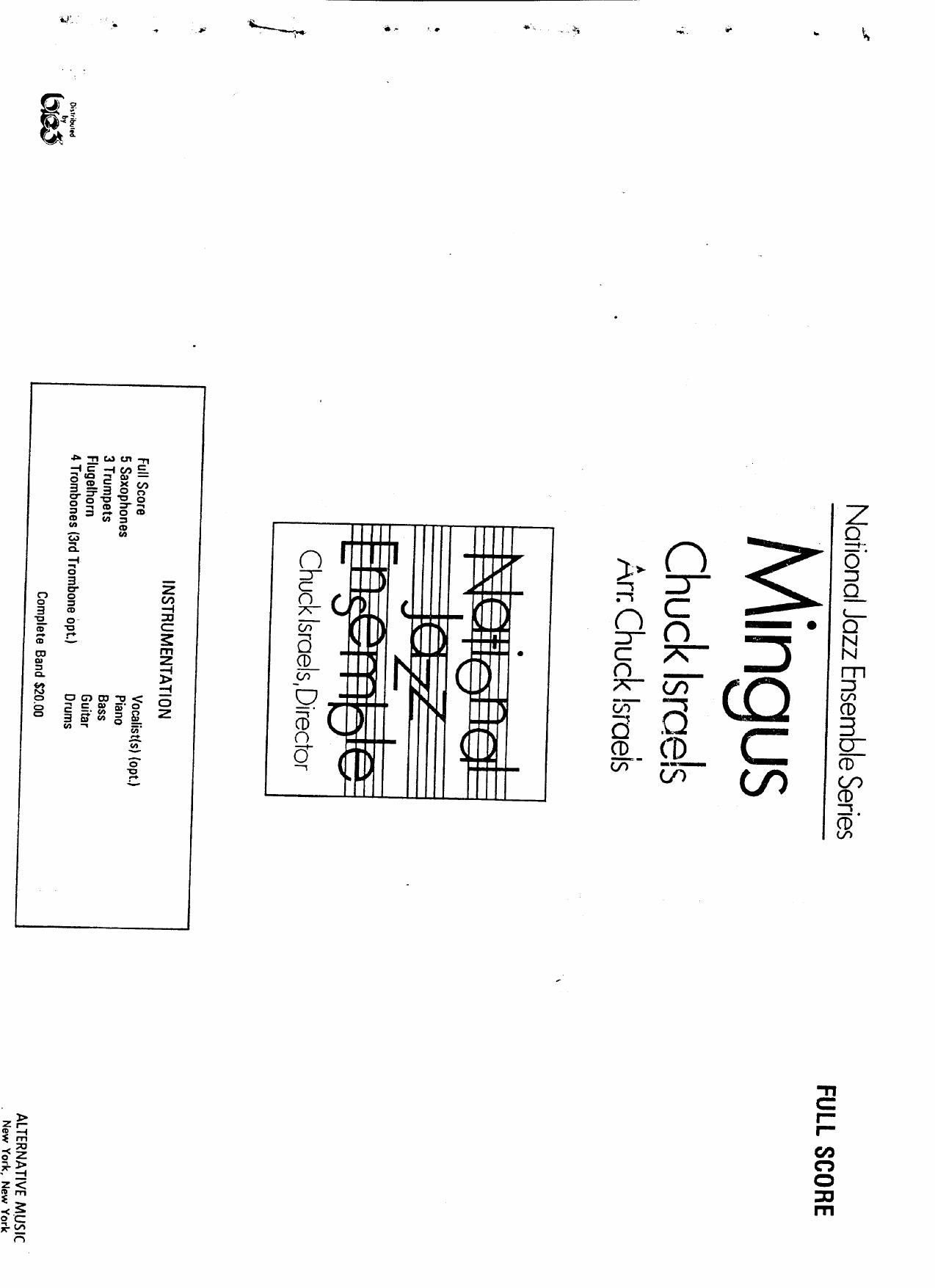
Mingus (C.Israels) sheet music preview

Mingus (C.Israels)

Composed by Chuck Israels

Arranged by Charles Mingus

  • Ensemble: Big Band
  • Pages: 60
  • Instruments (18): 1st Alto Sax, 2nd Alto Sax, 1st Tenor Sax, 2nd Tenor Sax, Baritone Sax, 1st Trumpet, 2nd Trumpet, 3rd Trumpet, Flugelhorn, 1st Trombone, 2nd Trombone, 3rd Trombone (opt.), 4th Trombone (Bass), Piano, Guitar, Bass, Vocalist(s) (opt.), Drums
  • Difficulty: advanced
  • Content: Individual Parts
  • Format: PDF Download (Instant)
  • Price: $24.99

Chuck Israels, renowned deeply for his masterful bass work with the Bill Evans Trio, originally penned this sophisticated composition, which later found a formidable home within the expansive sonic architecture of the Charles Mingus workshop universe. Emerging from the post-bop and avant-garde currents of the 1960s jazz landscape, the piece bridges the gap between structured cool-school counterpoint and the fiery, unbridled emotional intensity characteristic of Mingus's legendary collaborative ensembles. This fusion of Israels' penchant for intricate harmonic movement and Mingus's demand for raw, gut-level expression creates a compelling historical artifact that honors the lineage of modern creative orchestra writing while pushing the boundaries of conventional big band norms. Propelled by an insistent, driving medium-up swing feel in 4/4 time, the music crackles with restless energy, shifting effortlessly between dense, polyphonic horn textures and explosive, blues-drenched climaxes. The harmonic language is rich with extended alterations, minor-mode explorations, and startling chromatic shifts that evoke a mood of urban nocturnal mystery mixed with urgent vitality. Listeners will experience a shifting landscape of tension and release, where melancholic, labyrinthine melodic lines suddenly give way to roaring ensemble unisons that capture the quintessential grit of mid-century modern jazz exploration. In reimagining Israels' thematic material, Charles Mingus applies his signature compositional approach—treating the 8-instrument ensemble not merely as a sectional choir, but as a living, breathing chamber-jazz unit capable of sudden textural mutations. The arrangement relies heavily on interlocking horn counterpoint, overlapping ostinatos, and collective improvisation principles integrated directly into the written arrangement. Rather than relying on standard stock voicings, the writing utilizes tight, dissonant cluster harmonies in the saxophones contrasted against wide, brass-driven intervals in the trumpet and trombone, ensuring a dark, muscular timbre that avoids overly bright or commercial jazz clichés. The front-line melodic duty is shared dynamically across the 8-instrument configuration, with the alto and tenor saxophones frequently carrying the primary thematic weight before handing off intricate counter-lines to the low-end baritone sax and trombone. Solo sections provide ample room for advanced improvisers to stretch out over challenging, shifting modal chord changes, while technical hurdles—such as maintaining clean articulation at rapid tempos and balancing intricate inner-voice countermelodies—demand a high level of listening and intonation from every player. Advanced collegiate, community, and professional jazz ensembles will find this 60-page score an immensely rewarding centerpiece for a concert program, offering a rare window into the collaborative synergy between two towering minds of modern jazz composition. Navigating this arrangement requires an exceptional degree of rhythmic precision and stylistic flexibility from the entire ensemble. The core tempo should settle firmly into a driving medium-up swing, anchored securely by the rhythm section; avoid rushing the turnaround figures, as rhythmic drag will compromise the tension of the dissonant voicings. Conductors must pay close attention to dynamic balance during dense polyphonic passages, ensuring that inner-voice counterlines played by the tenor and baritone saxophones are not overpowered by the brass. Special techniques include controlled fall-offs, subtle plunger effects in the trombone, and targeted use of accent-driven articulation to mimic a loose, workshop-style delivery without sacrificing ensemble cohesion. Rehearsals should begin section-by-section, isolating the complex metric modulations and overlapping thematic entrances before attempting full-ensemble runs, allowing the musicians to internalize the conversational interplay that defines the chart's unique character. Q: What instruments and parts are included in this publication? A: This 60-page arrangement is scored for an 8-instrument ensemble, specifically featuring Alto Saxophone, Tenor Saxophone, Baritone Saxophone, Trumpet, Trombone, and a complete rhythm section framework. Q: What is the overall difficulty level of this arrangement? A: This chart is recommended for advanced high school, collegiate, and professional jazz ensembles due to its complex inner-voice counterpoint, demanding harmonic language, and required rhythmic independence. Q: What is the style and historical context of the music? A: Rooted in the post-bop and avant-garde jazz movements of the 1960s, the piece merges Chuck Israels' sophisticated, cool-inflected harmonic writing with the fiery, blues-drenched intensity of Charles Mingus's workshop ethos. Q: What makes this specific arrangement unique? A: It uniquely combines Israels' penchant for intricate, chamber-like counterpoint with Mingus's signature approach of treating a compact 8-piece ensemble like a massive, dynamic orchestra capable of sudden textural shifts. Q: What is the performance duration and tempo feel of the piece? A: The arrangement is built around an insistent, driving medium-up swing feel in 4/4 time, with a typical performance duration stretching between 6 to 8 minutes depending on the length of the improvised solos.

Questions and answers

What is included in the Mingus (C.Israels) PDF?
The verified current file contains a conductor score and individual parts across 60 pages.
How many instruments or parts are listed for Mingus (C.Israels)?
The verified instrumentation list contains 18 entries for this Big Band arrangement.
Who is credited for Mingus (C.Israels)?
Composer: Chuck Israels. Arranger: Charles Mingus.
What difficulty is listed for Mingus (C.Israels)?
The verified difficulty level is advanced.
Can I preview Mingus (C.Israels) before buying?
Yes. The product page provides a preview generated from the current PDF file.
How is Mingus (C.Israels) delivered?
After successful payment, the digital PDF is made available for download. The displayed price is $24.99.

Musicians Also Search For

Mingus Charles Mingus PDFMingus Charles Mingus sheet musicMingus arranged by Charles MingusCharles Mingus big band chartsCharles Mingus jazz arrangements PDFMingus Chuck Israels sheet musicMingus Chuck Israels big band arrangementsChuck Israels big band chartsMingus big band arrangementsMingus big band PDF downloadMingus jazz sheet musicbig band sheet music downloadMingus conductor score PDFMingus individual parts downloadMingus sheet music PDFbuy Mingus sheet musicdownload Mingus PDFMingus jazz chartsbest Charles Mingus big band arrangementsChuck Israels arranged by Charles MingusMingus printable sheet musicbig band repertoire PDF

All arrangements by Charles Mingus All Chuck Israels sheet music