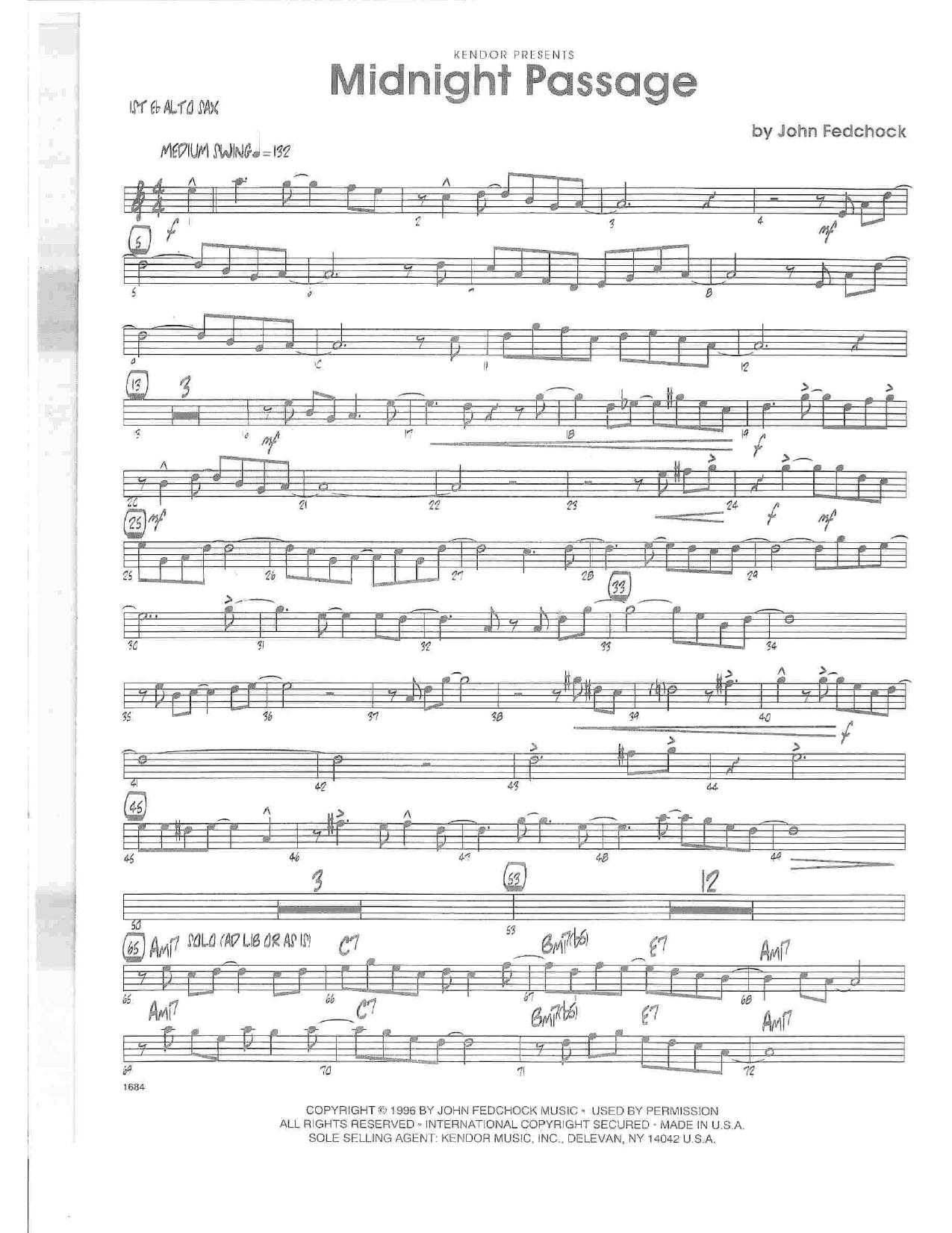
Midnight Passage (J.Fedchock)
Composed by John Fedchock
Arranged by John Fedchock
- Ensemble: Big Band
- Pages: 53
- Instruments (17): 1st Eb Alto Sax, 2nd Eb Alto Sax, 1st Bb Tenor Sax, 2nd Bb Tenor Sax, Eb Baritone Sax, 1st Bb Trumpet, 2nd Bb Trumpet, 3rd Bb Trumpet, 4th Bb Trumpet, 1st Trombone, 2nd Trombone, 3rd Trombone, 4th Trombone, Piano, Guitar, Bass, Drums
- Difficulty: advanced
- Content: Individual Parts
- Format: PDF Download (Instant)
- Price: $24.99
John Fedchock’s "Midnight Passage" stands as a definitive example of modern big band composition, emerging from the vibrant New York jazz scene of the late 20th century. Originally featured on the John Fedchock New York Big Band’s critically acclaimed debut recordings, the piece captures the sophisticated, driving energy of post-bop orchestral jazz. As a trombonist and veteran of the Woody Herman orchestra, Fedchock utilized this composition to bridge the gap between the hard-swinging tradition of the big band era and the more complex, modal harmonic language of the 1990s. It has since become a staple in the contemporary large ensemble repertoire, recognized for its sleek melodic lines and urban atmosphere. The musical character of "Midnight Passage" is defined by a relentless, medium-up swing feel that evokes the nocturnal pulse of a metropolitan landscape. Set primarily in a minor tonality, the piece balances a sense of mystery with high-octane technical displays. The groove is firmly rooted in a 4/4 swing, but it is frequently punctuated by sophisticated rhythmic displacements that challenge the listener’s expectations. The mood is one of controlled intensity, beginning with a deceptive coolness that gradually builds into a towering wall of sound, characteristic of the modern "New York" big band aesthetic. Fedchock’s approach as an arranger is on full display here, particularly his mastery of linear writing and dense, four-part trombone voicings. Unlike traditional block-chord arranging, Fedchock employs independent melodic lines that weave through the sections, creating a rich contrapuntal texture. The shout chorus is a highlight of the score, featuring the high-register brass precision and intricate saxophone solis that have become his signature. His use of extended harmonies—specifically 9ths, 11ths, and 13ths—gives the ensemble a lush, modern sheen without sacrificing the visceral impact of a swinging rhythm section. Performance demands are significant, requiring a cohesive unit capable of navigating rapid-fire ensemble figures and sudden dynamic shifts. While the saxophone section carries much of the initial thematic material, the brass section is tasked with demanding range requirements and rhythmic accuracy. The arrangement typically features extended solo space for tenor saxophone or trombone, allowing for individual expression within the structured framework of the composition. The 53-page conductor score reveals a meticulously organized architecture, where every crescendo and accent is placed to maximize the ensemble’s forward momentum. Due to its technical complexity and the maturity required to execute the rhythmic nuances, this arrangement is best suited for advanced collegiate ensembles and professional big bands. The lead trumpet part demands a strong upper register and consistent endurance, while the rhythm section must maintain a sophisticated, driving swing without rushing the intricate horn lines. For ensembles looking to showcase their precision and command of modern jazz vocabulary, "Midnight Passage" offers an exceptionally rewarding challenge. Navigating "Midnight Passage" requires a primary focus on rhythmic clarity and ensemble "lock." The tempo should be established at a brisk medium-up swing; if the tempo drags, the linear counterpoint in the woodwinds loses its forward motion. Conductors should pay close attention to the articulation of the eighth-note lines, ensuring they are played with a modern "straight-ahead" feel rather than a heavy, old-fashioned shuffle. The brass section must approach the shout chorus with a unified concept of breath support to handle the high tessitura and sustained fortissimo passages. Special attention should be given to the balance of the trombone section, as Fedchock’s voicings are specifically designed to highlight the rich, dark colors of the lower brass. Rehearsal time should be dedicated to the transition points between solo sections and ensemble interludes to ensure the energy remains consistent throughout the performance. Q: What specific instrumentation is required for this arrangement? A: This is a standard 17-piece big band arrangement consisting of 5 Saxophones (2 Altos, 2 Tenors, 1 Baritone), 4 Trumpets, 4 Trombones, and a 4-piece rhythm section (Piano, Bass, Drums, and Guitar). The 53-page score provides detailed parts for each player, ensuring a full, professional orchestral sound. Q: What is the difficulty level of "Midnight Passage"? A: This arrangement is classified as Advanced (Grade 5/6), making it appropriate for professional musicians and high-level university jazz ensembles. The primary challenges include high lead trumpet notes, complex rhythmic unisons, and the need for a sophisticated understanding of modern swing phrasing. Q: How would you describe the musical style and historical context of this piece? A: It is a modern "New York Style" big band swing piece composed and arranged by John Fedchock in the late 20th century. It represents the evolution of the big band tradition, incorporating post-bop harmonies and linear arranging techniques popularized by Fedchock’s own New York Big Band. Q: What makes John Fedchock’s arrangement of this piece unique? A: The uniqueness lies in Fedchock’s "trombonistic" approach to the brass writing and his use of linear counterpoint rather than standard block-chord voicing. The arrangement features a highly developed shout chorus and sophisticated harmonic extensions that provide a more modern, "no-nonsense" sound compared to traditional swing charts. Q: What is the typical performance duration and recommended tempo? A: Depending on the length of the improvised solos, the piece typically lasts between 6 and 8 minutes. It is intended to be performed at a medium-up to up-tempo swing, generally hovering around 200-220 BPM to maintain its characteristic drive and energy.
Questions and answers
- What is included in the Midnight Passage (J.Fedchock) PDF?
- The verified current file contains a conductor score and individual parts across 53 pages.
- How many instruments or parts are listed for Midnight Passage (J.Fedchock)?
- The verified instrumentation list contains 17 entries for this Big Band arrangement.
- Who is credited for Midnight Passage (J.Fedchock)?
- Composer: John Fedchock. Arranger: John Fedchock.
- What difficulty is listed for Midnight Passage (J.Fedchock)?
- The verified difficulty level is advanced.
- Can I preview Midnight Passage (J.Fedchock) before buying?
- Yes. The product page provides a preview generated from the current PDF file.
- How is Midnight Passage (J.Fedchock) delivered?
- After successful payment, the digital PDF is made available for download. The displayed price is $24.99.
Musicians Also Search For
Midnight Passage John Fedchock PDF • Midnight Passage John Fedchock sheet music • Midnight Passage arranged by John Fedchock • John Fedchock big band charts • John Fedchock jazz arrangements PDF • Midnight Passage John Fedchock big band arrangements • Midnight Passage big band arrangements • Midnight Passage big band PDF download • Midnight Passage jazz sheet music • big band sheet music download • Midnight Passage conductor score PDF • Midnight Passage individual parts download • Midnight Passage sheet music PDF • buy Midnight Passage sheet music • download Midnight Passage PDF • Midnight Passage jazz charts • best John Fedchock big band arrangements • Midnight Passage printable sheet music • big band repertoire PDF