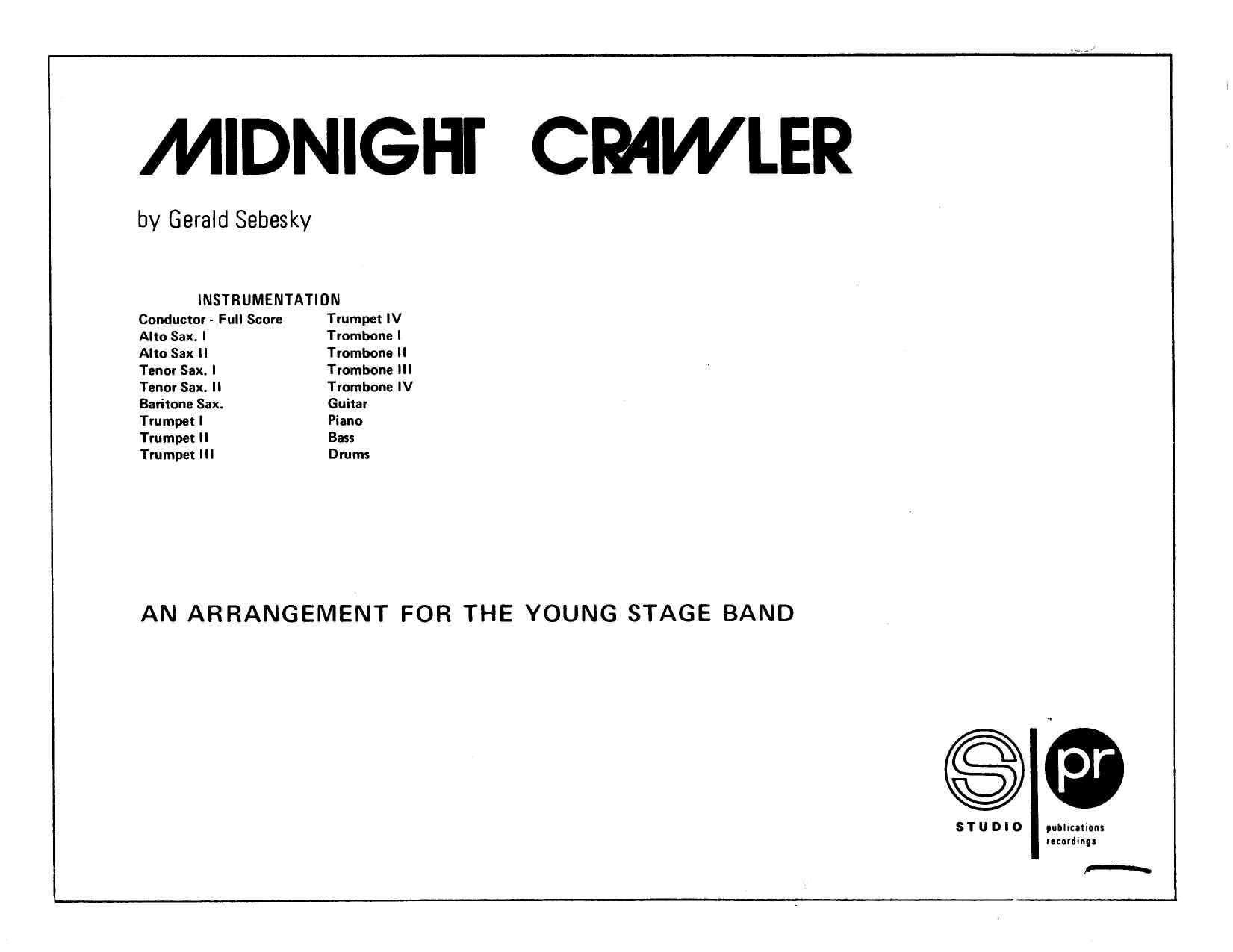
Midnight Crawler (G.Sebesky)
Composed by George Sebesky
Arranged by G.Sebesky
- Ensemble: Big Band
- Style: Jazz Standard
- Pages: 43
- Instruments (17): 1st Alto Saxophone, 2nd Alto Saxophone, 1st Tenor Saxophone, 2nd Tenor Saxophone, Baritone Saxophone, 1st Trumpet, 2nd Trumpet, 3rd Trumpet, 4th Trumpet, 1st Trombone, 2nd Trombone, 3rd Trombone, 4th Trombone, Piano, Bass, Drums, Guitar
- Difficulty: medium
- Content: Individual Parts
- Format: PDF Download (Instant)
- Price: $24.99
Sultry, driving, and sophisticated, "Midnight Crawler," composed and arranged by the esteemed George Sebesky, stands as a masterclass in modern big band writing that bridges classic swing sensibilities with contemporary harmonic color. Emerging from Sebesky’s prolific career as a composer, arranger, and orchestrator who worked across jazz, pop, and classical idioms, this chart captures the nocturnal, cinematic atmosphere characteristic of advanced small-group modal jazz scaled up for a full 17-piece jazz ensemble. Rather than relying on standard stock-chart formulas, the composition utilizes a distinct urban grit, blending infectious, blues-inflected grooves with rich, extended contemporary voicings that challenge the listener's ear while remaining deeply accessible. At its core, "Midnight Crawler" drives forward with a assertive medium-tempo groove, anchored by a muscular bass line and crisp drum-set pocket that evokes late-night city streets. The harmonic landscape is anchored in a minor-key framework, shifting between brooding, atmospheric tension and explosive, brass-heavy releases of energy. The mood shifts seamlessly from moody, whispered unison lines in the lower reeds to soaring, high-octane ensemble shout choruses. Sebesky employs lush chord clusters in the saxophones and biting, muted brass figures to create an enveloping textural depth, generating an emotional arc that moves from stealthy anticipation to triumphant, high-energy release. Sebesky’s distinctive arranging approach shines through the meticulous voice-leading and dynamic interplay between sections. The arrangement bypasses predictable head arrangements in favor of intricate sax solis that demand absolute rhythmic unison and stylistic cohesion, particularly between the two alto and two tenor saxophones. Brass writing utilizes artful colorations—employing cup and basket mutes to alter the timbre during transitional statements before opening up into wide, searing brass blocks. The structural pacing builds organically, featuring a sophisticated development section that allows space for improvised solos over a rolling modal vamp, climaxing in a powerhouse shout chorus that reincorporates the primary thematic material with intensified rhythmic syncopation. Designed with advanced ensembles in mind, this chart is exceptionally well-suited for collegiate jazz ensembles, top-tier high school bands with strong section players, and professional or community big bands looking to elevate their book. The primary technical challenges lie in maintaining a precise, unhurried groove at a medium tempo, executing complex dynamic shifts, and balancing the intricate inner voicings of the brass against the rhythm section. Lead trumpet players will encounter comfortable yet assertive upper-register demands, while the rhythm section must possess a strong internal pulse to sustain the hypnotic, driving momentum. Performing "Midnight Crawler" rewards the ensemble with a sophisticated workout in modern big band style, guaranteeing a memorable, high-impact highlight for any concert program. Conductors should approach "Midnight Crawler" with a focus on rhythmic precision and deep pocket placement, avoiding any tendency to rush the medium-tempo groove. The articulation throughout the chart must be crisp and uniform: short, punchy quarter notes in the brass need to be supported by diaphragm breath rather than tongue clipping, while saxophones should utilize a smooth, linear approach on connected lines. Pay close attention to the dynamic contrast between the stealthy, muted background figures and the sudden open-horn bursts; the ensemble must execute these shifts instantly without distorting the overall balance. For the rhythm section, the pianist should voice chords sparingly, leaning into rootless, upper-structure voicings that complement Sebesky's sophisticated modal harmonies without cluttering the sonic space. The drummer should maintain a steady, unyielding ride cymbal pattern that breathes with the soloists, utilizing subtle cross-stick and snare commentary during the head. Rehearsal time should be divided evenly between isolating the sax soli for intonation and balance, and drilling the transition into the final shout chorus to ensure maximum dynamic impact. Q: What instruments and parts are included in this arrangement? A: The instrumentation comprises a complete 17-piece big band setup: 2 alto saxophones, 2 tenor saxophones, 1 baritone saxophone, 4 trumpets, 4 trombones, guitar, piano, bass, and drums, accompanied by a comprehensive 43-page conductor score. Q: What is the difficulty level of "Midnight Crawler"? A: This arrangement is graded as advanced, making it ideal for collegiate jazz ensembles, professional big bands, and elite high school groups with strong section players and confident soloists. Q: What is the musical style and historical context of the piece? A: Written by George Sebesky, the piece is a contemporary jazz standard-style composition that fuses modal jazz, urban blues, and sophisticated big band arranging traditions reminiscent of late-20th-century studio jazz writing. Q: What makes this specific arrangement unique? A: Sebesky’s chart stands out due to its cinematic, nocturnal atmosphere, intricate sax solis, innovative use of brass mutes for contrasting timbres, and a powerful shout chorus built on extended contemporary harmonies. Q: What is the performance duration and tempo feel of the piece? A: The arrangement is set in a driving, assertive medium-tempo swing/groove, designed to run approximately 4 to 5 minutes depending on the length allotted for improvised solos.
Questions and answers
- What is included in the Midnight Crawler (G.Sebesky) PDF?
- The verified current file contains a conductor score and individual parts across 43 pages.
- How many instruments or parts are listed for Midnight Crawler (G.Sebesky)?
- The verified instrumentation list contains 17 entries for this Big Band arrangement.
- Who is credited for Midnight Crawler (G.Sebesky)?
- Composer: George Sebesky. Arranger: G.Sebesky.
- What difficulty is listed for Midnight Crawler (G.Sebesky)?
- The verified difficulty level is medium.
- What style is listed for Midnight Crawler (G.Sebesky)?
- The catalog lists the style as Jazz Standard.
- Can I preview Midnight Crawler (G.Sebesky) before buying?
- Yes. The product page provides a preview generated from the current PDF file.
- How is Midnight Crawler (G.Sebesky) delivered?
- After successful payment, the digital PDF is made available for download. The displayed price is $24.99.
Musicians Also Search For
Midnight Crawler G.Sebesky PDF • Midnight Crawler G.Sebesky sheet music • Midnight Crawler arranged by G.Sebesky • G.Sebesky big band charts • G.Sebesky jazz arrangements PDF • Midnight Crawler George Sebesky sheet music • Midnight Crawler George Sebesky big band arrangements • George Sebesky big band charts • Midnight Crawler big band arrangements • Midnight Crawler big band PDF download • Midnight Crawler jazz sheet music • big band sheet music download • Midnight Crawler conductor score PDF • Midnight Crawler individual parts download • Midnight Crawler sheet music PDF • Midnight Crawler Jazz Standard charts • Jazz Standard big band arrangements • buy Midnight Crawler sheet music • download Midnight Crawler PDF • Midnight Crawler jazz charts • best G.Sebesky big band arrangements • George Sebesky arranged by G.Sebesky • Midnight Crawler printable sheet music • big band repertoire PDF