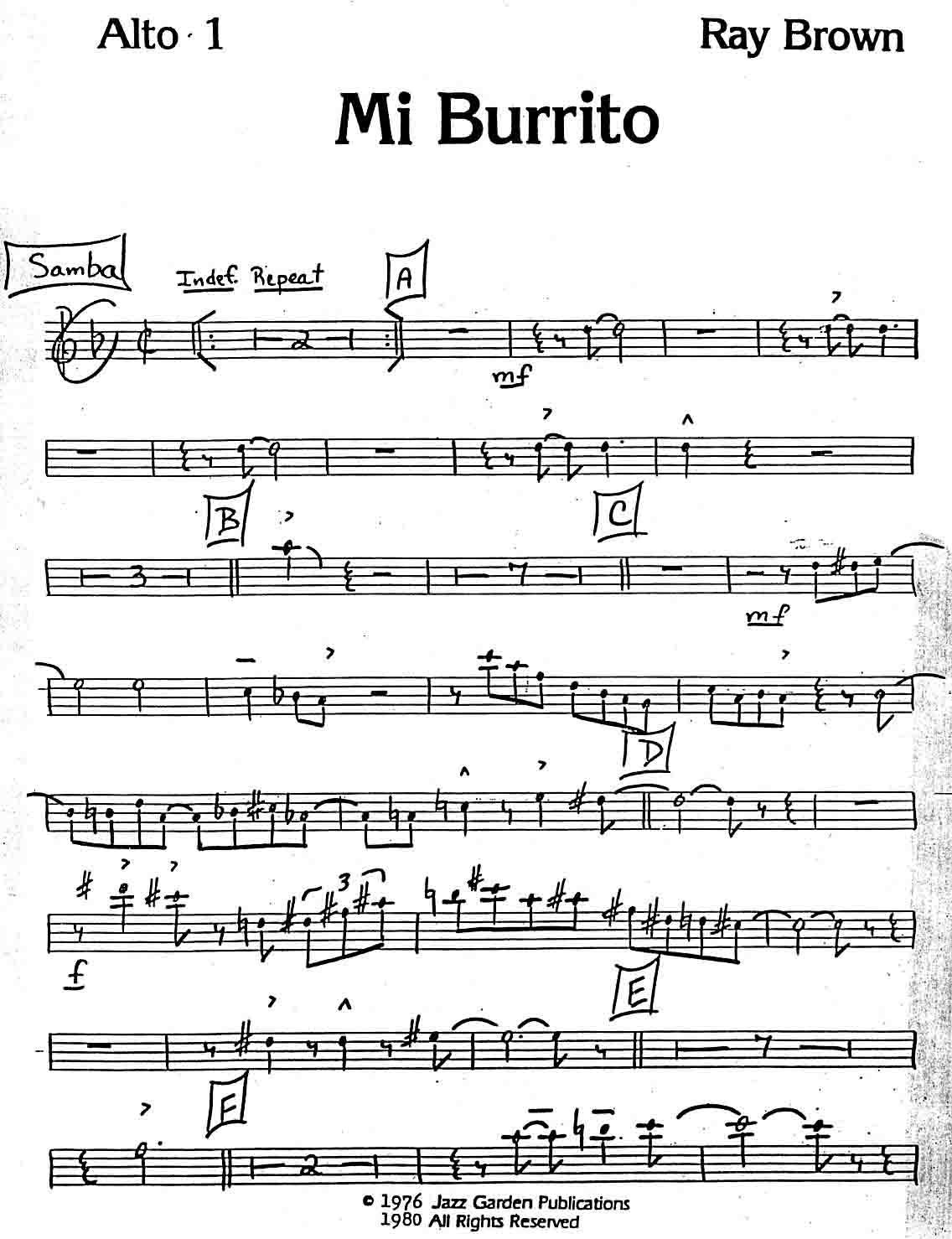
Mi Burrito (R.Brown)
Composed by Ray Brown
Arranged by Ray Brown
- Ensemble: Big Band
- Style: Jazz Standard
- Pages: 72
- Instruments (19): Alto 1, Alto 2, Tenor 1, Tenor 2, Bari, Trumpet 1, Trumpet 2, Trumpet 3, Trumpet 4, Trumpet 5 (Jazz), Trombone 1, Trombone 2, Trombone 3, Trombone 4, Trombone 5 (Bass), Piano, Guitar, Bass, Drums
- Difficulty: advanced
- Content: Individual Parts
- Format: PDF Download (Instant)
- Price: $24.99
Ray Brown’s dynamic big band chart for "Mi Burrito" captures the vibrant intersection of traditional Afro-Cuban rhythmic vitality and sophisticated post-bop jazz harmonisation. Originally conceived within the rich tapestry of modern jazz composition where latin grooves meet swinging horn lines, this piece exemplifies the compositional prowess of a true jazz master. Ray Brown—renowned globally as a foundational pillar of modern jazz bass—brings his innate sense of time, groove, and structural elegance to the arranging pen, translating his deep understanding of small-group interplay into a massive, thunderous orchestral canvas. The composition stands out in the contemporary big band repertoire for its infectious momentum, bridging rhythmic accessibility with harmonic sophistication. Pulsing with an energetic, driving Latin-swing hybrid groove in 4/4 time, "Mi Burrito" establishes an immediate sense of urgency and celebration from the downbeat. The harmonic landscape shifts fluidly between modal vamp sections and rich, extended tertian harmonies, evoking a mood that is simultaneously celebratory, sophisticated, and deeply swinging. The arrangement opens with a rhythmic percussion and bass ostinato before the full brass section enters with punchy, syncopated figures that immediately command attention. The emotional arc moves from tense, rhythmic anticipation during the verse vamps to an overwhelming release of energy in the ensemble climaxes, creating a captivating journey for both performers and listeners alike. Ray Brown’s arranging approach on this chart highlights his trademark preference for strong, linear bass movement underpinning tightly voiced, modern horn chords. Rather than relying on simple background pads, the saxophones and brass engage in intricate counterpoint that mirrors horn-section writing found in classic West Coast and contemporary big band recordings. The chart features a sweeping saxophone soli section that builds in dynamic intensity, leading organically into a powerhouse shout chorus where the full ensemble trades sharp, accented figures against a driving drum groove. Brown skillfully balances thick, five-note brass voicings with transparent, open textures, allowing individual melodic lines to pierce through the ensemble without requiring forced dynamics. Carrying the primary melodic weight, the lead trumpet and alto saxophone sections handle the initial thematic statements with crisp articulation, while designated solo spaces provide ample room for expressive improvisation from the rhythm section and lead horns. Technically, the chart demands strong double-tonguing from the brass, precise stylistic uniformity within the saxophone section, and a rhythm section that can fiercely maintain an authentic Latin-swing pocket. Advanced high school bands with exceptional lead players, as well as collegiate and professional ensembles, will find "Mi Burrito" an exceptionally rewarding centerpiece for festival performances and formal concert programs, offering a masterclass in ensemble blend, rhythmic precision, and stylistic versatility across all 19 parts. Rehearsing "Mi Burrito" successfully requires meticulous attention to the rhythmic interplay between the percussion, piano, and bass, as the entire Latin-swing groove depends on an unwavering, forward-moving pulse. The conductor should establish a crisp, moderate-to-up-tempo Latin feel, ensuring the eighth notes maintain an even, articulated placement rather than a heavy, triplet-based swing until specified in the arrangement's swing sections. Key technical challenges include executing the syncopated cross-rhythms in the brass without sacrificing tone quality or rushing the tempo. Brass players should utilize clean, defined articulations—paying close attention to marked accents and staccato dots—while avoiding overblown edges on high register passages. The saxophone section must lock together during the intricate soli, using unified air support to phrase through long, interconnected lines. Special performance techniques called for in this chart include fall-offs on key brass stabs and occasional muted passages for the trumpets to create dynamic contrast behind the soloists. During rehearsals, isolate the rhythm section first to build a solid groove foundation before layering in the saxophones and brass by section. Encourage the ensemble to exaggerate the dynamic contrasts written on the page, as the dramatic swells and sudden drops are what give Ray Brown's chart its signature cinematic flair and driving momentum. Q: What instruments and parts are included in this arrangement? A: This 72-page big band chart is scored for a standard 19-instrument ensemble, including Alto Saxophone 1, Alto Saxophone 2, Tenor Saxophone 1, Tenor Saxophone 2, Baritone Saxophone, four trumpets, four trombones, and a full rhythm section comprising piano, bass, drums, and auxiliary percussion. Q: What is the difficulty level of this chart? A: This arrangement is graded as advanced, making it best suited for college, professional, and top-tier high school jazz ensembles that possess strong section-playing capabilities and experienced improvisers. Q: What is the musical style and historical context of "Mi Burrito"? A: Written by the legendary Ray Brown, the piece is a sophisticated jazz standard that brilliantly fuses Latin-groove elements with modern big band arranging traditions, reflecting the post-bop era's appetite for cross-cultural rhythmic exploration. Q: What makes this Ray Brown arrangement unique? A: It is distinguished by Brown's signature linear writing style, which emphasizes strong bass-driven counterpoint, intricate saxophone solis, and transparent brass voicings that maximize harmonic color without muddying the texture. Q: What is the recommended performance tempo and duration? A: The chart is designed to be performed at a brisk, driving tempo with a strong Latin-swing feel, resulting in a performance duration of approximately 5 to 6 minutes depending on the length of the open improvised solos.
Questions and answers
- What is included in the Mi Burrito (R.Brown) PDF?
- The verified current file contains individual parts across 72 pages.
- How many instruments or parts are listed for Mi Burrito (R.Brown)?
- The verified instrumentation list contains 19 entries for this Big Band arrangement.
- Who is credited for Mi Burrito (R.Brown)?
- Composer: Ray Brown. Arranger: Ray Brown.
- What difficulty is listed for Mi Burrito (R.Brown)?
- The verified difficulty level is advanced.
- What style is listed for Mi Burrito (R.Brown)?
- The catalog lists the style as Jazz Standard.
- Can I preview Mi Burrito (R.Brown) before buying?
- Yes. The product page provides a preview generated from the current PDF file.
- How is Mi Burrito (R.Brown) delivered?
- After successful payment, the digital PDF is made available for download. The displayed price is $24.99.
Musicians Also Search For
Mi Burrito Ray Brown PDF • Mi Burrito Ray Brown sheet music • Mi Burrito arranged by Ray Brown • Ray Brown big band charts • Ray Brown jazz arrangements PDF • Mi Burrito Ray Brown big band arrangements • Mi Burrito big band arrangements • Mi Burrito big band PDF download • Mi Burrito jazz sheet music • big band sheet music download • Mi Burrito individual parts download • Mi Burrito sheet music PDF • Mi Burrito Jazz Standard charts • Jazz Standard big band arrangements • buy Mi Burrito sheet music • download Mi Burrito PDF • Mi Burrito jazz charts • best Ray Brown big band arrangements • Mi Burrito printable sheet music • big band repertoire PDF