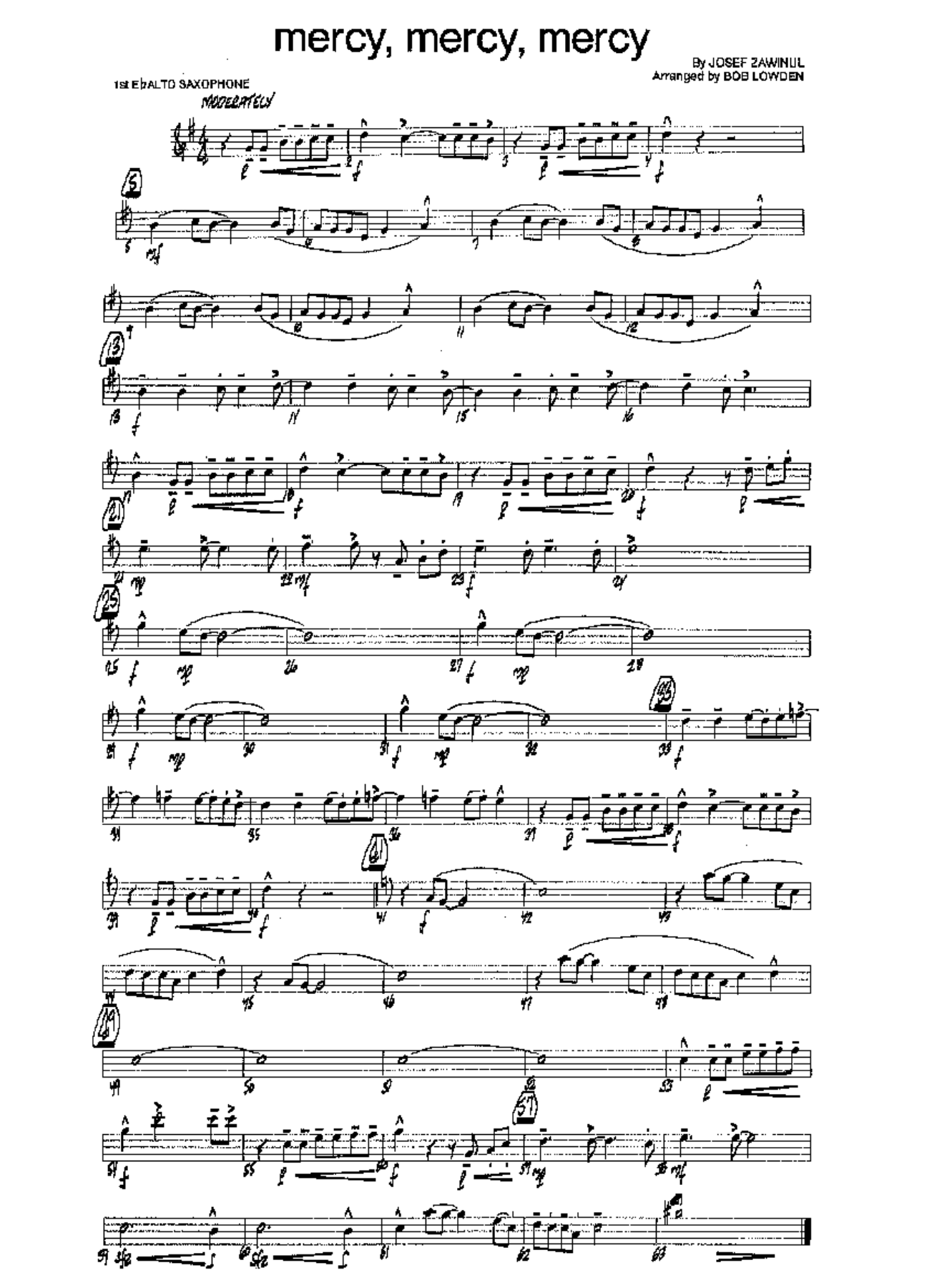
Mercy Mercy Mercy (B.Lowden) sheet music preview

Mercy Mercy Mercy (B.Lowden)

Composed by Joe Zawinul

Arranged by Bob Lowden

  • Ensemble: Big Band
  • Style: Jazz Standard
  • Pages: 33
  • Instruments (16): 1st Eb Alto Saxophone, 2nd Eb Alto Saxophone, 1st Bb Tenor Saxophone, 2nd Bb Tenor Saxophone, Eb Baritone Saxophone, 1st Bb Trumpet, 2nd Bb Trumpet, 3rd Bb Trumpet, 1st Trombone, 2nd Trombone, 3rd Trombone, Piano, Guitar, Bass, Drums, Conductor
  • Difficulty: medium
  • Content: Individual Parts
  • Format: PDF Download (Instant)
  • Price: $24.99

Joe Zawinul's iconic "Mercy, Mercy, Mercy" emerged in 1966, penned for the legendary Cannonball Adderley Quintet and featured prominently on their landmark album, *Mercy, Mercy, Mercy! Live at 'The Club'*. Though recorded in a studio with an invited audience, the album masterfully captured the raw energy of a live club performance, complete with Adderley's charismatic spoken introduction. This soulful instrumental quickly transcended jazz circles, becoming a surprise crossover hit in early 1967, climbing to #2 on the Soul chart and #11 on the Billboard Hot 100. Its enduring appeal lies in its infectious groove and accessible melody, embodying the spirit of soul jazz—a genre blending elements of jazz, blues, and gospel that resonated deeply with a broad audience. The original recording famously featured Zawinul on a Wurlitzer electric piano, lending the track its distinctive, churchy, and soulful texture. The tune is characterized by its primarily B-flat major key, a bluesy harmonic progression, and a unique 20-bar structure that deviates from standard jazz forms, contributing to its memorable and singable quality. Bob Lowden's big band arrangement of "Mercy, Mercy, Mercy" captures the essence of this beloved jazz standard while expertly translating its intimate, soulful feel to a full 15-instrument ensemble. Lowden, a prolific and respected composer and arranger known for his accessible yet musically rich treatments of jazz classics, meticulously crafts this chart to highlight the big band's dynamic capabilities. His approach typically involves clear melodic statements, well-voiced brass and saxophone soli sections, and a keen understanding of ensemble balance, making his arrangements both engaging for performers and enjoyable for audiences. This particular arrangement is designed to evoke the original's medium-tempo, gospel-infused groove, maintaining the bluesy dominant-seventh chord feel that defines the piece. The arrangement features the familiar melody primarily in the saxophone section, often reinforced by the brass, ensuring the iconic tune shines through. Lowden thoughtfully incorporates opportunities for improvisation, typically featuring a solo for tenor saxophone, allowing a soloist to explore the bluesy landscape of the tune. The chart builds dynamically through well-placed shout choruses and layered voicings, creating moments of exhilarating ensemble power. Technical challenges are moderate, focusing on rhythmic precision and maintaining a consistent, relaxed swing feel, rather than extreme ranges or complex harmonic substitutions. The rewarding aspect of performing this arrangement lies in its ability to connect with audiences through its universally appealing melody and irresistible groove. This arrangement is ideally suited for high school, college, and community jazz ensembles looking to program a recognizable and engaging soul-jazz standard. Its thoughtful scoring makes it achievable for developing bands while offering plenty of musical depth for more advanced groups to explore, making it a staple in any big band library. To achieve the authentic soul-jazz feel of "Mercy, Mercy, Mercy," conductors should emphasize a relaxed, medium swing tempo, ideally around quarter note = 128. The rhythm section is crucial; the bass line should be driving yet understated, laying down a solid foundation for the gospel-influenced groove. Drummers should focus on a consistent shuffle or swing pattern, incorporating subtle fills that enhance rather than overpower the ensemble. Key technical challenges include maintaining precise rhythmic articulation, particularly in the saxophone soli sections, and ensuring balanced voicings across the brass and saxophones. Encourage brass players to use plunger mutes for specific sections to emulate the vocal inflections characteristic of the soul-jazz idiom. Rehearsal time should be dedicated to perfecting the ensemble's dynamic contrasts, from the initial laid-back groove to the powerful shout choruses, ensuring each section contributes to the overall emotional arc of the piece. **Q: What instruments are included in this arrangement?** A: This big band arrangement includes parts for 15 instruments: Alto Saxophone 1 & 2, Tenor Saxophone 1 & 2, Baritone Saxophone, Trumpet 1, 2, 3 & 4, Trombone 1, 2, 3 & 4, Piano, Bass, and Drums. It also includes a conductor score. **Q: What is the difficulty level of this arrangement?** A: This arrangement is considered to be of moderate difficulty, suitable for high school, college, and community jazz ensembles. It focuses on solid ensemble playing, rhythmic precision, and a comfortable swing feel rather than extreme technical demands. **Q: What is the musical style and historical context of "Mercy, Mercy, Mercy"?** A: "Mercy, Mercy, Mercy" is a quintessential soul-jazz standard, originally composed by Joe Zawinul in 1966 for Cannonball Adderley. It blends elements of jazz, blues, and gospel music, characterized by its infectious medium swing groove and accessible, soulful melody. **Q: What makes Bob Lowden's arrangement unique?** A: Bob Lowden's arrangement effectively translates the original's intimate soul-jazz feel to a full big band. It features well-crafted voicings, dynamic soli sections, and provides opportunities for improvisation, all while maintaining the accessible and engaging character for which Lowden is known. **Q: What is the approximate performance duration and recommended tempo?** A: The approximate performance duration for this arrangement is around 3-4 minutes, depending on the length of improvised solos. The recommended tempo is a relaxed medium swing, ideally around quarter note = 128.

Questions and answers

What is included in the Mercy Mercy Mercy (B.Lowden) PDF?
The verified current file contains a conductor score and individual parts across 33 pages.
How many instruments or parts are listed for Mercy Mercy Mercy (B.Lowden)?
The verified instrumentation list contains 16 entries for this Big Band arrangement.
Who is credited for Mercy Mercy Mercy (B.Lowden)?
Composer: Joe Zawinul. Arranger: Bob Lowden.
What difficulty is listed for Mercy Mercy Mercy (B.Lowden)?
The verified difficulty level is medium.
What style is listed for Mercy Mercy Mercy (B.Lowden)?
The catalog lists the style as Jazz Standard.
Can I preview Mercy Mercy Mercy (B.Lowden) before buying?
Yes. The product page provides a preview generated from the current PDF file.
How is Mercy Mercy Mercy (B.Lowden) delivered?
After successful payment, the digital PDF is made available for download. The displayed price is $24.99.

Musicians Also Search For

Mercy Mercy Mercy Bob Lowden PDFMercy Mercy Mercy Bob Lowden sheet musicMercy Mercy Mercy arranged by Bob LowdenBob Lowden big band chartsBob Lowden jazz arrangements PDFMercy Mercy Mercy Joe Zawinul sheet musicMercy Mercy Mercy Joe Zawinul big band arrangementsJoe Zawinul big band chartsMercy Mercy Mercy big band arrangementsMercy Mercy Mercy big band PDF downloadMercy Mercy Mercy jazz sheet musicbig band sheet music downloadMercy Mercy Mercy conductor score PDFMercy Mercy Mercy individual parts downloadMercy Mercy Mercy sheet music PDFMercy Mercy Mercy Jazz Standard chartsJazz Standard big band arrangementsbuy Mercy Mercy Mercy sheet musicdownload Mercy Mercy Mercy PDFMercy Mercy Mercy jazz chartsbest Bob Lowden big band arrangementsJoe Zawinul arranged by Bob LowdenMercy Mercy Mercy printable sheet musicbig band repertoire PDF

All arrangements by Bob Lowden All Joe Zawinul sheet music