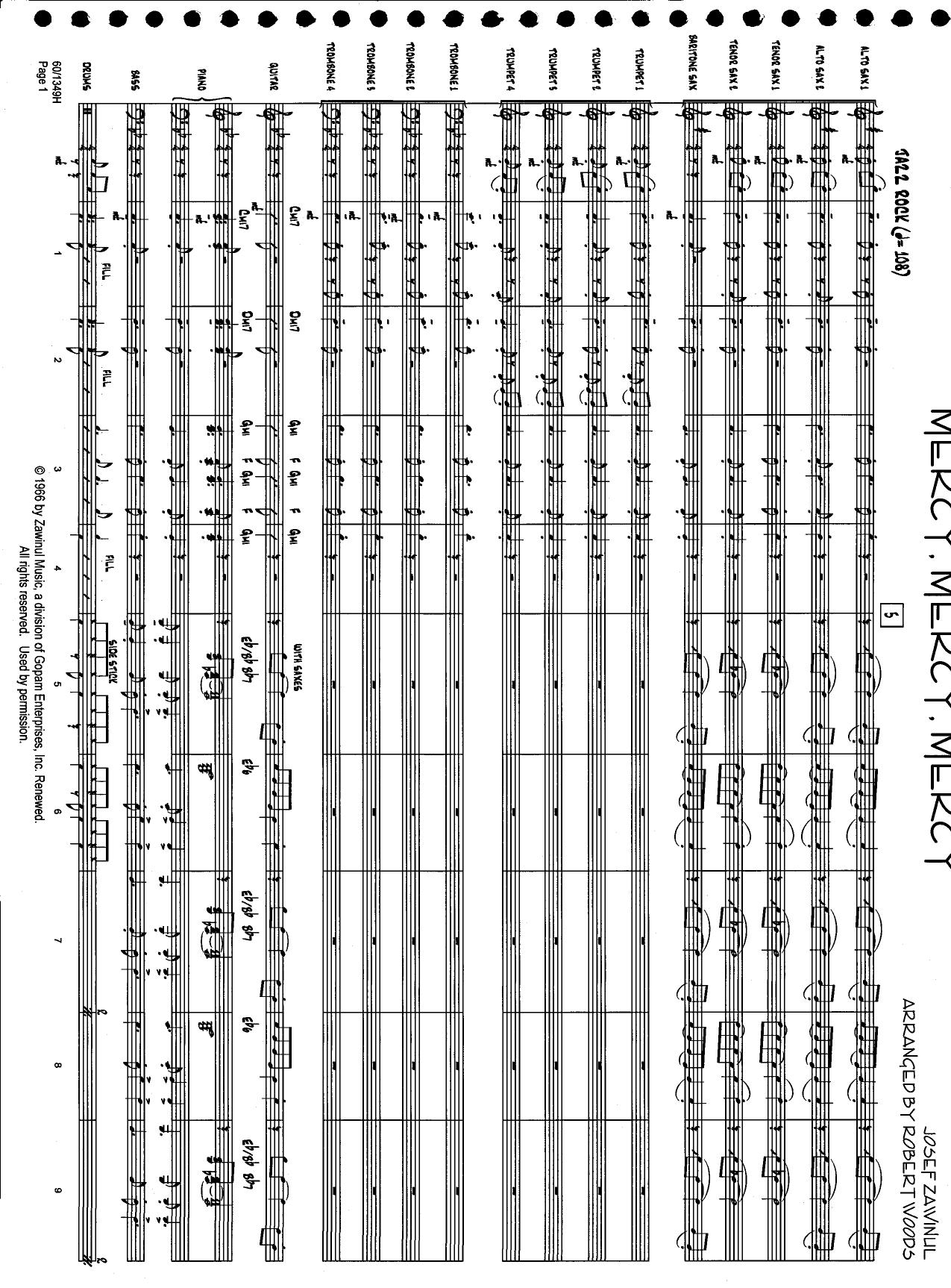
Mercy, Mercy, Mercy (R.Woods) sheet music preview

Mercy, Mercy, Mercy (R.Woods)

Composed by Joe Zawinul

Arranged by R.Woods

  • Ensemble: Big Band
  • Style: Jazz Standard
  • Pages: 45
  • Instruments (17): Alto Sax 1, Alto Sax 2, Tenor Sax 1, Tenor Sax 2, Baritone Sax, Trumpet 1, Trumpet 2, Trumpet 3, Trumpet 4, Trombone 1, Trombone 2, Trombone 3, Trombone 4, Guitar, Piano, Bass, Drums
  • Difficulty: medium
  • Content: Individual Parts
  • Format: PDF Download (Instant)
  • Price: $24.99

Composed by keyboardist Joe Zawinul and originally recorded by The Cannonball Adderley Quintet in 1966, "Mercy, Mercy, Mercy" stands as one of the definitive soul-jazz anthems of the 1960s. Captured live at the Club Chez Paree in Chicago, the original recording broke the mold of traditional hard bop by infusing gospel-soaked blues with an infectious, laid-back electric piano groove and an unmistakable swinging swagger. It quickly crossed over from the jazz charts to the R&B and pop mainstream, establishing itself as an enduring jazz standard that bridges the gap between sophisticated harmonic language and visceral, danceable rhythm. Rooted in a relaxed, soulful mid-tempo rock-infused swing feel in 4/4 time, this big band interpretation radiates an irresistible swagger and blues-drenched energy. The mood is simultaneously sophisticated and earthy, driven by a heavy backbeat and buoyant horn lines that evoke the celebratory atmosphere of a packed Saturday night club. The harmonic landscape retains Zawinul’s iconic, blues-inflected minor-mode motifs while expanding the sonic palette to exploit the full dynamic weight of a traditional 17-piece jazz orchestra, shifting effortlessly from sultry, whispered ensemble passages to roaring, high-octane blues shout choruses. Arranger R.Woods approaches this timeless classic with a keen respect for the original's infectious groove while injecting fresh, contemporary big-band colors through inventive section writing. The arrangement utilizes lush, contemporary brass voicings and tight saxophone solis that honor the original soul-jazz ethos while introducing clever counter-melodies and dynamic contrast. Woods builds the arrangement organically, utilizing sparse, punchy accompaniment during the head statements before opening up the form for extended soloist features, ultimately driving toward a powerful, harmonically rich climax that reinvigorates the familiar theme. The melody is primarily carried by the saxophones and muted brass before the full ensemble engages in rich, call-and-response figures that demand crisp articulation and deep stylistic integration. Featured solo spaces allow marquee performers within the reed or brass sections to stretch out over standard blues changes, backed by a rhythm section required to maintain an unyielding, pocket-driven groove. Advanced high school bands with strong rhythmic foundations, as well as collegiate and community big bands, will find this chart to be an absolute crowd-pleaser that offers profound educational value in stylistic phrasing, articulation, and soulful group interplay. The primary technical challenge of this arrangement lies not in extreme velocity, but in maintaining an authentic, unhurried soul-jazz groove without dragging. Conductor and rhythm section players must lock in early on the signature backbeat feel, ensuring the eighth notes are properly swung with a relaxed, forward-moving momentum. Horn sections should pay close attention to dynamic markings, contrasting the biting, blues-inflected accents with smooth, connected slurs in the soli sections. Stylistic devices such as subtle falls, doits, and cup or bucket mutes in the brass are encouraged to replicate the vocal, expressive qualities of the original recording. During rehearsal, focus first on isolating the rhythm section to establish the foundational pocket before layering in the horn backgrounds. Encourage the soloists to lean heavily into the blues scale, prioritizing melodic storytelling and expressive phrasing over rapid-fire technical display. Q: What instrumentation and parts are included in this publication? A: The arrangement is scored for a standard 17-instrument big band, consisting of 2 alto saxophones, 2 tenor saxophones, 1 baritone saxophone, 4 trumpets, 4 trombones, guitar, piano, bass, and drums, along with a comprehensive 45-page conductor score. Q: What is the difficulty level of this R.Woods arrangement? A: This chart is graded as medium-advanced, making it well-suited for accomplished high school ensembles, university jazz bands, and professional community big bands with strong section players and confident blues soloists. Q: What is the musical style and historical background of the piece? A: It is a classic soul-jazz standard originally composed by Joe Zawinul and popularized by The Cannonball Adderley Quintet in 1966, blending gospel-inflected blues harmony with a infectious, driving dance groove. Q: What makes this specific arrangement unique? A: R.Woods balances reverence for the iconic 1966 recording with inventive contemporary big-band voicings, clever dynamic shifts, and rich section interplay that expands a small-group masterpiece into a powerhouse orchestral chart. Q: What is the recommended tempo and performance duration? A: The arrangement is set at a relaxed, driving soul-jazz tempo of approximately 116 BPM, yielding a performance duration of roughly 4 to 5 minutes depending on the length of the open solo sections.

Questions and answers

What is included in the Mercy, Mercy, Mercy (R.Woods) PDF?
The verified current file contains a conductor score and individual parts across 45 pages.
How many instruments or parts are listed for Mercy, Mercy, Mercy (R.Woods)?
The verified instrumentation list contains 17 entries for this Big Band arrangement.
Who is credited for Mercy, Mercy, Mercy (R.Woods)?
Composer: Joe Zawinul. Arranger: R.Woods.
What difficulty is listed for Mercy, Mercy, Mercy (R.Woods)?
The verified difficulty level is medium.
What style is listed for Mercy, Mercy, Mercy (R.Woods)?
The catalog lists the style as Jazz Standard.
Can I preview Mercy, Mercy, Mercy (R.Woods) before buying?
Yes. The product page provides a preview generated from the current PDF file.
How is Mercy, Mercy, Mercy (R.Woods) delivered?
After successful payment, the digital PDF is made available for download. The displayed price is $24.99.

Musicians Also Search For

Mercy, Mercy, Mercy R.Woods PDFMercy, Mercy, Mercy R.Woods sheet musicMercy, Mercy, Mercy arranged by R.WoodsR.Woods big band chartsR.Woods jazz arrangements PDFMercy, Mercy, Mercy Joe Zawinul sheet musicMercy, Mercy, Mercy Joe Zawinul big band arrangementsJoe Zawinul big band chartsMercy, Mercy, Mercy big band arrangementsMercy, Mercy, Mercy big band PDF downloadMercy, Mercy, Mercy jazz sheet musicbig band sheet music downloadMercy, Mercy, Mercy conductor score PDFMercy, Mercy, Mercy individual parts downloadMercy, Mercy, Mercy sheet music PDFMercy, Mercy, Mercy Jazz Standard chartsJazz Standard big band arrangementsbuy Mercy, Mercy, Mercy sheet musicdownload Mercy, Mercy, Mercy PDFMercy, Mercy, Mercy jazz chartsbest R.Woods big band arrangementsJoe Zawinul arranged by R.WoodsMercy, Mercy, Mercy printable sheet musicbig band repertoire PDF

All arrangements by R.Woods All Joe Zawinul sheet music