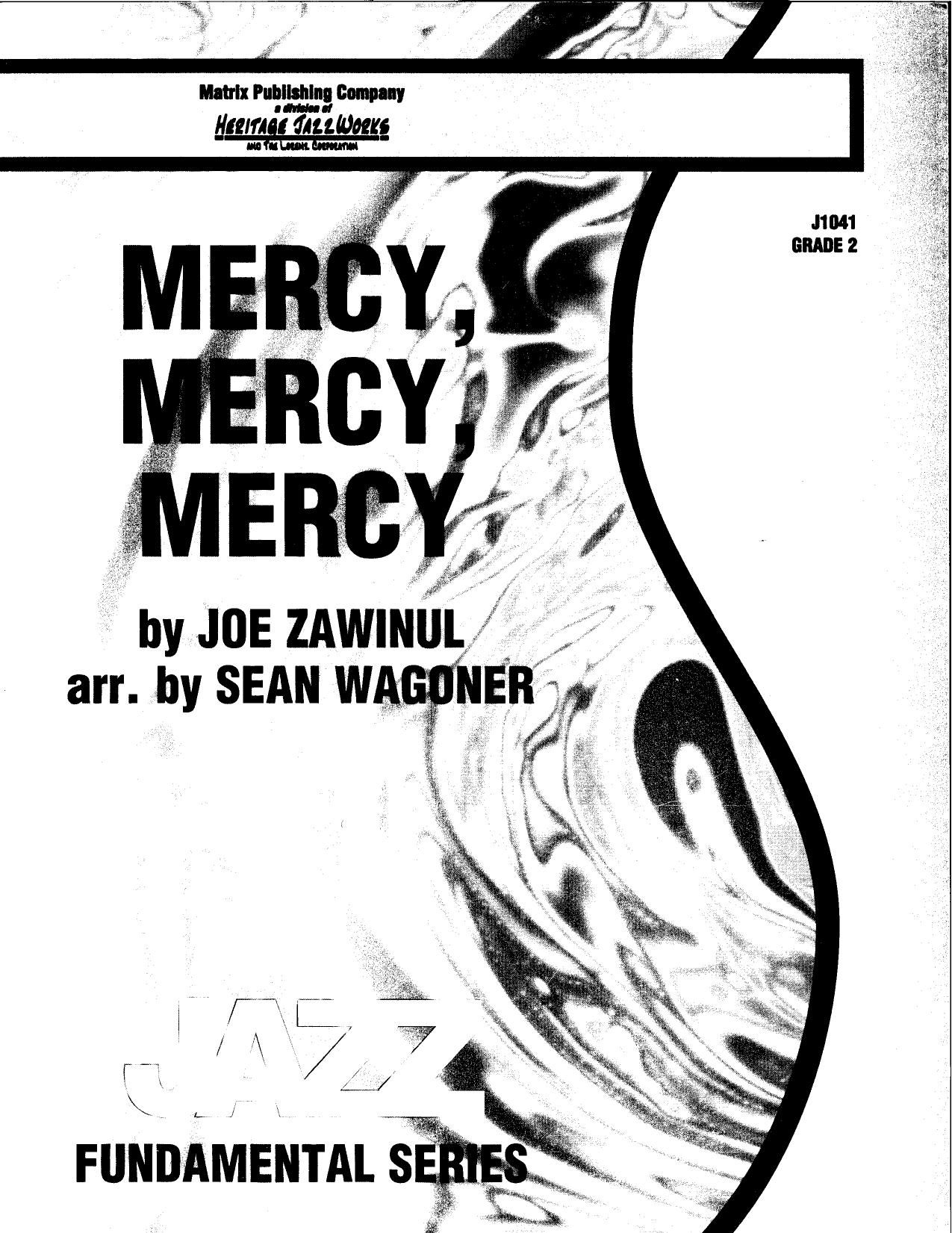
Mercy, Mercy, Mercy (S.Wagoner)
Composed by Joe Zawinul
Arranged by S.Wagoner
- Ensemble: Big Band
- Style: Jazz Standard
- Pages: 48
- Instruments (17): Alto Sax 1, Alto Sax 2, Tenor Sax 1, Tenor Sax 2, Bari Sax, Trumpet 1, Trumpet 2, Trumpet 3, Trumpet 4, Trombone 1, Trombone 2, Trombone 3, Trombone 4, Piano, Bass, Drums, Guitar
- Difficulty: medium
- Content: Individual Parts
- Format: PDF Download (Instant)
- Price: $24.99
Composed by keyboardist Joe Zawinul and originally recorded by The Cannonball Adderley Quintet in 1966, "Mercy, Mercy, Mercy" stands as one of the definitive soul-jazz anthems of the 1960s. Rooted in the church-infused gospel-jazz movement, the tune captured the public imagination with its infectious, driving groove and blues-drenched phrasing, bridging the gap between hard bop and crossover soul-jazz. Zawinul’s composition became an immediate crossover hit, defining an era where jazz musicians embraced electric pianos, backbeat-heavy rhythms, and earthy, blues-driven melodies that resonated far beyond traditional jazz clubs. Driven by an irresistible, laid-back minor-blues feel in 4/4 time, this S.Wagoner big band adaptation maintains the iconic swagger of the original recording while expanding its sonic palette for a full 17-piece jazz ensemble. The mood is confident, greasy, and high-energy, evoking the smoky atmosphere of a mid-60s Chicago jazz club while utilizing the dynamic horsepower of a modern big band. The arrangement balances tight, rhythmic ensemble unisons with rich, gospel-influenced horn voicings that give the brass and reeds a powerful, vocal-like quality. S.Wagoner approaches the classic chart with a deep respect for its soulful origins, infusing the score with clever dynamic contrasts and modern harmonic coloring. Rather than merely transcribing the small-group recording, S.Wagoner reimagines the thematic material through dynamic section solis and a thunderous shout chorus that builds tension using staggered entrances and sustained, blues-infused cluster voicings. The melody is initially introduced by the alto saxophone section before being opened up to the full ensemble, ensuring every section shares the spotlight. Featured solo space is provided for trumpet and tenor saxophone, allowing improvisers to stretch out over the standard minor-blues changes. Advanced high school, collegiate, and professional community big bands will find this chart exceptionally rewarding. While the technical demands are moderate—relying heavily on stylistic articulation rather than breakneck tempos—the primary challenge lies in capturing the authentic, behind-the-beat groove. Horn players must master tight fall-offs, subtle doits, and expressive phrasing to bring out the blues essence. Conductor and rhythm section focus will be paramount in locking in the quintessential backbeat, making it an absolute crowd-pleaser for festival performances and formal concert sets alike. The primary technical challenge of this arrangement lies not in complex harmonic reading, but in the execution of an authentic, laid-back soul-jazz groove. The tempo must remain steady, anchored by a solid, unhurried backbeat from the drummer and a locked-in bassline that sits comfortably in the pocket. Avoid rushing the sixteenth-note pickups; precision in articulation is vital to maintaining the swagger of the style. Brass players should utilize natural, vocal-like inflections, employing subtle doits and controlled fall-offs only where marked, ensuring they never overshadow the core melody. The saxophones need to approach their unison lines with a unified jazz articulation, bending notes slightly where appropriate to evoke a blues-vocal quality. During rehearsal, the conductor should isolate the rhythm section first to establish the groove before layering in the horns. Pay close attention to the dynamic contrasts leading into the shout chorus; the sudden drop in volume right before the final climax creates a dramatic tension that requires absolute discipline from the entire ensemble. Q: What instruments and parts are included in this arrangement? A: This chart is scored for a standard 17-instrument big band, consisting of 2 alto saxophones, 2 tenor saxophones, baritone saxophone, 4 trumpets, 4 trombones, guitar, piano, bass, drums, and a comprehensive conductor score. Q: What is the difficulty level of this S.Wagoner arrangement? A: It is graded as medium-advanced, making it ideal for high school jazz ensembles with strong section players, as well as collegiate and professional community big bands looking for a crowd-pleasing groove chart. Q: What is the historical style and background of the piece? A: Originally composed by Joe Zawinul and made famous by The Cannonball Adderley Quintet in 1966, the piece is a legendary soul-jazz standard defined by its gospel-infused, minor-blues groove and cross-genre appeal. Q: What makes this specific arrangement by S.Wagoner unique? A: S.Wagoner successfully scales down a classic small-group soul-jazz hit into a full big-band powerhouse, incorporating rich gospel voicings, dynamic section solis, and a high-impact shout chorus while preserving the raw, bluesy feel of the original. Q: What is the performance duration and tempo feel for this chart? A: The arrangement runs approximately 4 to 5 minutes at a medium, laid-back swing/soul-jazz tempo of around 116 beats per minute, allowing ample room for featured solos and stylistic breathing.
Questions and answers
- What is included in the Mercy, Mercy, Mercy (S.Wagoner) PDF?
- The verified current file contains a conductor score and individual parts across 48 pages.
- How many instruments or parts are listed for Mercy, Mercy, Mercy (S.Wagoner)?
- The verified instrumentation list contains 17 entries for this Big Band arrangement.
- Who is credited for Mercy, Mercy, Mercy (S.Wagoner)?
- Composer: Joe Zawinul. Arranger: S.Wagoner.
- What difficulty is listed for Mercy, Mercy, Mercy (S.Wagoner)?
- The verified difficulty level is medium.
- What style is listed for Mercy, Mercy, Mercy (S.Wagoner)?
- The catalog lists the style as Jazz Standard.
- Can I preview Mercy, Mercy, Mercy (S.Wagoner) before buying?
- Yes. The product page provides a preview generated from the current PDF file.
- How is Mercy, Mercy, Mercy (S.Wagoner) delivered?
- After successful payment, the digital PDF is made available for download. The displayed price is $24.99.
Musicians Also Search For
Mercy, Mercy, Mercy S.Wagoner PDF • Mercy, Mercy, Mercy S.Wagoner sheet music • Mercy, Mercy, Mercy arranged by S.Wagoner • S.Wagoner big band charts • S.Wagoner jazz arrangements PDF • Mercy, Mercy, Mercy Joe Zawinul sheet music • Mercy, Mercy, Mercy Joe Zawinul big band arrangements • Joe Zawinul big band charts • Mercy, Mercy, Mercy big band arrangements • Mercy, Mercy, Mercy big band PDF download • Mercy, Mercy, Mercy jazz sheet music • big band sheet music download • Mercy, Mercy, Mercy conductor score PDF • Mercy, Mercy, Mercy individual parts download • Mercy, Mercy, Mercy sheet music PDF • Mercy, Mercy, Mercy Jazz Standard charts • Jazz Standard big band arrangements • buy Mercy, Mercy, Mercy sheet music • download Mercy, Mercy, Mercy PDF • Mercy, Mercy, Mercy jazz charts • best S.Wagoner big band arrangements • Joe Zawinul arranged by S.Wagoner • Mercy, Mercy, Mercy printable sheet music • big band repertoire PDF