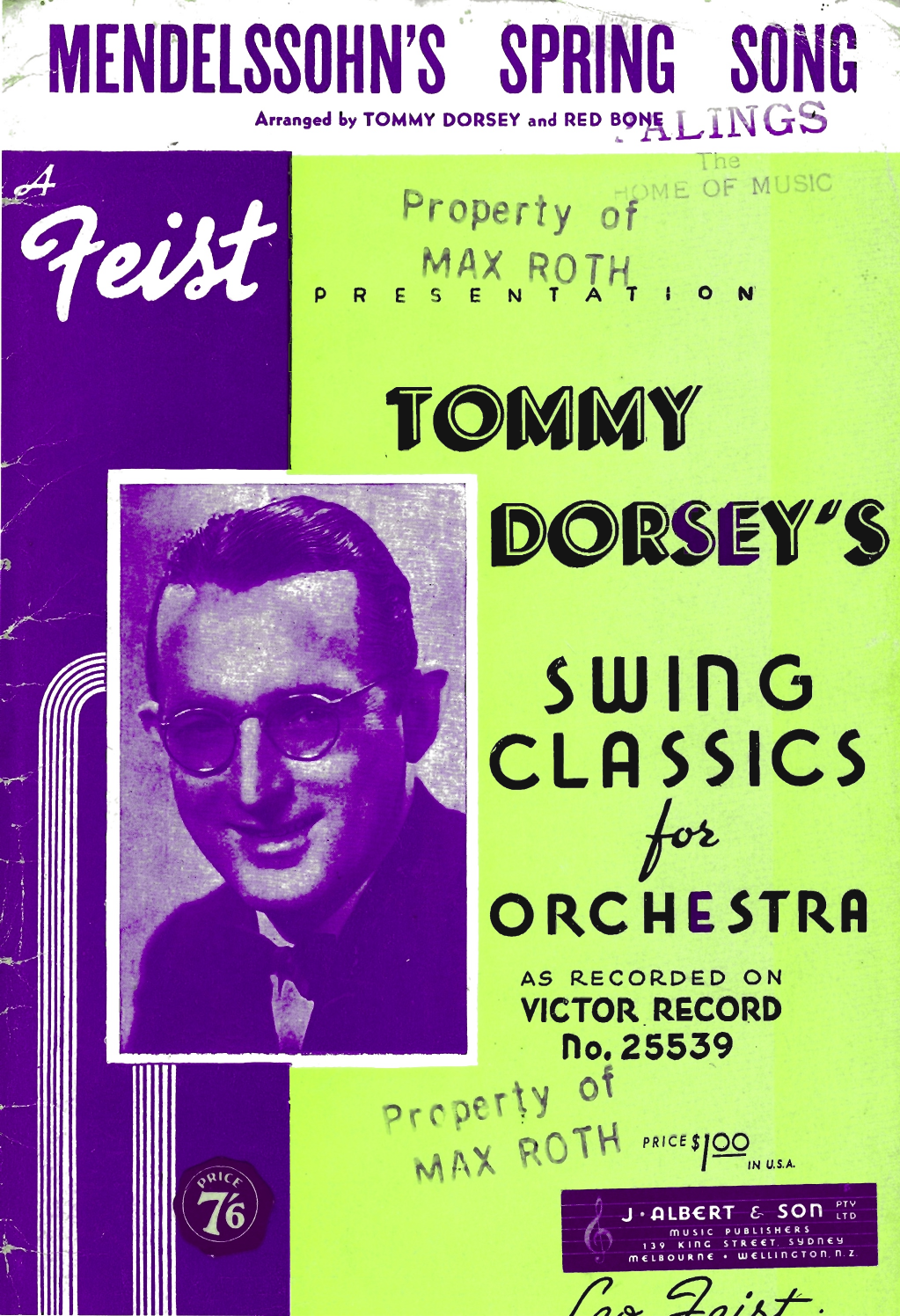
Mendelssohn's Spring Song (T.Dorsey) sheet music preview

Mendelssohn's Spring Song (T.Dorsey)

Composed by Felix Mendelssohn

Arranged by Tommy Dorsey-Jimmy Dorsey

  • Ensemble: Big Band
  • Pages: 31
  • Instruments (15): 1st Saxophone Eb Alto, 3rd Saxophone Eb Alto, 2nd Saxophone Bb Tenor, 4th Saxophone Bb Tenor, 4th Saxophone Eb Baritone, 1st Trumpet in Bb, 2nd Trumpet in Bb, 3rd Trumpet in Bb, 1st Trombone, 2nd Trombone, Piano, Guitar, Bass, Drums, 1st Violins
  • Difficulty: medium
  • Content: Individual Parts
  • Format: PDF Download (Instant)
  • Price: $24.99

Felix Mendelssohn’s beloved "Spring Song" (Frühlingslied), originally penned as a lyrical piano composition from his *Songs Without Words* (Lieder ohne Worte, Op. 62, No. 6), underwent a brilliant metamorphosis during the swing era when transformed into a jazz big band vehicle by the legendary Dorsey brothers. Tommy and Jimmy Dorsey captured the transitional aesthetic of late-1930s jazz, bridging the sophisticated sweetness of sweet bands with the driving propulsion of hot swing. This arrangement reimagines nineteenth-century Romantic classical themes through a polished, brass-heavy jazz lens, illustrating how swing-era arrangers freely plundered the European classical canon to create sophisticated, highly accessible radio and dancehall entertainment. Swinging at a bright, buoyant medium-up tempo, the arrangement opens with Mendelssohn’s familiar, cascading melodic motif before quickly transitioning into a crisp, driving 4/4 swing feel. The mood is effervescent, nostalgic, and rhythmically infectious, evoking the sophisticated atmosphere of a high-end 1930s supper club or a crisp springtime broadcast from the Hotel Pennsylvania. The harmonic language expands upon Mendelssohn's original tonality by introducing sweet extended chords, clever chromatic passing tones, and characteristic swing-era voice-leading that keeps the texture light, transparent, and rhythmically buoyant. The Dorsey treatment relies heavily on seamless interplay between sections, showcasing smooth, impeccably balanced reed solis contrasted with bright, punchy brass punctuation. Jimmy Dorsey’s influence is felt in the intricate, flowing woodwind lines that navigate the rapid scalar passages of the original melody with effortless agility, while Tommy’s signature trombone warmth anchors the lower-mid register with lyrical counter-melodies. The arrangement features crisp ensemble shout choruses that build dynamic tension without ever losing their characteristic elegance. Solos are integrated organically into the form, providing ample space for lead trumpet and trombone improvisation over classic swing changes. Bringing this chart to life requires exceptional technical facility, particularly from the saxophone section, which must execute rapid, classical-derived scalar runs with a clean, light jazz articulation. The brass section needs refined control over dynamic shading, ensuring that background figures support rather than overpower the delicate melodic statements. It is a deeply rewarding piece that demands clean phrasing, precise rhythmic placement on eighth-note subdivisions, and a strong sense of historical swing style. Advanced high school, collegiate, and professional big bands will find this chart an exceptional showcase for developing ensemble blend, stylistic versatility, and stylistic wit. Navigating "Mendelssohn's Spring Song" successfully requires treating the classical source material with both stylistic respect and genuine swing-era verve. The primary technical challenge lies in the woodwinds executing Mendelssohn's rapid, intricate melodic figures with a light, non-legato jazz articulation rather than a heavy classical staccato or romantic smear. Set the tempo at a comfortable, driving medium-bright swing (around quarter note = 152–160 BPM) to maintain the sparkling, buoyant character without letting the faster passages rush. Conductors should pay close attention to dynamic balance during the transitional modulations, ensuring that the brass backgrounds do not obscure the delicate reed soli lines. Encourage the rhythm section to keep the ride cymbal pattern crisp and the bass line walking evenly, avoiding heavy downbeat accentuation. Special attention should be paid to precise section cut-offs and uniform vibrato usage across the brass to capture the authentic, polished sheen of the classic Dorsey orchestra sound. Q: What instruments and parts are included in this arrangement? A: The chart is scored for a standard 17-instrument big band instrumentation, comprising 4 trumpets, 4 trombones, 5 saxophones (with standard double woodwind/reed switching capabilities as dictated by the classic Dorsey parts), and a 4-piece rhythm section (piano, guitar, bass, and drums) across 31 pages of music. Q: What is the difficulty level of this arrangement? A: This arrangement is graded as advanced (appropriate for collegiate, advanced high school, and professional big bands) primarily due to the rapid technical facility required by the saxophone section to navigate the classical-derived scalar passages in a swing context. Q: What is the style and historical context of this piece? A: Written in the classic big band swing style of the late 1930s, this arrangement bridges European Romantic classical music (Felix Mendelssohn's original piano miniature) with the sophisticated dance-orchestra jazz idiom championed by Tommy and Jimmy Dorsey. Q: What makes this Tommy and Jimmy Dorsey arrangement unique? A: It uniquely blends nineteenth-century classical thematic material with characteristic swing-era harmonic extensions, featuring intricate woodwind solis, warm trombone counter-melodies, and a bright, buoyant treatment that elevates a familiar classical melody into a high-energy jazz showcase. Q: What is the recommended performance duration and tempo? A: The arrangement typically runs approximately 3 to 4 minutes in duration when performed at the recommended medium-bright swing tempo of around quarter note = 152 to 160 BPM.

Questions and answers

What is included in the Mendelssohn's Spring Song (T.Dorsey) PDF?
The verified current file contains individual parts across 31 pages.
How many instruments or parts are listed for Mendelssohn's Spring Song (T.Dorsey)?
The verified instrumentation list contains 15 entries for this Big Band arrangement.
Who is credited for Mendelssohn's Spring Song (T.Dorsey)?
Composer: Felix Mendelssohn. Arranger: Tommy Dorsey-Jimmy Dorsey.
What difficulty is listed for Mendelssohn's Spring Song (T.Dorsey)?
The verified difficulty level is medium.
Can I preview Mendelssohn's Spring Song (T.Dorsey) before buying?
Yes. The product page provides a preview generated from the current PDF file.
How is Mendelssohn's Spring Song (T.Dorsey) delivered?
After successful payment, the digital PDF is made available for download. The displayed price is $24.99.

Musicians Also Search For

Mendelssohn's Spring Song Tommy Dorsey-Jimmy Dorsey PDFMendelssohn's Spring Song Tommy Dorsey-Jimmy Dorsey sheet musicMendelssohn's Spring Song arranged by Tommy Dorsey-Jimmy DorseyTommy Dorsey-Jimmy Dorsey big band chartsTommy Dorsey-Jimmy Dorsey jazz arrangements PDFMendelssohn's Spring Song Felix Mendelssohn sheet musicMendelssohn's Spring Song Felix Mendelssohn big band arrangementsFelix Mendelssohn big band chartsMendelssohn's Spring Song big band arrangementsMendelssohn's Spring Song big band PDF downloadMendelssohn's Spring Song jazz sheet musicbig band sheet music downloadMendelssohn's Spring Song individual parts downloadMendelssohn's Spring Song sheet music PDFbuy Mendelssohn's Spring Song sheet musicdownload Mendelssohn's Spring Song PDFMendelssohn's Spring Song jazz chartsbest Tommy Dorsey-Jimmy Dorsey big band arrangementsFelix Mendelssohn arranged by Tommy Dorsey-Jimmy DorseyMendelssohn's Spring Song printable sheet musicbig band repertoire PDF

All arrangements by Tommy Dorsey-Jimmy Dorsey All Felix Mendelssohn sheet music