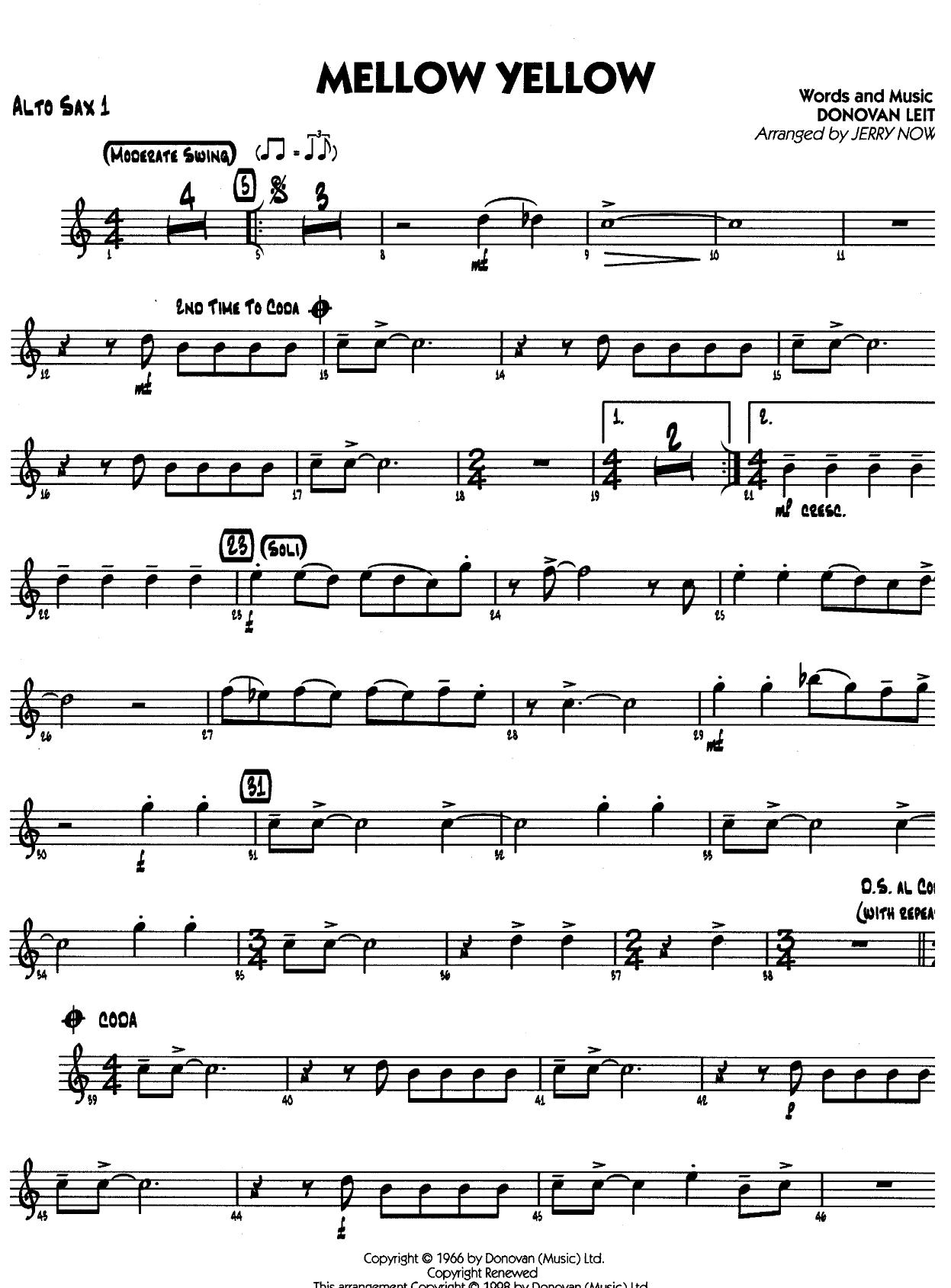
Mellow Yellow (J.Nowak) sheet music preview

Mellow Yellow (J.Nowak)

Composed by Donovan

Arranged by Jerry Nowak

  • Ensemble: Big Band
  • Pages: 22
  • Instruments (15): Alto Sax 1, Alto Sax 2, Tenor Sax 1, Tenor Sax 2, Baritone Sax, Trumpet 1, Trumpet 2, Trumpet 3, Trombone 1, Trombone 2, Trombone 3, Piano, Guitar, Bass, Drums
  • Difficulty: medium
  • Content: Individual Parts
  • Format: PDF Download (Instant)
  • Price: $24.99

Donovan’s 1966 psychedelic pop smash "Mellow Yellow" occupies a fascinating intersection where late-sixties counterculture meets timeless melodic catchiness. Originally produced by Mickie Most and famously rumored to feature Paul McCartney on backing vocals, the song captured the breezy, sun-drenched optimism of the mid-1960s London scene. While conceived as a pop-rock track, its underlying groove, bluesy undertones, and memorable hook have long made it an enticing vehicle for jazz interpretation. Translating this iconic tune into the big band idiom allows ensembles to explore a lighter, infectious side of jazz repertoire that immediately connects with audiences of all generations. Jerry Nowak’s masterful adaptation reimagines the tune with a buoyant, infectious medium-swing feel that replaces the original's folk-rock shuffle with a sophisticated, driving jazz groove. Set in a bright and accessible key, the chart radiates a feel-good, optimistic energy, balancing laid-back sophistication with punchy big band brass stabs. Nowak avoids making it a novelty tune; instead, he treats the familiar melody with genuine harmonic respect, injecting clever chromatic voice-leading and subtle counter-melodies that elevate the material far beyond a simple cover. The mood shifts effortlessly between playful, walking-bass-driven verses and high-energy ensemble passages that evoke the classic swinging sound of mid-century studio jazz bands. The arrangement distributes thematic material democratically across the ensemble, ensuring every section gets a chance to shine. The woodwinds—featuring two altos, two tenors, and baritone saxophone—frequently handle playful, harmonized soli lines that mimic the whimsical nature of the original vocal delivery, while the brass section interjects with crisp, articulate counter-punches. Nowak incorporates dynamic shading and clever section interplay, leading up to a spirited shout chorus that builds textural density without ever feeling overcrowded. Rhythm section players are given ample room to establish an authentic pocket, utilizing a steady, driving swing beat peppered with clever syncopated kicks that keep the toes tapping from the downbeat to the final chord. Advanced middle school, high school, and community big bands will find this chart to be an exceptionally rewarding addition to their libraries. While the technical demands remain approachable for developing players—avoiding extreme altissimo ranges or breakneck tempos—the arrangement requires a strong sense of swing subdivision and precise section articulation to truly come alive. Directors will appreciate how the chart teaches students the importance of lighter phrasing, dynamic contrast, and stylistic cohesion. Complete with a full 22-page conductor score and parts for a standard 15-instrument big band instrumentation, this arrangement offers a masterclass in turning a pop culture artifact into a swinging crowd-pleaser. Achieving the right pocket is essential for this chart; the tempo should sit comfortably in a medium-swing groove that prioritizes forward momentum over heavy-handedness. The rhythm section bears primary responsibility for maintaining a light, buoyant feel—the drummer should utilize a crisp ride cymbal pattern with a gentle hi-hat chick on beats two and four, avoiding overly dense fills during the head statements. Horn players must pay close attention to short, articulated notes, ensuring that eighth-note passages are swung naturally rather than played straight or overly dotted. Watch out for dynamic balance during the transitional bridges; the brass should never overpower the saxophones when the reeds carry the primary melodic line. Directors should rehearse the ensemble in sections first to lock in the unison articulations, paying special attention to the dynamic swells leading into the shout chorus. Encourage the brass players to use controlled, warm tones rather than forced, brassy volumes, preserving the relaxed, sunny character that defines the composition. Q: What instruments and parts are included in this arrangement? A: This chart is scored for a standard 15-instrument big band, featuring parts for two alto saxophones, two tenor saxophones, a baritone saxophone, and a comprehensive 22-page conductor score. While rhythm and brass parts complete the full big band texture, the exact instrumentation covers the core 15-piece configuration. Q: What is the difficulty level of this arrangement? A: Jerry Nowak designed this chart to be highly accessible for developing and intermediate ensembles, making it ideal for advanced middle school, high school, and community jazz bands. The technical requirements focus more on ensemble blend, articulation, and swing feel rather than extreme ranges or complex polyrhythms. Q: What musical style and historical context does this chart represent? A: The arrangement transforms Donovan’s 1966 pop-rock hit into a swinging, upbeat big band jazz chart. It bridges the gap between mid-century popular culture and traditional jazz repertoire, offering a fun, recognizable melody framed by classic swing-era arranging techniques. Q: What makes Jerry Nowak's treatment of "Mellow Yellow" unique? A: Rather than playing the song strictly as a novelty, Nowak applies sophisticated jazz harmony, clever counter-melodies, and a driving medium-swing groove that elevates the pop tune into a legitimate jazz chart. It features playful woodwind solis and a spirited shout chorus without losing the charm of the original melody. Q: What is the approximate performance duration and tempo feel? A: The arrangement is set in a comfortable medium-swing tempo that typically clocks in around 3 to 4 minutes in duration. This makes it an ideal length for festival programs, pops concerts, or as an engaging mid-set tune to lift the energy of the room.

Questions and answers

What is included in the Mellow Yellow (J.Nowak) PDF?
The verified current file contains a conductor score and individual parts across 22 pages.
How many instruments or parts are listed for Mellow Yellow (J.Nowak)?
The verified instrumentation list contains 15 entries for this Big Band arrangement.
Who is credited for Mellow Yellow (J.Nowak)?
Composer: Donovan. Arranger: Jerry Nowak.
What difficulty is listed for Mellow Yellow (J.Nowak)?
The verified difficulty level is medium.
Can I preview Mellow Yellow (J.Nowak) before buying?
Yes. The product page provides a preview generated from the current PDF file.
How is Mellow Yellow (J.Nowak) delivered?
After successful payment, the digital PDF is made available for download. The displayed price is $24.99.

Musicians Also Search For

Mellow Yellow Jerry Nowak PDFMellow Yellow Jerry Nowak sheet musicMellow Yellow arranged by Jerry NowakJerry Nowak big band chartsJerry Nowak jazz arrangements PDFMellow Yellow Donovan sheet musicMellow Yellow Donovan big band arrangementsDonovan big band chartsMellow Yellow big band arrangementsMellow Yellow big band PDF downloadMellow Yellow jazz sheet musicbig band sheet music downloadMellow Yellow conductor score PDFMellow Yellow individual parts downloadMellow Yellow sheet music PDFbuy Mellow Yellow sheet musicdownload Mellow Yellow PDFMellow Yellow jazz chartsbest Jerry Nowak big band arrangementsDonovan arranged by Jerry NowakMellow Yellow printable sheet musicbig band repertoire PDF

All arrangements by Jerry Nowak All Donovan sheet music