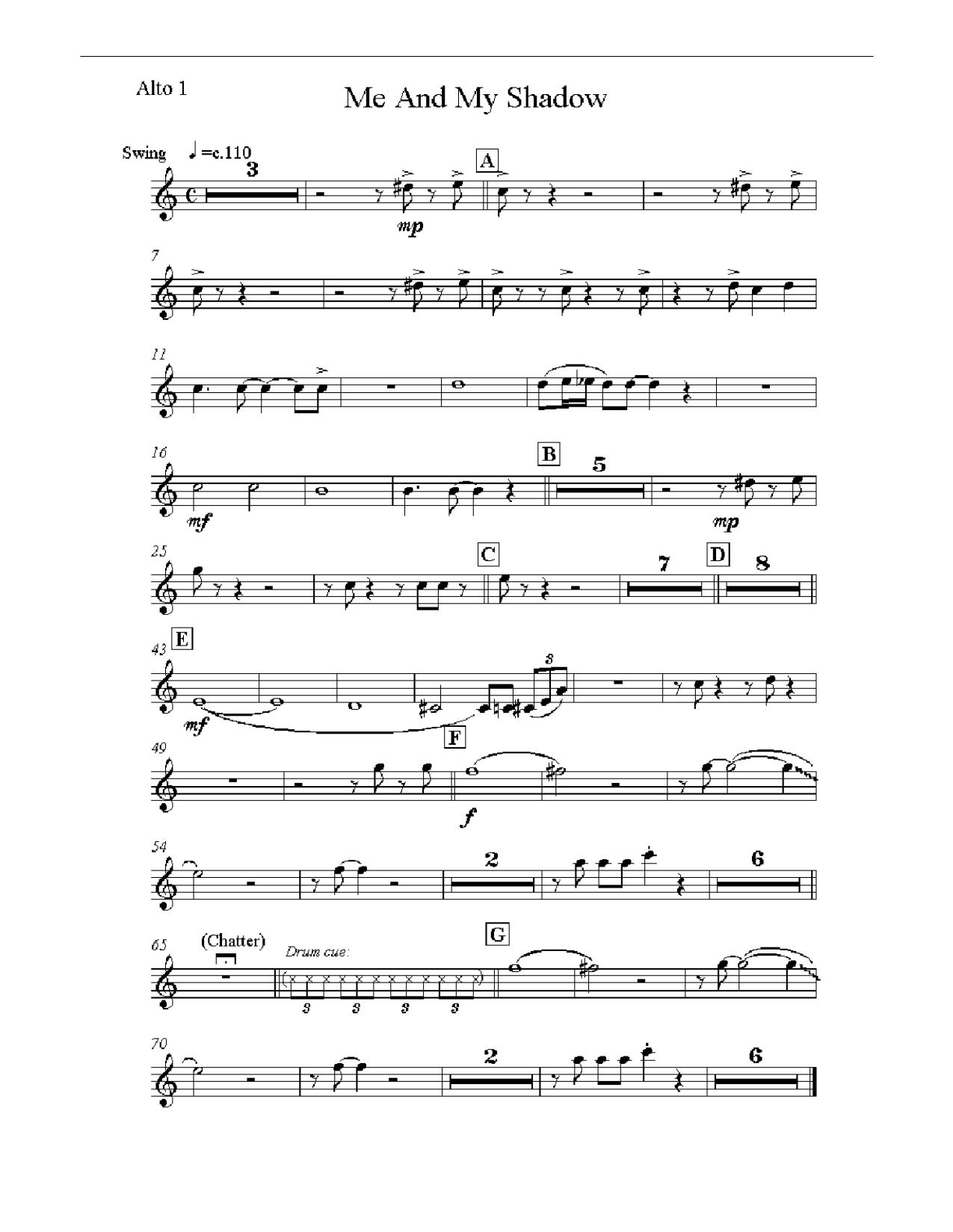
Me & My Shadow (F.Sinatra & Sammy Davis Jr)
Composed by Al Jolson
Arranged by Frank Sinatra & Nelson Riddle
- Ensemble: Big Band
- Pages: 21
- Instruments (18): Alto 1, Alto 2, Tenor 1, Tenor 2, Bari. Sax., Trumpet 1, Trumpet 2, Trumpet 3, Trumpet 4, Trombone 1, Trombone 2, Trombone 3, Trombone 4, Piano, Bass, Drums, Guitar, Vocals
- Difficulty: medium
- Content: Individual Parts
- Format: PDF Download (Instant)
- Price: $24.99
Originally patented in 1927 by Al Jolson, Dave Dreyer, and Billy Rose, "Me and My Shadow" achieved legendary status when it became a cornerstone of the mid-century Rat Pack vocal canon, most notably immortalized through the dynamic stage chemistry and vocal sparring of Frank Sinatra and Sammy Davis Jr. Representing the pinnacle of the American popular songbook meeting sophisticated swing-era orchestration, this tune captures the buoyant optimism, theatrical showmanship, and effortless swagger of mid-1950s and 60s Las Vegas entertainment. As a jazz standard, it transcends its Tin Pan Alley roots, offering a masterclass in vocal interplay, rhythmic drive, and lyrical storytelling. Propelled by a vibrant, medium-up swing feel in 4/4 time, this arrangement radiates high-energy optimism and playful camaraderie. The harmonic language is rich with classic mid-century extended chords, featuring clever chromatic passing tones, lush major-sixth and ninth voicings, and sudden dynamic shifts that mimic a live stage performance. The mood oscillates between swinging confidence and theatrical whimsy, evoking smoke-filled showrooms, slick tuxedos, and the kinetic joy of classic vocal jazz performance. Nelson Riddle’s signature arranging genius shines through the meticulous counterpoint, witty instrumental commentary, and seamless transitions between vocal lines. Rather than merely backing a singer, the 10-piece ensemble acts as a theatrical character in its own right, tossing jaunty figures between the brass and saxophones. The arrangement utilizes tight, harmonized horn solis, brisk conversational interjections behind the dual vocal leads, and a driving rhythm section foundation that keeps the propulsion steady. Saxophones enjoy warm, breathy chordal pads and biting bebop-inflected counter-melodies, while the brass punctuates the form with crisp, articulate stabs. The 21-page score distributes melodic and accompanimentary duties evenly across the ensemble, ensuring every section remains fully engaged. The dual-vocal lead drives the narrative, while the trumpet and trombone trade bright, punchy counter-lines and melodic extensions. Alto and tenor saxophones provide both foundational harmonic backing and linear counterpoint, anchoring the mid-range with classic golden-age phrasing. Technical challenges include maintaining a light, articulate swing eighth-note feel at a brisk tempo, executing precise dynamic drops, and achieving stylistic synchronization between the rhythm section and the horn punch-lines. Performers will find immense gratification in the clever voicings and the sheer theatrical momentum baked into every measure. Advanced high school, collegiate, and professional jazz ensembles will find this arrangement exceptionally well-suited to their needs. While the individual note reading is accessible, capturing the authentic Rat Pack articulation, dynamic subtlety, and infectious swing groove demands a mature ensemble with a strong command of stylistic nuance. It serves as an ideal centerpiece for a vocal jazz showcase, pops concert, or historical retrospective program. Unlocking the authentic charm of this arrangement requires careful attention to a brisk, buoyant medium-swing tempo (approx. quarter note = 132–140 BPM). The rhythm section must establish a feather-light, driving beat; the drummer should lean heavily on a triplet-oriented ride cymbal pattern while keeping the hi-hat crisp on beats two and four. Horn players must prioritize short, detached quarter notes and articulated off-beats, avoiding any heavy, sluggish tonguing. Dynamic contrast is vital: sudden drops to piano behind vocal passages must be absolute to let the lyric delivery cut through cleanly, followed by explosive, brassy shout sections that bloom without forcing tone quality. Trumpets and trombones should utilize subtle lip slurs and natural bends rather than excessive mechanical effects, keeping the articulation clean and vocal-esque. Rehearsals should begin strictly at a slower tempo to lock in the unison section phrasing and dynamic swells before pushing up to performance speed. Conductors should spend dedicated rehearsal time balancing the instrumental counter-lines against the vocal leads to ensure Riddle's intricate conversational arrangements remain transparent. Q: What instruments and parts are included in this 21-page arrangement? A: The chart is scored for a 10-instrument ensemble comprising dual vocal leads (tailored for Sinatra and Sammy Davis Jr. styles), trumpet, trombone, alto saxophone, tenor saxophone, and a full rhythm section (piano, bass, drums, and guitar). Q: What is the overall difficulty level of this big band chart? A: This arrangement is calibrated for advanced high school, collegiate, and professional jazz bands, requiring strong stylistic awareness, sharp articulation, and precise dynamic control rather than extreme technical fingerwork. Q: What is the historical and stylistic context of this piece? A: Rooted in a 1927 Tin Pan Alley composition, this arrangement embodies the golden age of the Rat Pack vocal jazz style, blending swing-era big band orchestration with theatrical showmanship popularized by Frank Sinatra and Sammy Davis Jr. Q: What makes this particular Nelson Riddle-style arrangement unique? A: It treats the 10-piece ensemble as an active conversational partner to the vocalists, utilizing witty counter-melodies, clever harmonic twists, and dynamic interplay rather than acting as a static background accompaniment. Q: What is the ideal performance tempo and duration for this piece? A: The arrangement is performed at a brisk, buoyant medium-swing tempo (around 132–140 BPM) and typically runs between 3 to 4 minutes depending on the chosen vocal trade-offs and staging.
Questions and answers
- What is included in the Me & My Shadow (F.Sinatra & Sammy Davis Jr) PDF?
- The verified current file contains individual parts across 21 pages.
- How many instruments or parts are listed for Me & My Shadow (F.Sinatra & Sammy Davis Jr)?
- The verified instrumentation list contains 18 entries for this Big Band arrangement.
- Who is credited for Me & My Shadow (F.Sinatra & Sammy Davis Jr)?
- Composer: Al Jolson. Arranger: Frank Sinatra & Nelson Riddle.
- What difficulty is listed for Me & My Shadow (F.Sinatra & Sammy Davis Jr)?
- The verified difficulty level is medium.
- Can I preview Me & My Shadow (F.Sinatra & Sammy Davis Jr) before buying?
- Yes. The product page provides a preview generated from the current PDF file.
- How is Me & My Shadow (F.Sinatra & Sammy Davis Jr) delivered?
- After successful payment, the digital PDF is made available for download. The displayed price is $24.99.
Musicians Also Search For
Me & My Shadow Frank Sinatra & Nelson Riddle PDF • Me & My Shadow Frank Sinatra & Nelson Riddle sheet music • Me & My Shadow arranged by Frank Sinatra & Nelson Riddle • Frank Sinatra & Nelson Riddle big band charts • Frank Sinatra & Nelson Riddle jazz arrangements PDF • Me & My Shadow Al Jolson sheet music • Me & My Shadow Al Jolson big band arrangements • Al Jolson big band charts • Me & My Shadow big band arrangements • Me & My Shadow big band PDF download • Me & My Shadow jazz sheet music • big band sheet music download • Me & My Shadow individual parts download • Me & My Shadow sheet music PDF • buy Me & My Shadow sheet music • download Me & My Shadow PDF • Me & My Shadow jazz charts • best Frank Sinatra & Nelson Riddle big band arrangements • Al Jolson arranged by Frank Sinatra & Nelson Riddle • Me & My Shadow printable sheet music • big band repertoire PDF