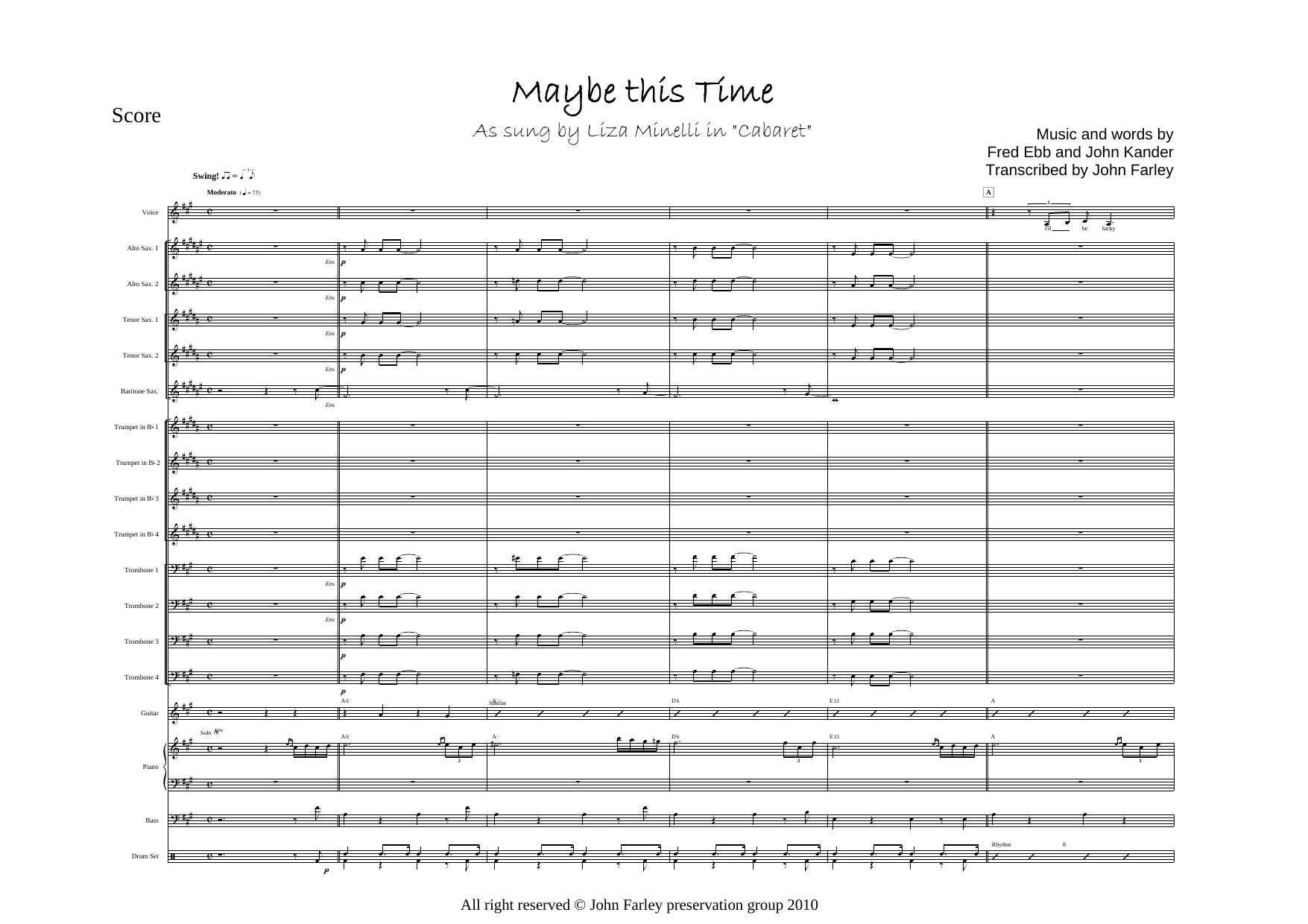
Maybe This Time (J.Farley)
Composed by John Kander
Arranged by John Farley
- Ensemble: Big Band
- Pages: 36
- Instruments (18): Vocal, Alto Sax. 1, Alto Sax. 2, Tenor Sax. 1, Tenor Sax. 2, Baritone Sax., Trumpet in Bb 1, Trumpet in Bb 2, Trumpet in Bb 3, Trumpet in Bb 4, Trombone 1, Trombone 2, Trombone 3, Trombone 4, Guitar, Piano, Bass, Drum Set
- Difficulty: medium
- Content: Individual Parts
- Format: PDF Download (Instant)
- Price: $24.99
Originally written by John Kander and Fred Ebb for the 1972 cinematic masterpiece *Cabaret*—where it was immortalized by Liza Minnelli—"Maybe This Time" occupies a unique intersection between Broadway dramatic storytelling and sophisticated cabaret jazz. While initially conceived as a theatrical character song about desperate hope and romantic longing, the composition’s underlying minor-mode tension, soaring sequential melodies, and dramatic harmonic architecture have made it a magnetic vehicle for jazz interpreters ranging from Tony Bennett to Carmen McRae. John Farley’s masterful big band adaptation reimagines the classic tune as a smoldering, mid-tempo jazz waltz (3/4 time), shifting the emotional landscape from Broadway pathos to late-night club sophistication. The arrangement opens with a rubato, atmospheric intro featuring sparse piano and muted trumpet voicings before settling into a supple, undulating groove driven by a lightly walking bassline and crisp ride cymbal. The mood is at once bittersweet and resilient, balancing lush, extended chord structures in the saxophones with biting, sophisticated brass countermelodies that evoke the smoky atmosphere of a 1930s Berlin jazz cellar crossed with mid-century West Coast cool. Farley’s structural approach relies heavily on dynamic contrast and textural variety. The arrangement features a gorgeous, four-part harmonized saxophone soli that reinterprets the verse material with rich, contemporary modal colorations. As the chart builds toward its emotional apex, a deftly constructed modulation elevates the tension, leading into a powerful, ensemble-wide shout chorus that showcases the full dynamic breadth of an 8-piece or reduced big band instrumentation. Rather than relying on sheer volume, the climax achieves its impact through dense vertical voicings and rhythmic syncopation that forces the ensemble to lock in tightly with the rhythm section. Tailored specifically for an 8-instrument lineup (Vocal, Alto Sax, Tenor Sax, Trumpet, Trombone, plus a full rhythm section), this 36-page set of parts demands a high degree of musical maturity and stylistic versatility. It is ideally suited for advanced high school ensembles, collegiate jazz orchestras, and professional freelance big bands looking to feature a compelling vocalist. The vocal part sits comfortably in a mid-range suitable for a wide variety of singers, though the interpreter must possess the theatrical nuance necessary to deliver the lyric's emotional narrative. Instrumentalists will find the chart deeply rewarding for its emphasis on balance, intonation, and subtle swing phrasing over fast technical display. Conductors should approach this arrangement with an emphasis on rubato flexibility and elastic phrasing, particularly during the vocal introduction and transitional interludes. The primary groove is a flowing, expressive jazz waltz; the rhythm section must maintain a steady, hypnotic pulse without ever feeling heavy-handed or rigid. Drummers should utilize brush work or light stick combinations that accent beat 2 and 3 subtly to keep the 3/4 momentum moving forward. Brass players should pay close attention to dynamic markings, utilizing cup or harmon mutes where indicated to create the signature textural warmth characteristic of Farley’s orchestration. Intonation within the saxophone soli requires careful listening across the section, as the extended tertian and quartal harmonies will expose any minor pitch discrepancies. Rehearsal should begin with section-only work on the dynamic swells of the shout chorus, ensuring the band can peak together without forcing their tone. Q: What instruments and parts are included in this arrangement? A: The chart is scored for an 8-instrument core ensemble consisting of a lead Vocal part, Alto Saxophone, Tenor Saxophone, Trumpet, Trombone, and a standard rhythm section (Piano, Bass, and Drums), spanning a comprehensive 36-page manuscript. Q: What is the difficulty level of this John Farley arrangement? A: This arrangement is rated advanced-intermediate to advanced, primarily due to its sophisticated harmonic language, stylistic demands in 3/4 jazz waltz time, and the requirement for tight ensemble blend within a smaller 8-piece instrumentation. Q: What is the style and historical context of "Maybe This Time"? A: Originally composed by John Kander for the film *Cabaret*, this arrangement transforms the classic theatrical number into a sophisticated jazz waltz, drawing on the traditions of vocal jazz standards and smoky late-night club styling. Q: What makes this specific arrangement by John Farley unique? A: Farley’s chart stands out through its clever use of modal colorations, a lush harmonized saxophone soli, and an expertly paced modulation that builds intense emotional release without requiring a full-sized 17-piece big band. Q: What is the performance duration and recommended tempo for this piece? A: The arrangement runs approximately 4 to 5 minutes in duration and is designed to be performed at a comfortable, flowing medium jazz waltz tempo of around quarter note = 120-126 BPM.
Questions and answers
- What is included in the Maybe This Time (J.Farley) PDF?
- The verified current file contains a conductor score and individual parts across 36 pages.
- How many instruments or parts are listed for Maybe This Time (J.Farley)?
- The verified instrumentation list contains 18 entries for this Big Band arrangement.
- Who is credited for Maybe This Time (J.Farley)?
- Composer: John Kander. Arranger: John Farley.
- What difficulty is listed for Maybe This Time (J.Farley)?
- The verified difficulty level is medium.
- Can I preview Maybe This Time (J.Farley) before buying?
- Yes. The product page provides a preview generated from the current PDF file.
- How is Maybe This Time (J.Farley) delivered?
- After successful payment, the digital PDF is made available for download. The displayed price is $24.99.
Musicians Also Search For
Maybe This Time John Farley PDF • Maybe This Time John Farley sheet music • Maybe This Time arranged by John Farley • John Farley big band charts • John Farley jazz arrangements PDF • Maybe This Time John Kander sheet music • Maybe This Time John Kander big band arrangements • John Kander big band charts • Maybe This Time big band arrangements • Maybe This Time big band PDF download • Maybe This Time jazz sheet music • big band sheet music download • Maybe This Time conductor score PDF • Maybe This Time individual parts download • Maybe This Time sheet music PDF • buy Maybe This Time sheet music • download Maybe This Time PDF • Maybe This Time jazz charts • best John Farley big band arrangements • John Kander arranged by John Farley • Maybe This Time printable sheet music • big band repertoire PDF