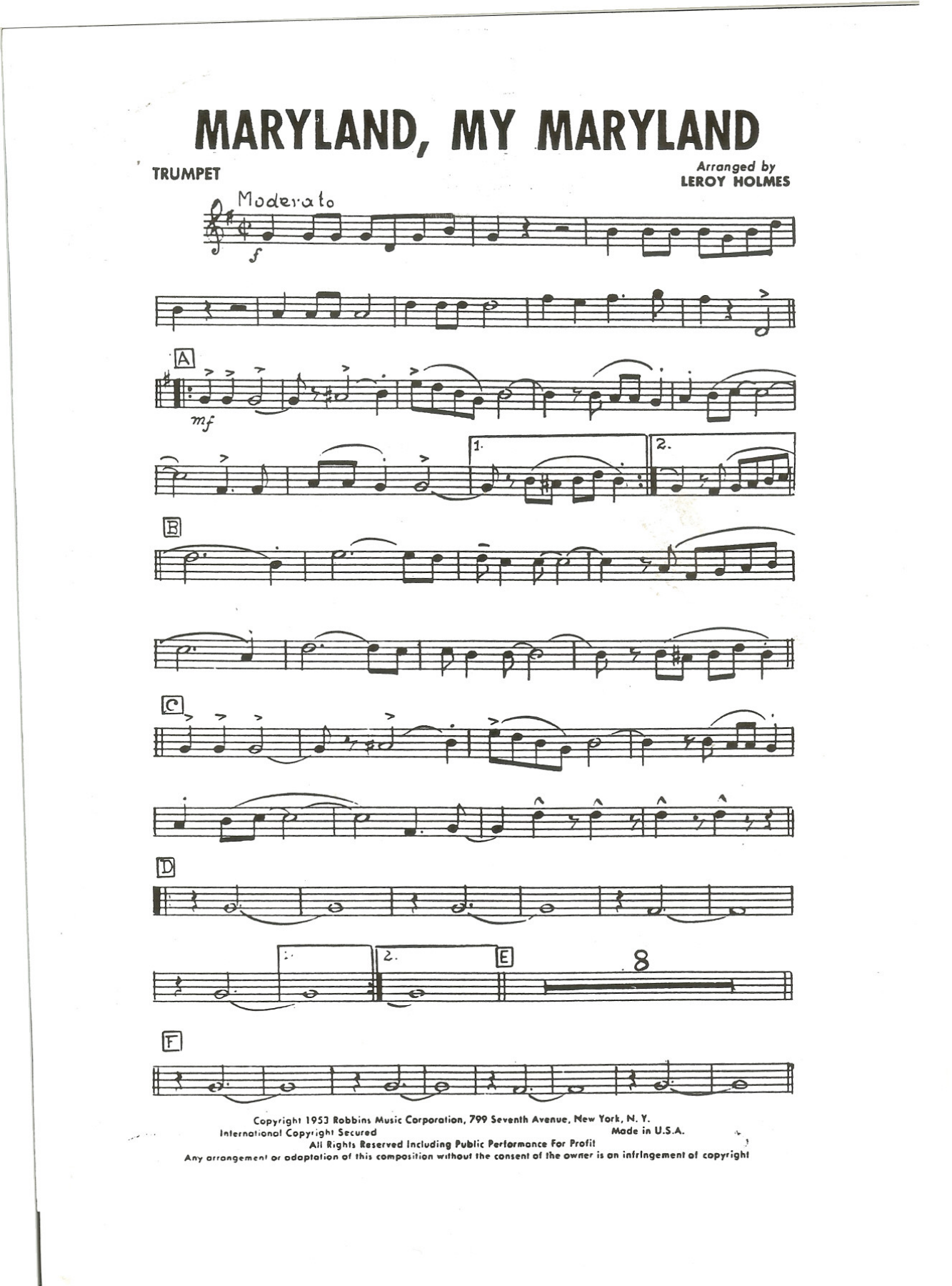
Maryland, My Maryland (L.Holmes) sheet music preview

Maryland, My Maryland (L.Holmes)

Composed by James Ryder Randall

Arranged by L.Holmes

  • Ensemble: Dixieland Band
  • Style: Traditional
  • Pages: 17
  • Difficulty: easy
  • Content: Sheet Music
  • Format: PDF Download (Instant)
  • Price: $18.99

"Maryland, My Maryland" originates from a nine-stanza poem penned by James Ryder Randall in April 1861, amidst the tumultuous early days of the American Civil War. Outraged by Union troop movements through Baltimore, Randall, a Maryland native teaching in Louisiana, wrote the poem as a powerful call to his home state to join the Confederacy. It was quickly set to the traditional German folk melody "Lauriger Horatius," famously known today as "O Tannenbaum." This martial anthem became immensely popular throughout the South, often dubbed "the Marseillaise of the South," and served as Maryland's official state song from 1939 until its repeal in 2021 due to its controversial pro-Confederate lyrics. The piece embodies the raw, impassioned sentiment of a divided nation, reflecting a pivotal moment in American history through its stirring, familiar melody. L.Holmes’s arrangement of "Maryland, My Maryland" breathes new life into this historic tune, reimagining it through the vibrant lens of traditional Dixieland jazz. This rendition captures the celebratory, polyphonic spirit characteristic of early 20th-century New Orleans jazz, a style that emerged from a rich blend of ragtime, blues, and military brass band influences. The musical character is an energetic, medium-up tempo two-beat feel, typical of Dixieland, often counted as "1-2, 1-2" rather than "1-2-3-4". The arrangement maintains a bright, optimistic mood, contrasting with the original's somber, defiant lyrical context, and is likely set in a comfortable, accessible key to facilitate the ensemble's collective improvisation. The overall energy is infectious and designed to evoke the lively atmosphere of a parade or a bustling jazz hall. L.Holmes, known for their authentic and engaging Dixieland arrangements, approaches this piece with a keen understanding of the style's core elements. Expect classic Dixieland instrumentation, featuring a "front line" of trumpet (or cornet), clarinet, and trombone, supported by a rhythm section that typically includes piano, banjo (or guitar), tuba (or string bass), and drums. The arrangement will prominently feature collective improvisation, where the trumpet carries the main melody, the clarinet weaves intricate counter-melodies, and the trombone provides "tailgate" glissandos and rhythmic fills, creating a rich polyphonic texture. Signature L.Holmes techniques might include well-crafted soli sections that showcase the brass or reeds in unison or harmony, and dynamic shout choruses designed to build excitement. The arrangement is structured to highlight the interplay between instruments, with clear melodic statements often passed between the front-line horns, interspersed with opportunities for featured soloists to improvise over the driving rhythm section. Technical challenges will primarily involve maintaining tight ensemble cohesion during collective improvisation and executing characteristic Dixieland articulations like smears, slides, and falls. The reward lies in the sheer joy of performing this historically significant melody with the spontaneous, effervescent energy of a Dixieland band. This arrangement is ideally suited for high school, college, and community Dixieland bands, as well as professional ensembles seeking an authentic and spirited take on a classic tune. Its accessible structure and clear delineation of parts make it an excellent teaching tool for introducing musicians to the nuances of Dixieland style, collective improvisation, and traditional jazz voicings. More advanced ensembles will appreciate the opportunities for expressive interpretation and the chance to showcase individual and collective virtuosity within a well-defined framework. The 17 pages of sheet music suggest a comprehensive arrangement that provides ample material for a full performance, making it a valuable addition to any Dixieland repertoire. This Dixieland arrangement of "Maryland, My Maryland" thrives on a medium-up tempo, aiming for approximately 180-200 BPM, with a buoyant two-beat feel that drives the ensemble forward. Conductors should emphasize a light, swinging eighth-note interpretation, avoiding a rigid, straight feel. Key technical challenges include maintaining rhythmic precision within the collective improvisation sections; the front line (trumpet, clarinet, trombone) must listen intently to each other to ensure their improvised lines interlock rather than clash. Trombonists should practice their "tailgate" glissandos and smears for authentic stylistic effect. Clarinetists should focus on fluid, agile lines that embellish the melody without obscuring it. Drummers should employ press rolls and a steady, march-influenced snare pattern, while the bass (tuba or string bass) provides a solid, walking two-beat foundation. Rehearsal tips include isolating the collective improvisation sections, encouraging musicians to experiment with melodic fragments and counter-melodies, and gradually building the ensemble sound. Special techniques like plunger mutes for brass or subtle falls at the end of phrases can add significant character. Q: What instruments/parts are included in this arrangement? A: This arrangement is scored for a standard Dixieland band, typically including trumpet (or cornet), clarinet, trombone, piano, banjo (or guitar), tuba (or string bass), and drums. Specific parts for each of these instruments are provided. Q: What is the difficulty level of this arrangement? A: This arrangement is suitable for intermediate to advanced Dixieland ensembles, including high school, college, community, and professional bands. It offers accessible melodic lines while providing ample opportunities for stylistic interpretation and collective improvisation. Q: What is the musical style and historical context of this arrangement? A: This is a Dixieland jazz arrangement of "Maryland, My Maryland," a tune originally set to a Civil War-era poem from 1861. The arrangement captures the traditional jazz style that emerged from New Orleans in the early 20th century, characterized by collective improvisation and a lively two-beat feel. Q: What makes L.Holmes's arrangement of "Maryland, My Maryland" unique? A: L.Holmes's treatment is distinctive for its authentic Dixieland voicings, engaging collective improvisation sections, and dynamic shout choruses. It transforms a historically significant, martial tune into a vibrant and celebratory jazz piece, showcasing the arranger's deep understanding of the genre. Q: What is the typical performance duration or tempo for this piece? A: This arrangement is designed for a medium-up tempo, approximately 180-200 BPM, maintaining a lively two-beat swing feel. The exact performance duration will vary depending on the number and length of improvised solos, but typically ranges from 3 to 5 minutes.

Musicians Also Search For

Maryland, My Maryland L.Holmes PDFMaryland, My Maryland L.Holmes sheet musicMaryland, My Maryland arranged by L.HolmesL.Holmes dixieland band chartsL.Holmes jazz arrangements PDFMaryland, My Maryland James Ryder Randall sheet musicMaryland, My Maryland James Ryder Randall dixieland band arrangementJames Ryder Randall dixieland band chartsMaryland, My Maryland dixieland band arrangementMaryland, My Maryland dixieland band PDF downloadMaryland, My Maryland jazz ensemble sheet musicdixieland band sheet music instant downloadMaryland, My Maryland sheet music with partsMaryland, My Maryland Traditional chartTraditional dixieland band arrangementsbuy Maryland, My Maryland sheet music onlinedownload Maryland, My Maryland PDFMaryland, My Maryland jazz chartbest L.Holmes dixieland band arrangementsJames Ryder Randall songs arranged by L.HolmesMaryland, My Maryland printable sheet musicdixieland band repertoire PDF

All arrangements by L.Holmes All James Ryder Randall sheet music