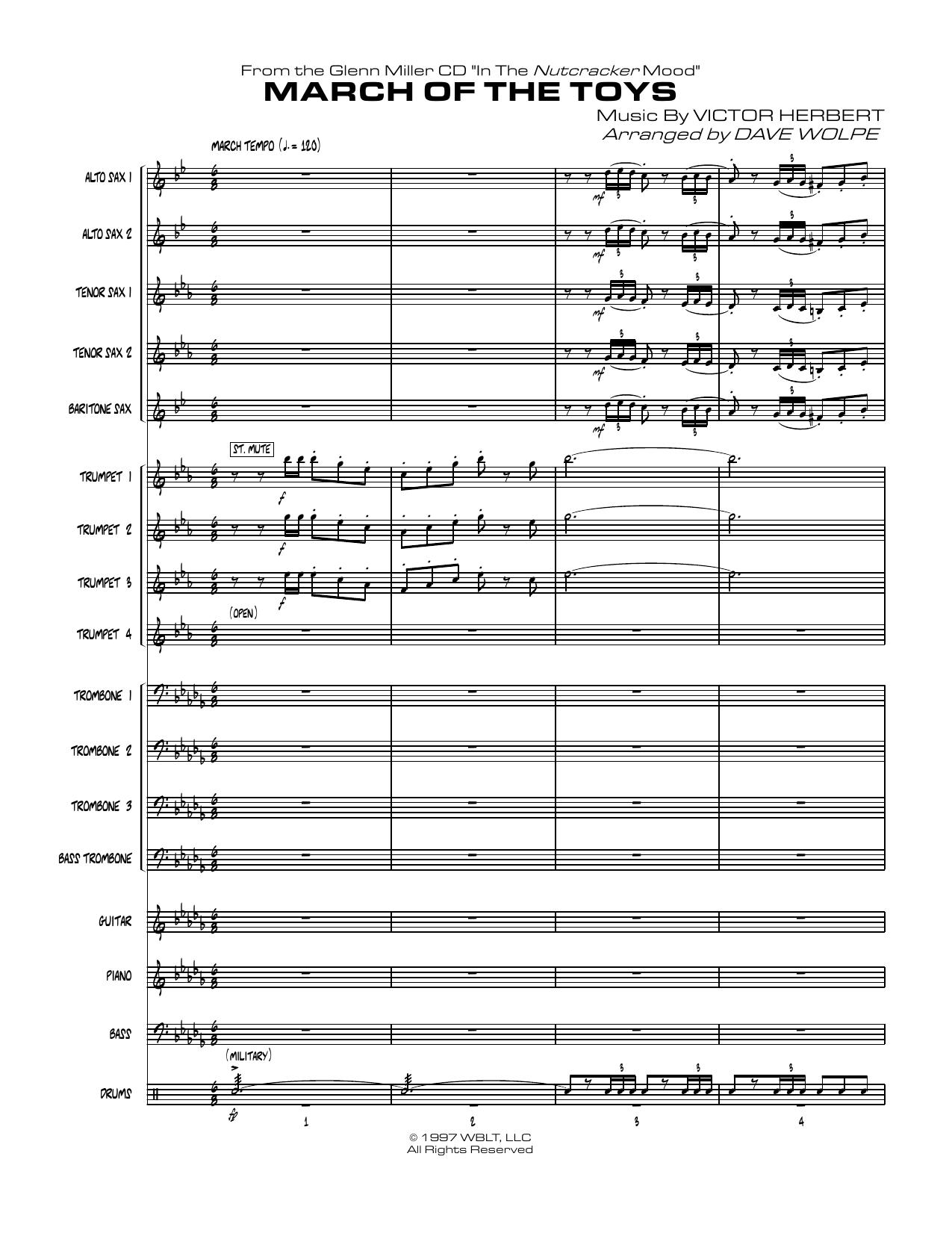
March Of The Toys G. Miller (D.Wolpe)
Composed by Victor Herbert
Arranged by Dave Wolpe
- Ensemble: Big Band
- Pages: 78
- Instruments (17): Alto Sax 1, Alto Sax 2, Tenor Sax 1, Tenor Sax 2, Baritone Sax, Trumpet 1, Trumpet 2, Trumpet 3, Trumpet 4, Trombone 1, Trombone 2, Trombone 3, Bass Trombone, Guitar, Piano, Bass, Drums
- Difficulty: advanced
- Content: Individual Parts
- Format: PDF Download (Instant)
- Price: $24.99
Victor Herbert’s whimsical 1903 operetta classic *Babes in Toyland* gained a vibrant new lease on life when the legendary Glenn Miller Orchestra and contemporary big band arrangers reimagined its most iconic themes for jazz ensemble. "March of the Toys" bridges the gap between turn-of-the-century light classical parlor music and mid-century swing brilliance, offering a fascinating glimpse into how traditional melodies can be successfully retrofitted for the jazz idiom. While Herbert’s original composition relies on marching percussion and playful, programmatic orchestration, the big band adaptation transforms it into a tightly wound, rhythmically infectious showcase that retains all of the original’s theatrical charm while injecting authentic brass-and-reed swagger. Driven by an energetic, buoyant medium-swing tempo, this arrangement radiates a playful yet sophisticated mood. The harmonic language balances familiar diatonic movements with clever secondary dominants and unexpected chord substitutions that give the chart a distinctly modern jazz flavor without alienating audiences. The energy builds steadily from a crisp, mechanical opening motif into a full-throated celebration of swinging syncopation. Listeners will immediately recognize the iconic descending melodic lines, but the treatment feels entirely fresh, evoking a cinematic sense of clockwork precision colliding with uninhibited jazz-age joy. Master arranger Dave Wolpe is renowned for his uncanny ability to write idiomatically for big bands of varying capabilities, capturing the essence of the swing era with clean, playable, yet rich voicings. In this chart, Wolpe utilizes tight section writing, classic block-chord sax solis, and dynamic counterpoint that mirrors the mechanical bustle of a toy factory. The brass writing features crisp articulations—including deliberate staccatos and controlled falls—that demand absolute precision from the section players. Wolpe avoids overcomplicating the form, instead allowing the brilliant juxtaposition of heavy swing grooves and lighter, detached march-like passages to do the heavy lifting stylistically. The melody is shared gracefully across the ensemble, moving fluidly from a bright clarinet-doubled or high-register saxophone statement into powerful brass declarations. The chart includes well-crafted transitional moments that highlight the rhythm section's ability to drive a steady, buoyant swing feel, alongside an engaging section that invites featured soloists to stretch out within comfortable modern-swing changes. Advanced high school bands, collegiate ensembles, and professional community big bands will find this arrangement remarkably rewarding. It offers enough technical demands in terms of articulation and stylistic discipline to challenge developing players, while providing the sophisticated harmonic color and rhythmic drive necessary to satisfy seasoned performers and appreciative audiences alike. Achieving the right stylistic balance between a traditional march feel and a loose, swinging jazz groove is the primary challenge of this arrangement. The tempo should remain steady and forward-moving, avoiding any tendency to drag during the denser contrapuntal passages. Conductor focus must be placed on section articulation: the eighth notes should be played with a traditional medium-swing interpretation—long on the upbeats, clipped and accented on the downbeats where indicated. The rhythm section needs to lock in tight; the drummer should utilize a crisp ride-cymbal pattern that emphasizes beats two and four, keeping the dynamic level transparent during horn solis so the inner voices remain audible. Horn players should pay close attention to dynamic contrast, ensuring that background figures do not obscure the primary melodic line. Rehearsal time is best spent isolating the rhythmically tricky syncopations in the brass section and ensuring the saxophones achieve a unified, homogenous blend during their key soli moments. Q: What instruments and parts are included in this big band arrangement? A: The complete 17-instrument big band instrumentation features Alto Saxophone 1, Alto Saxophone 2, Tenor Saxophone 1, Tenor Saxophone 2, Baritone Saxophone, 4 Trumpets, 4 Trombones, Piano, Guitar, Bass, and Drums, backed by a comprehensive 78-page score. Q: What is the difficulty level of this Dave Wolpe chart? A: This arrangement is graded as medium-advanced, making it an ideal fit for strong high school jazz ensembles, collegiate bands, and professional community big bands looking for solid swing-era stylistic challenges. Q: What is the historical background and musical style of this piece? A: Originally composed by Victor Herbert in 1903 for the operetta *Babes in Toyland*, this version reimagines the classical theme through a vibrant, mid-century jazz and swing lens popularized by big band legends like Glenn Miller. Q: What makes this specific arrangement by Dave Wolpe unique? A: Wolpe uniquely blends the mechanical, march-like cadence of Herbert's original composition with sophisticated big band voicings, clever harmonic substitutions, and classic sax solis that maintain high theatrical energy throughout. Q: What is the recommended performance duration and tempo feel for this arrangement? A: The piece is structured around an energetic medium-swing tempo designed to run approximately 3 to 4 minutes, requiring precise articulation and a steady, driving rhythmic pulse from the entire ensemble.
Questions and answers
- What is included in the March Of The Toys G. Miller (D.Wolpe) PDF?
- The verified current file contains a conductor score and individual parts across 78 pages.
- How many instruments or parts are listed for March Of The Toys G. Miller (D.Wolpe)?
- The verified instrumentation list contains 17 entries for this Big Band arrangement.
- Who is credited for March Of The Toys G. Miller (D.Wolpe)?
- Composer: Victor Herbert. Arranger: Dave Wolpe.
- What difficulty is listed for March Of The Toys G. Miller (D.Wolpe)?
- The verified difficulty level is advanced.
- Can I preview March Of The Toys G. Miller (D.Wolpe) before buying?
- Yes. The product page provides a preview generated from the current PDF file.
- How is March Of The Toys G. Miller (D.Wolpe) delivered?
- After successful payment, the digital PDF is made available for download. The displayed price is $24.99.
Musicians Also Search For
March Of The Toys G. Miller Dave Wolpe PDF • March Of The Toys G. Miller Dave Wolpe sheet music • March Of The Toys G. Miller arranged by Dave Wolpe • Dave Wolpe big band charts • Dave Wolpe jazz arrangements PDF • March Of The Toys G. Miller Victor Herbert sheet music • March Of The Toys G. Miller Victor Herbert big band arrangements • Victor Herbert big band charts • March Of The Toys G. Miller big band arrangements • March Of The Toys G. Miller big band PDF download • March Of The Toys G. Miller jazz sheet music • big band sheet music download • March Of The Toys G. Miller conductor score PDF • March Of The Toys G. Miller individual parts download • March Of The Toys G. Miller sheet music PDF • buy March Of The Toys G. Miller sheet music • download March Of The Toys G. Miller PDF • March Of The Toys G. Miller jazz charts • best Dave Wolpe big band arrangements • Victor Herbert arranged by Dave Wolpe • March Of The Toys G. Miller printable sheet music • big band repertoire PDF