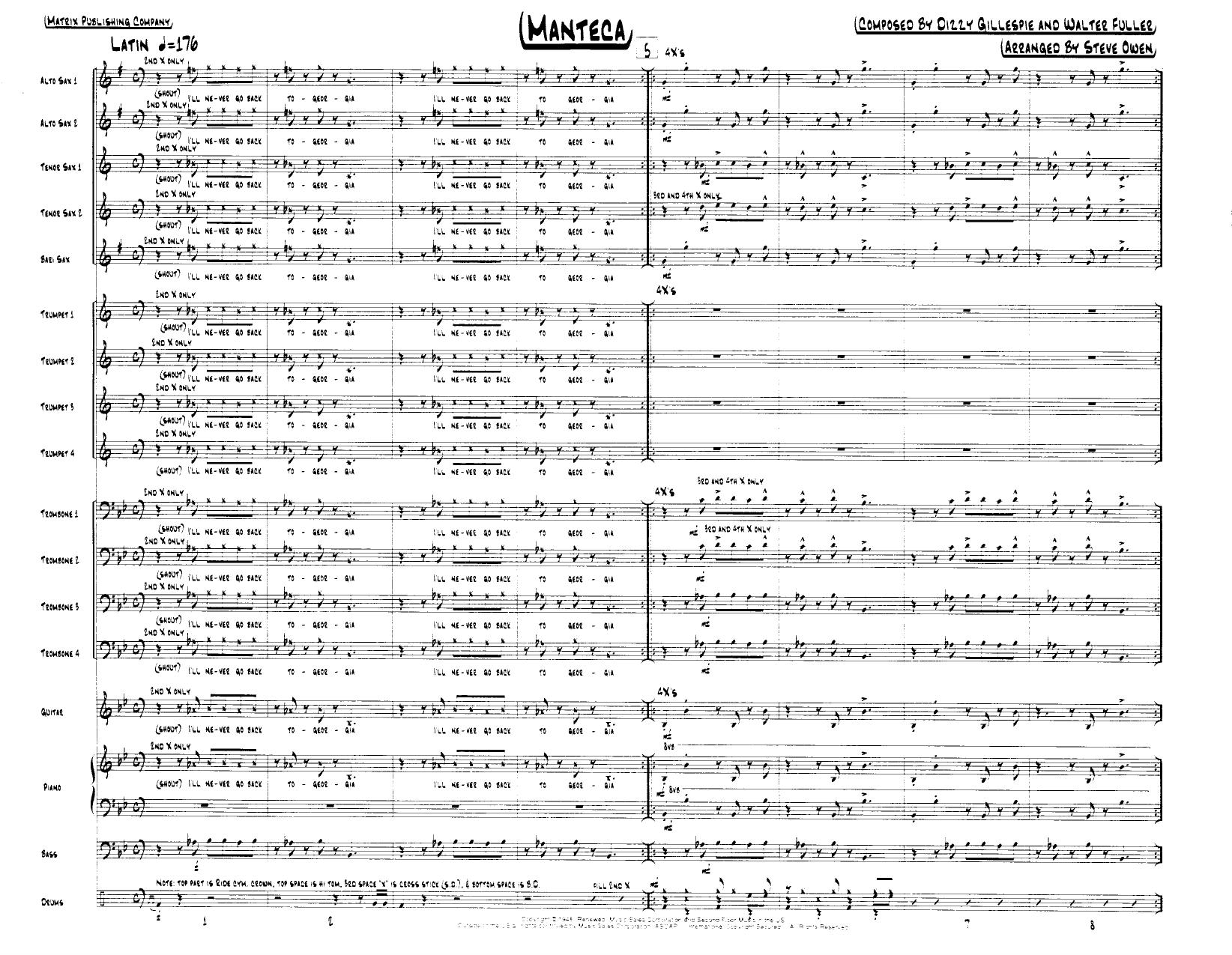
Manteca (S.Owen)
Composed by Dizzy Gillespie
Arranged by Gil Fuller-D.GILLESPIE
- Ensemble: Big Band
- Pages: 47
- Instruments (17): Alto Sax 1, Alto Sax 2, Tenor Sax 1, Tenor Sax 2, Bari Sax, Trumpet 1, Trumpet 2, Trumpet 3, Trumpet 4, Trombone 1, Trombone 2, Trombone 3, Trombone 4, Guitar, Piano, Bass, Drums
- Difficulty: medium
- Content: Individual Parts
- Format: PDF Download (Instant)
- Price: $24.99
Bebop pioneer Dizzy Gillespie and Cuban conguero Chano Pozo forever altered the landscape of American music in 1947 by crafting "Manteca," the foundational masterwork of Afro-Cuban jazz. Recorded initially by the Dizzy Gillespie Big Band with an arrangement co-penned by Gil Fuller and Dizzy Gillespie himself, this landmark composition bridged the harmonic sophistication of modern bebop with the infectious, rhythmic vitality of traditional Cuban drumming. As one of the earliest and most successful fusions of North American jazz and Latin percussion, "Manteca" stands today as an essential pillar of the big band repertoire, celebrated for its driving montuno sections, powerful brass stabs, and irresistible syncopated groove. Exploding out of the gate with an unmistakable, high-energy Latin-jazz groove in 4/4 time, the chart alternates dynamically between aggressive, rhythmically complex unison lines and expansive, swinging shout choruses. The mood shifts masterfully from dark, tension-building minor-key vamps in the low reeds and brass to exuberant, celebratory brass explosions that capture the peak excitement of the 1940s jazz club scene. The arrangement derives its immense emotional power from the friction between heavy Afro-Cuban percussion patterns and sophisticated bebop horn voicings, creating a visceral, pulse-pounding sonic landscape that demands total physical and mental commitment from every section on stage. Gil Fuller and Dizzy Gillespie’s collaborative arrangement approaches the material with a brilliant balance of percussive authenticity and big band muscle. Fuller utilizes tight, punchy block-chord voicings for the saxophones that cut cleanly through the dense rhythmic undercurrent, while the brass section is deployed in dramatic call-and-response figures that mimic traditional Cuban rumba structures before opening up into roaring, high-register counterlines. Rather than treating the Latin elements as mere window dressing, the arrangement integrates the clave directly into the architectural framework of the charts, giving the ensemble sections an authentic, interlocking momentum that drives relentlessly toward the climax. Carrying the iconic, jagged main theme are the lead trumpet and alto saxophone, supported closely by the tenor and baritone saxophones anchoring the heavy rhythmic riffs. The chart features designated solo spaces—traditionally showcasing fiery trumpet and tenor saxophone improvisations over driving modal and blues-based vamps—alongside a powerhouse shout chorus that tests the endurance and articulation precision of the entire brass roster. Advanced high school bands with strong section players, collegiate ensembles, and professional big bands will find this arrangement an exhilarating centerpiece for concerts and festivals. It rewards precise articulation, immaculate section blending, and a deep, intuitive understanding of the intersection between swing and Afro-Cuban groove. Achieving success with this arrangement requires a rhythm section that firmly understands the mechanics of Afro-Cuban styles, particularly the interplay between the bass and the congas or auxiliary percussion. The tempo must remain locked and driving without rushing during the swinging sections; maintain a steady, unyielding pulse throughout the 4/4 transitions. Brass players should approach the staccato accents with crisp, dry tongue placement, avoiding excessive weight on short notes to keep the texture transparent. Saxophone solis demand absolute unanimity in phrasing and intonation, especially when navigating the chromatic bebop lines embedded within the Latin framework. Directors should rehearse the ensemble in distinct layers: first establishing the rhythm section's montuno groove independently, then layering the low-frequency horn riffs before introducing the soaring high-register melodies. Pay close attention to dynamic contrast between the subdued, tension-building vamps and the explosive, wide-open ensemble tuttis. Q: What instruments and parts are included in this 8-instrument big band arrangement? A: The arrangement is scored for an 8-instrument ensemble format comprising Alto Saxophone, Tenor Saxophone, Baritone Saxophone, Trumpet, and Trombone parts, alongside essential rhythm section support tailored to fit compact big band instrumentations. Q: What is the official difficulty level of this Gil Fuller and Dizzy Gillespie arrangement? A: This chart is best suited for advanced high school, collegiate, and professional jazz ensembles due to its demanding tempo, technical bebop-infused horn lines, and complex rhythmic coordination. Q: What is the historical and stylistic background of "Manteca"? A: Composed by Dizzy Gillespie and Chano Pozo with an arrangement by Gil Fuller and Dizzy Gillespie, "Manteca" premiered in 1947 and is widely recognized as the composition that birthed the Afro-Cuban jazz movement. Q: What makes this specific arrangement by Gil Fuller and Dizzy Gillespie unique? A: It uniquely integrates authentic Afro-Cuban rhythmic structures and clave-based vamps with sophisticated 1940s bebop horn voicings and high-impact big band shout choruses. Q: What is the typical performance duration and tempo feel of this piece? A: The arrangement runs approximately 4 to 5 minutes in length and features an energetic, driving Afro-Cuban Latin groove that transitions dynamically into driving swing sections.
Questions and answers
- What is included in the Manteca (S.Owen) PDF?
- The verified current file contains a conductor score and individual parts across 47 pages.
- How many instruments or parts are listed for Manteca (S.Owen)?
- The verified instrumentation list contains 17 entries for this Big Band arrangement.
- Who is credited for Manteca (S.Owen)?
- Composer: Dizzy Gillespie. Arranger: Gil Fuller-D.GILLESPIE.
- What difficulty is listed for Manteca (S.Owen)?
- The verified difficulty level is medium.
- Can I preview Manteca (S.Owen) before buying?
- Yes. The product page provides a preview generated from the current PDF file.
- How is Manteca (S.Owen) delivered?
- After successful payment, the digital PDF is made available for download. The displayed price is $24.99.
Musicians Also Search For
Manteca Gil Fuller-D.GILLESPIE PDF • Manteca Gil Fuller-D.GILLESPIE sheet music • Manteca arranged by Gil Fuller-D.GILLESPIE • Gil Fuller-D.GILLESPIE big band charts • Gil Fuller-D.GILLESPIE jazz arrangements PDF • Manteca Dizzy Gillespie sheet music • Manteca Dizzy Gillespie big band arrangements • Dizzy Gillespie big band charts • Manteca big band arrangements • Manteca big band PDF download • Manteca jazz sheet music • big band sheet music download • Manteca conductor score PDF • Manteca individual parts download • Manteca sheet music PDF • buy Manteca sheet music • download Manteca PDF • Manteca jazz charts • best Gil Fuller-D.GILLESPIE big band arrangements • Dizzy Gillespie arranged by Gil Fuller-D.GILLESPIE • Manteca printable sheet music • big band repertoire PDF