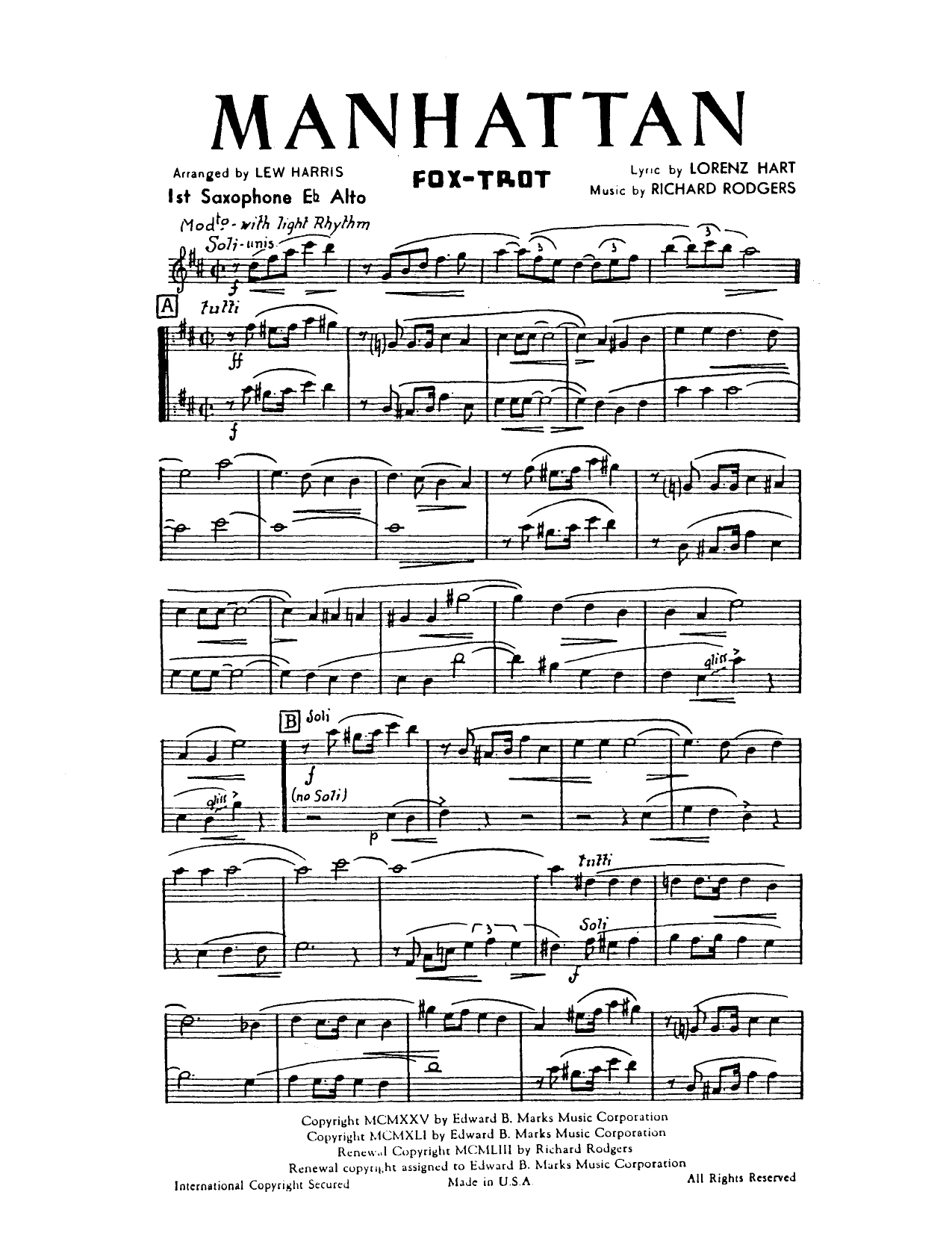
Manhattan (L.Harris)
Composed by Richard Rodgers
Arranged by L.Harris
- Ensemble: Big Band Dance
- Style: Jazz Standard
- Pages: 30
- Instruments (14): 1st Saxophone Eb Alto, 3rd Saxophone Eb Alto, 2nd Saxophone Bb Tenor, 4th Saxophone Bb Tenor, 1st Trumpet in Bb, 2nd Trumpet in Bb, 3rd Trumpet in Bb, 1st Trombone, 2nd Trombone, Piano, Bass, Drums, Guitar, Violins A, B
- Difficulty: medium
- Content: Individual Parts
- Format: PDF Download (Instant)
- Price: $24.99
Composed in 1925 by Richard Rodgers with lyrics by Lorenz Hart, "Manhattan" stands as one of the quintessential jewels of the Great American Songbook, introduced originally in the Broadway musical *The Garrick Gaieties*. Its urbane, witty lyricism and charming, undulating melody quickly captured the imagination of early jazz pioneers, transitioning from a theatrical show tune into an enduring jazz standard recorded by legends ranging from Duke Ellington and Lee Konitz to Ella Fitzgerald. This timeless composition epitomizes the sophisticated optimism of the Roaring Twenties, balancing a relaxed metropolitan elegance with an inherent harmonic sophistication that continues to captivate modern audiences and improvisers alike. Brought to life through a tailored big band dance orchestration, this setting inhabits a buoyant medium-swing groove in 4/4 time, radiating a breezy, sophisticated energy reminiscent of mid-century ballroom swing and classic supper-club elegance. The arrangement maintains a warm, inviting harmonic palette anchored by lush reed voicings and gentle brass underpinnings, evoking the amber-lit atmosphere of a 1930s Manhattan rooftop lounge. Rather than relying on aggressive, high-octane modern dissonance, the mood is nostalgic, urbane, and rhythmically infectious, driven by an effortless walking bassline and a crisp, conversational ride-cymbal pulse. Arranger L.Harris approaches the beloved Rodgers and Hart classic with a deft respect for traditional big band architecture while injecting fresh, colorful counterlines and clever sectional interplay. The writing utilizes classic closed-position and drop-2 chord voicings across the saxophones, blending Alto Saxophones 1 and 3 with Tenor Saxophones 2 and 4 to create a rich, homogeneous reed texture that honors the golden age of swing orchestration. Harmonically, L.Harris subtly refreshes the bridge with unexpected secondary dominants and passing chords that gently push the harmony forward without alienating traditionalists, culminating in a tasteful, tightly knit ensemble shout chorus that balances dynamic restraint with melodic clarity. The melody is shared fluidly across the ensemble, opening with a warm woodwind statement before passing conversational phrases between the trumpet and saxophone sections. Featured solo space allows improvisers to stretch out over standard changes, supported by crisp, conservative background figures that frame the soloist without cluttering the texture. Technically, the arrangement is accessible yet rewarding, placing a premium on section blend, intonation, and a uniform swing articulation rather than blazing tempos or extreme altissimo ranges. The lead trumpet tops out at a manageable register, making the chart exceptionally playable and satisfying for developing groups. Advanced high school ensembles, collegiate jazz orchestras, and professional community big bands will find this arrangement an ideal vehicle for showcasing stylistic versatility, ensemble cohesion, and swing feel. It serves as an exceptional programming choice for a sophisticated dance set, a retrospective concert of 1920s and 30s standards, or as a lyrical palate cleanser in a high-energy contest repertoire, rewarding musicians who prioritize micro-dynamics, pocket placement, and timeless swing phrasing. Achieving the authentic, relaxed feel of this arrangement requires strict attention to the rhythm section's time and the horn section's articulation. Set the tempo at a comfortable medium swing—around 116 to 124 BPM—ensuring the eighth notes are properly swung without being overly dotted or stiff. The primary technical challenge lies in maintaining consistent breath support and pitch center during sustained, close-harmony passages in the saxophones. Conductors should emphasize a warm, vibrato-laden sound reminiscent of traditional swing dance bands. Pay close attention to dynamic contrast; the background figures behind the solo sections must remain strictly sub-tone to allow the soloist room to breathe. Horn players should utilize subtle falls and smears only where explicitly marked, avoiding an overly stylized or cartoonish approach. Rehearsal should begin with the rhythm section locked into a steady, unhurried groove before layering in the horns section by section, focusing intensely on matching the articulation and release of every phrase. Q: What instruments and parts are included in this arrangement? A: This chart is scored for a 14-instrument big band dance ensemble configuration, featuring Alto Saxophone 1, Alto Saxophone 3, Tenor Saxophone 2, Tenor Saxophone 4, Trumpet 1, alongside a standard rhythm section and complementary horns. Q: What is the difficulty level of this arrangement? A: It is moderately graded, making it highly accessible and educational for advanced high school bands, college ensembles, and community jazz orchestras focusing on swing style and section blend. Q: What is the musical style and historical context of this piece? A: It is a classic jazz standard set in a medium-swing dance style, drawing inspiration from the timeless 1925 Richard Rodgers and Lorenz Hart Broadway composition popularized throughout the swing era. Q: What makes L.Harris's arrangement unique? A: L.Harris blends classic big band architecture with clever sectional counterlines, lush drop-2 reed voicings, and subtle harmonic refreshes on the bridge that keep the traditional standard sounding fresh and engaging. Q: What is the recommended performance duration and tempo? A: The arrangement is designed to be performed at a comfortable medium-swing tempo of roughly 116–124 BPM, resulting in a performance duration of approximately 3 to 4 minutes depending on solo choruses.
Questions and answers
- What is included in the Manhattan (L.Harris) PDF?
- The verified current file contains individual parts across 30 pages.
- How many instruments or parts are listed for Manhattan (L.Harris)?
- The verified instrumentation list contains 14 entries for this Big Band Dance arrangement.
- Who is credited for Manhattan (L.Harris)?
- Composer: Richard Rodgers. Arranger: L.Harris.
- What difficulty is listed for Manhattan (L.Harris)?
- The verified difficulty level is medium.
- What style is listed for Manhattan (L.Harris)?
- The catalog lists the style as Jazz Standard.
- Can I preview Manhattan (L.Harris) before buying?
- Yes. The product page provides a preview generated from the current PDF file.
- How is Manhattan (L.Harris) delivered?
- After successful payment, the digital PDF is made available for download. The displayed price is $24.99.
Musicians Also Search For
Manhattan L.Harris PDF • Manhattan L.Harris sheet music • Manhattan arranged by L.Harris • L.Harris big band dance charts • L.Harris jazz arrangements PDF • Manhattan Richard Rodgers sheet music • Manhattan Richard Rodgers big band dance arrangements • Richard Rodgers big band dance charts • Manhattan big band dance arrangements • Manhattan big band dance PDF download • Manhattan jazz sheet music • big band dance sheet music download • Manhattan individual parts download • Manhattan sheet music PDF • Manhattan Jazz Standard charts • Jazz Standard big band dance arrangements • buy Manhattan sheet music • download Manhattan PDF • Manhattan jazz charts • best L.Harris big band dance arrangements • Richard Rodgers arranged by L.Harris • Manhattan printable sheet music • big band dance repertoire PDF