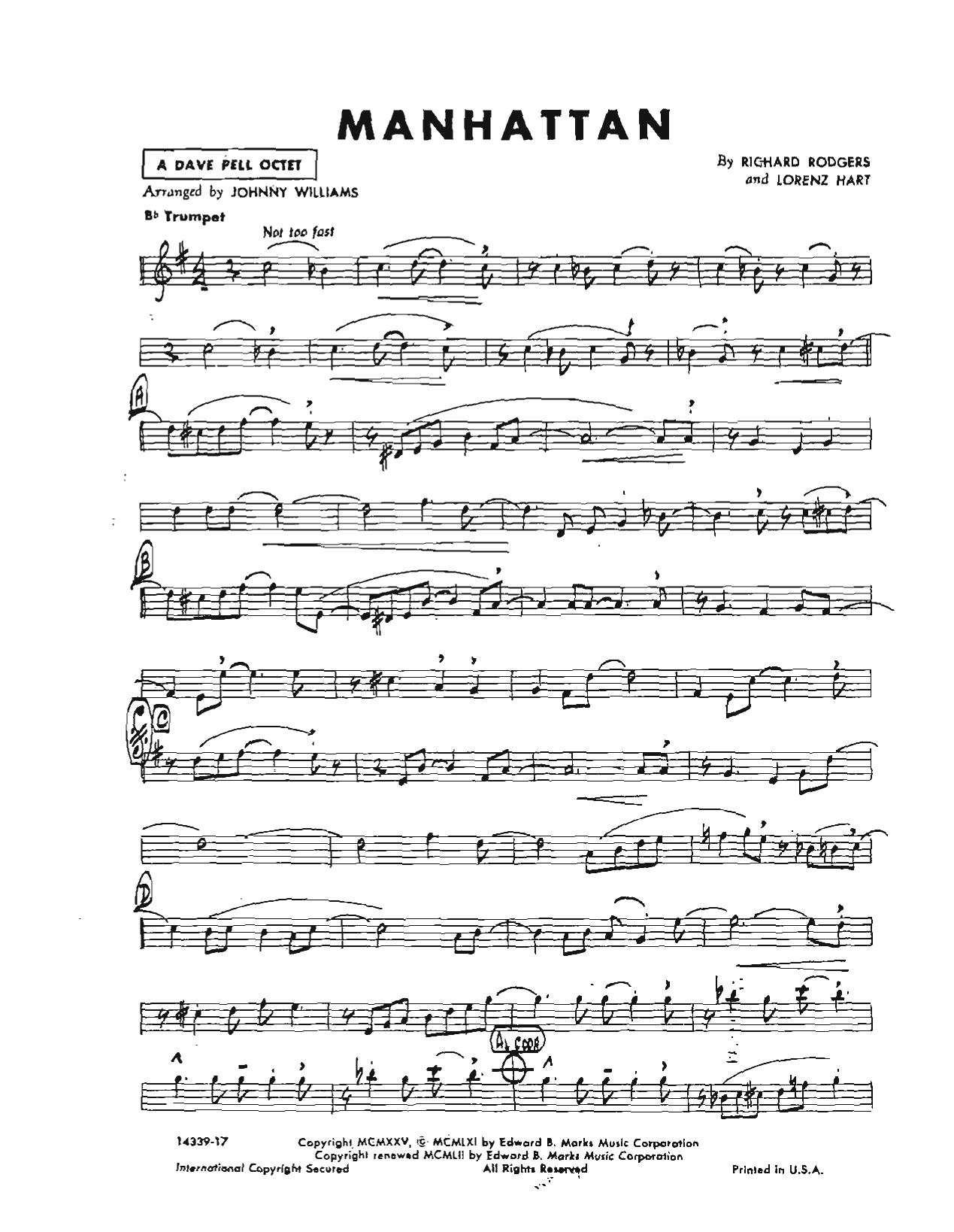
Manhattan (4.Octet)
Composed by Richard Rodgers
Arranged by 4 horns + Rhythm - Williams - Dave Pell Octet
- Ensemble: Small Ensemble
- Style: Jazz Standard
- Pages: 17
- Instruments (8): Bb Trumpet, Bb Tenor Saxophone, Trombone, Eb Baritone Saxophone, Piano, Guitar, Bass, Drums
- Difficulty: easy
- Content: Individual Parts
- Format: PDF Download (Instant)
- Price: $12.99
Richard Rodgers and Lorenz Hart’s timeless 1925 Tin Pan Alley masterpiece "Manhattan" found its definitive cool-jazz instrumental translation through the West Coast idiom, most notably championed by saxophonist Dave Pell and his celebrated octet. Originally introduced in the Broadway musical *Garrick Gaieties*, the tune rapidly transcended its theatrical origins to become a foundational jazz standard. The West Coast or "cool" school approach recast the urbane sophistication of Rodgers' melody into a relaxed yet intellectually stimulating framework, prioritizing linear counterpoint, pristine ensemble intonation, and understated swing over aggressive, high-pressure pyrotechnics. This specific small-ensemble adaptation for four horns and rhythm section distills the rich harmonic palette of the classic octet tradition into an agile, transparent texture. Driven by an effortless, buoyant medium-swing feel in a comfortable key center, the arrangement radiates a sophisticated, metropolitan mood. The energy is cool, confident, and driving without ever becoming bombastic, perfectly capturing the breezy optimism and romanticism of mid-century Manhattan streetscapes. The rhythm section lays down a feather-light yet propulsive comping foundation, allowing the frontline horns to weave intricate countermelodies and crisp harmonic statements with maximum clarity. The arranger's approach leverages the unique coloring potential of a four-horn frontline—typically comprising alto saxophone, tenor saxophone, baritone saxophone (or trumpet), and trombone—by employing tight, West Coast-style block voicings reminiscent of the historic Marty Paich and Dave Pell configurations. Rather than relying on massive, heavy-handed shout choruses, this chart builds excitement through clever polyphonic interplay, subtle dynamic shifts, and seamless transitions between harmonized soli sections and driving solo spaces. The arrangement opens with a characteristic hook-laden intro before handing the primary melodic statements to the frontline in sophisticated unison and harmonized variations. Featured improvised solo sections provide ample opportunity for horn players to stretch out over standard changes while maintaining the sophisticated, linear mindset inherent to the cool jazz style. Technical challenges here reside less in extreme range or blinding speed and more in the realm of stylistic precision: achieving uniform articulation, a balanced blend across the mixed horn voicing, and an immaculate, laid-back swing eighth-note subdivision. The reward for the ensemble lies in the sheer elegance of the chart; every voice has an active, melodically interesting line that contributes to the rich harmonic tapestry. Advanced high school ensembles, collegiate jazz combos, and professional pick-up groups alike will find this arrangement an ideal vehicle for developing ensemble listening and stylistic finesse. Because the texture is transparent, every player is exposed, making it an exceptional educational tool for refining intonation and stylistic unity. At the same time, its professional pedigree ensures that it commands the attention of sophisticated audiences in any club or concert hall setting. Success with this West Coast-style octet arrangement hinges on mastering a relaxed, forward-moving medium-swing tempo (approx. quarter note = 120-126). Avoid rushing; the groove must feel spacious and conversational, driven from the ride cymbal and a crisp, unforced high-hat on beats two and four. The primary technical challenge lies in achieving absolute stylistic uniformity across the four-horn frontline, particularly during tightly voiced soli passages where breath attacks, release lengths, and vibrato usage must match precisely. Horn players should keep their tone focused and lean, avoiding heavy, wide vibrato in favor of a cooler, more modern 1950s aesthetic. Articulation should generally feature light tongue-strokes on upbeats with natural slurs over bar lines to maintain horizontal momentum. Rehearsal should begin by isolating the rhythm section to lock in the comping density before layering in the horns voice by voice, ensuring that inner harmony parts balance cleanly against the lead melody without burying counterlines. Q: What instruments and parts are included in this arrangement? A: The chart is scored for a small jazz ensemble consisting of four horns (typically two saxophones, trumpet, and trombone) plus a standard rhythm section of piano, bass, and drums, spanning 17 pages and including a full conductor score. Q: What is the difficulty level of this chart? A: It is graded as intermediate to advanced (suitable for skilled high school, collegiate, and professional musicians), primarily demanding strong stylistic awareness, intonation, and ensemble balance rather than extreme technical dexterity. Q: What is the historical style and context of this piece? A: This arrangement captures the quintessential West Coast cool jazz style popularized by ensembles like the Dave Pell Octet, translating Richard Rodgers' 1925 Broadway standard into a sophisticated, mid-century idiom. Q: What makes this specific arrangement unique? A: It features meticulous four-horn voicings that mimic larger West Coast big band textures with chamber-music transparency, relying on clever linear counterpoint and tight soli writing rather than sheer volume. Q: What is the performance duration and recommended tempo? A: The arrangement performs at a relaxed medium-swing tempo (around quarter note = 120-126) and typically runs between 3.5 and 4.5 minutes, depending on the length of the improvised solo choruses.
Questions and answers
- What is included in the Manhattan (4.Octet) PDF?
- The verified current file contains individual parts across 17 pages.
- How many instruments or parts are listed for Manhattan (4.Octet)?
- The verified instrumentation list contains 8 entries for this Small Ensemble arrangement.
- Who is credited for Manhattan (4.Octet)?
- Composer: Richard Rodgers. Arranger: 4 horns + Rhythm - Williams - Dave Pell Octet.
- What difficulty is listed for Manhattan (4.Octet)?
- The verified difficulty level is easy.
- What style is listed for Manhattan (4.Octet)?
- The catalog lists the style as Jazz Standard.
- Can I preview Manhattan (4.Octet) before buying?
- Yes. The product page provides a preview generated from the current PDF file.
- How is Manhattan (4.Octet) delivered?
- After successful payment, the digital PDF is made available for download. The displayed price is $12.99.
Musicians Also Search For
Manhattan 4 horns + Rhythm - Williams - Dave Pell Octet PDF • Manhattan 4 horns + Rhythm - Williams - Dave Pell Octet sheet music • Manhattan arranged by 4 horns + Rhythm - Williams - Dave Pell Octet • 4 horns + Rhythm - Williams - Dave Pell Octet small ensemble charts • 4 horns + Rhythm - Williams - Dave Pell Octet jazz arrangements PDF • Manhattan Richard Rodgers sheet music • Manhattan Richard Rodgers small ensemble arrangements • Richard Rodgers small ensemble charts • Manhattan small ensemble arrangements • Manhattan small ensemble PDF download • Manhattan jazz sheet music • small ensemble sheet music download • Manhattan individual parts download • Manhattan sheet music PDF • Manhattan Jazz Standard charts • Jazz Standard small ensemble arrangements • buy Manhattan sheet music • download Manhattan PDF • Manhattan jazz charts • best 4 horns + Rhythm - Williams - Dave Pell Octet small ensemble arrangements • Richard Rodgers arranged by 4 horns + Rhythm - Williams - Dave Pell Octet • Manhattan printable sheet music • small ensemble repertoire PDF