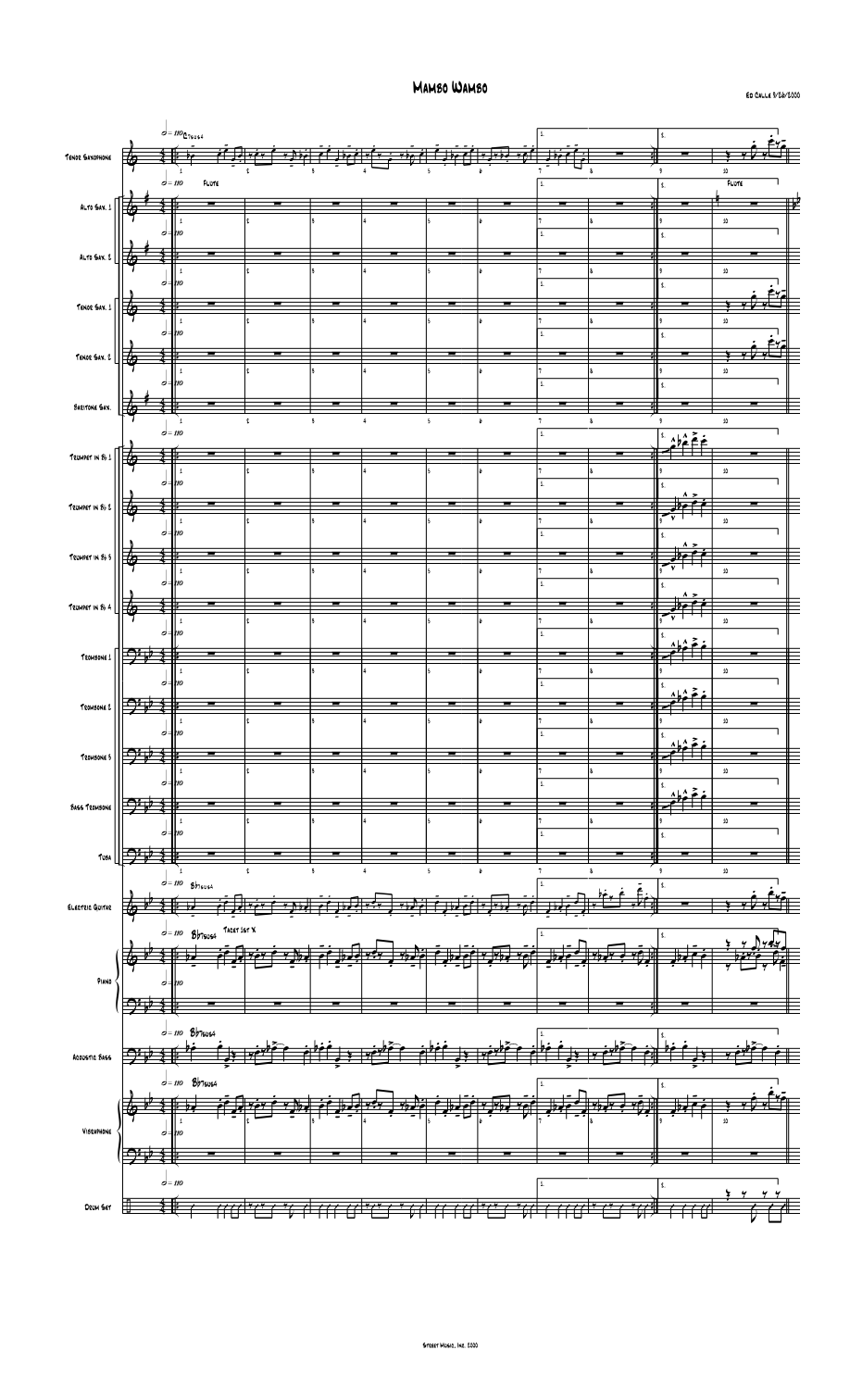
Mambo Wambo (E.Calle) sheet music preview

Mambo Wambo (E.Calle)

Composed by null

Arranged by E. Calle

  • Ensemble: Big Band Dance
  • Style: Mambo
  • Pages: 226
  • Instruments (20): Tenor Saxophone 1, Alto Saxophone 1, Alto Saxophone 2, Tenor Saxophone 2, Baritone Saxophone, Trumpet in Bb 1, Trumpet in Bb 2, Trumpet in Bb 3, Trumpet in Bb 4, Trombone 1, Trombone 2, Trombone 3, Bass Trombone, Flute, Electric Guitar, Piano, Acoustic Bass, Vibraphone, Drum Set, Tuba
  • Difficulty: advanced
  • Content: Individual Parts
  • Format: PDF Download (Instant)
  • Price: $24.99

"Mambo Wambo" by E. Calle is a vibrant and meticulously crafted big band arrangement that plunges headfirst into the exhilarating world of Latin Jazz, specifically the Mambo. While the original composer is E. Calle himself, this piece embodies the spirit and energy that defined the Mambo craze of the 1950s, a golden era when bandleaders like Pérez Prado, Tito Puente, and Machito brought these infectious rhythms to global prominence. This arrangement captures the essence of that period, offering a contemporary yet authentic take on the genre's characteristic syncopation, driving percussion, and powerful horn lines. It's a celebration of danceable, high-energy music, designed to transport audiences directly to the bustling dance halls where Mambo reigned supreme. Musically, "Mambo Wambo" is a relentless, up-tempo Mambo in a bright, driving Latin feel, likely in a minor key, which is common for this style to create a sense of intrigue and drama amidst the excitement. The energy is consistently high, propelled by a locked-in rhythm section that lays down an undeniable groove. E. Calle's arranging approach is characterized by his deep understanding of Latin big band orchestration. Expect tightly voiced brass sections delivering punchy, rhythmic figures, often in call-and-response with the saxophone section. Soli passages are prominent, showcasing the full power and precision of each section, particularly the saxophones with their intricate, interlocking lines. The arrangement features dynamic contrasts, building from powerful ensemble statements to more nuanced, yet still energetic, melodic phrases. Performance-wise, "Mambo Wambo" opens with an attention-grabbing rhythmic motif that immediately establishes the Mambo feel. The melody is shared dynamically, often featuring the lead trumpet or alto saxophone, but quickly develops into powerful ensemble unisons and harmonized soli sections. There are ample opportunities for featured solos, typically for tenor saxophone, trumpet, or trombone, allowing individual players to showcase their improvisational skills over the driving Latin rhythm section. The technical challenges lie in the precision required for the fast, syncopated rhythms, the blend and balance within the dense ensemble voicings, and the stamina needed to maintain the high energy throughout. The rewarding aspect is the sheer excitement generated by the piece, both for the performers and the audience, as it's designed to be a showstopper. This arrangement is ideally suited for advanced high school, college, community, and professional big bands. Its demands for rhythmic accuracy, ensemble blend, and improvisational facility make it a substantial challenge, but one that offers significant growth opportunities. Bands with a strong rhythm section and confident lead players will particularly shine with "Mambo Wambo," making it an excellent choice for concert programs, jazz festivals, or any performance where a vibrant, authentic Latin Jazz piece is desired to ignite the stage. "Mambo Wambo" demands a precise and energetic approach to truly come alive. The primary technical challenge lies in maintaining the relentless, driving Mambo feel at a brisk tempo, likely around 180-200 BPM, ensuring that the eighth notes are played straight, not swung. The rhythm section must establish a rock-solid foundation, with the bass and percussion locking into a tight groove, emphasizing the clave. Brass sections require clean articulation and precise rhythmic placement for the syncopated figures, particularly in the rapid soli passages. Saxophones must blend meticulously in their intricate soli lines, focusing on unified phrasing and intonation. Conductors should emphasize dynamic contrast, building intensity through the shout choruses and ensuring clean cut-offs. Rehearsal time should be dedicated to isolating difficult rhythmic passages, especially where brass and saxophones interact in call-and-response, and to ensuring soloists are comfortable improvising over the Latin harmonic structure. No special techniques like plunger mutes or falls are explicitly required, but strong, confident attacks and releases are crucial. Q: What instruments and parts are included in the "Mambo Wambo (E. Calle)" arrangement? A: This arrangement is scored for a standard 17-piece big band dance ensemble, including Alto Saxophone 1 & 2, Tenor Saxophone 1 & 2, Baritone Saxophone, Trumpet 1-4, Trombone 1-4, Piano, Bass, Guitar, and Drums. The full set comprises 226 pages of individual parts and a conductor's score. Q: What is the difficulty level of "Mambo Wambo (E. Calle)"? A: This arrangement is considered advanced, suitable for college, community, or professional big bands. It requires strong rhythmic precision, advanced ensemble blend, and confident improvisational skills from soloists due to its fast tempo and intricate Latin figures. Q: What musical style and historical context does "Mambo Wambo (E. Calle)" represent? A: "Mambo Wambo" is an authentic Mambo, a vibrant Latin Jazz style that gained immense popularity in the 1950s. It captures the high energy, driving rhythms, and characteristic orchestration associated with legendary Mambo bandleaders like Pérez Prado and Tito Puente. Q: What makes E. Calle's arrangement of "Mambo Wambo" unique? A: E. Calle's approach is distinguished by his masterful orchestration of traditional Mambo elements, featuring tightly voiced brass and saxophone soli sections, dynamic contrasts, and a relentless, authentic Latin groove. It's a contemporary arrangement that respects the historical integrity of the Mambo style. Q: What is the typical performance duration and tempo for "Mambo Wambo (E. Calle)"? A: While specific duration can vary with solos, "Mambo Wambo" is typically performed at a bright, up-tempo Mambo feel, around 180-200 BPM. Its high-energy nature makes it a dynamic concert piece, usually lasting between 3 to 5 minutes depending on the number and length of improvised solos.

Musicians Also Search For

Mambo Wambo E. Calle PDFMambo Wambo E. Calle sheet musicMambo Wambo arranged by E. CalleE. Calle big band dance chartsE. Calle jazz arrangements PDFMambo Wambo null sheet musicMambo Wambo null big band dance arrangementnull big band dance chartsMambo Wambo big band dance arrangementMambo Wambo big band dance PDF downloadMambo Wambo jazz ensemble sheet musicbig band dance sheet music instant downloadMambo Wambo conductor score PDFMambo Wambo individual parts downloadMambo Wambo sheet music with partsMambo Wambo Mambo chartMambo big band dance arrangementsbuy Mambo Wambo sheet music onlinedownload Mambo Wambo PDFMambo Wambo jazz chartbest E. Calle big band dance arrangementsnull songs arranged by E. CalleMambo Wambo printable sheet musicbig band dance repertoire PDF

All arrangements by E. Calle