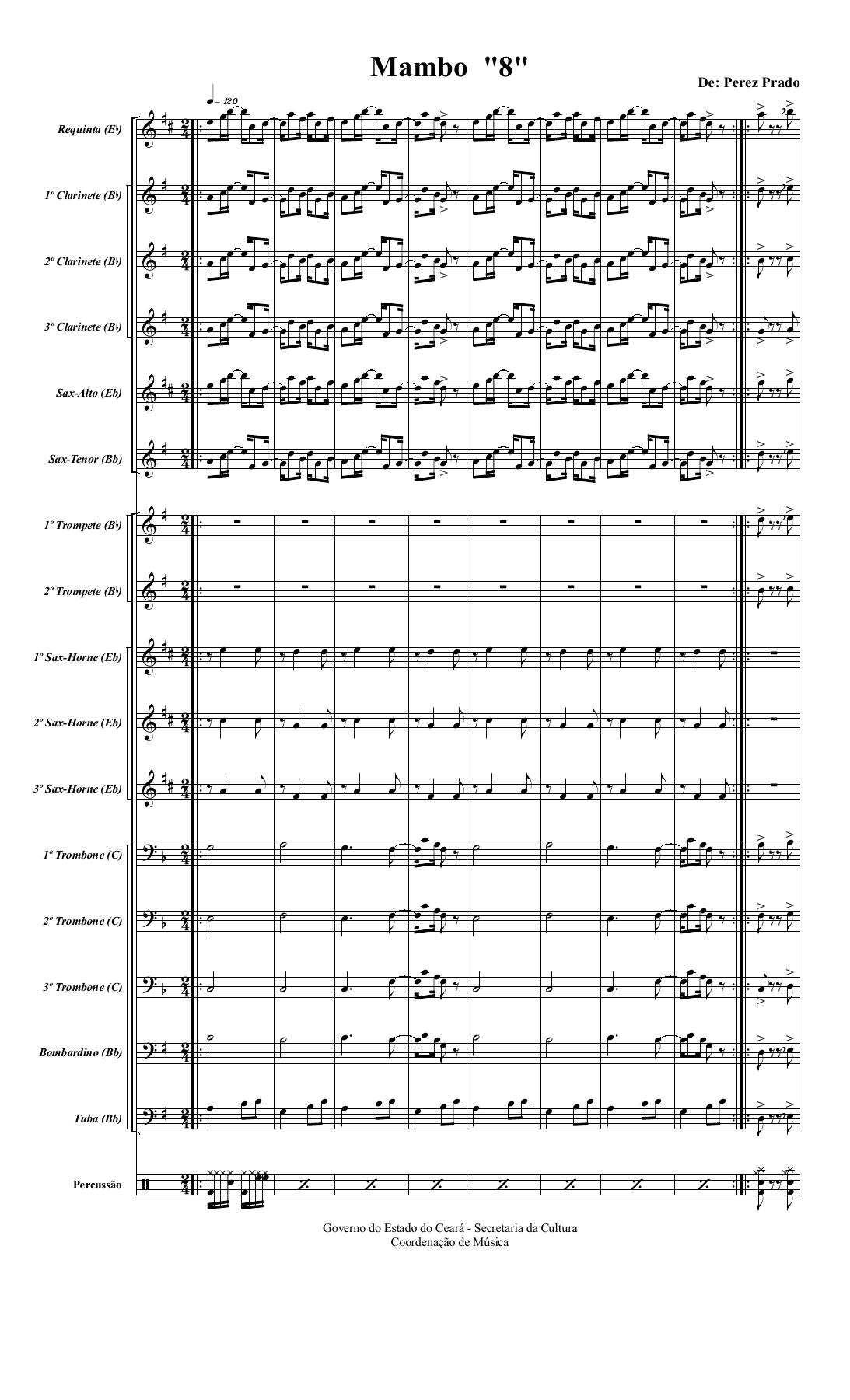
Mambo No.8 (P.Prado)
Composed by Perez Prado
Arranged by P. Prado
- Ensemble: Big Band Dance
- Style: Mambo
- Pages: 29
- Instruments (18): Requinta (Eb), 1º Clarinete (Bb), 2º Clarinete (Bb), 3º Clarinete (Bb), Sax-Alto (Eb), Sax-Tenor (Bb), 1º Trompete (Bb), 2º Trompete (Bb), 1º Sax-Horne (Eb), 2º Sax-Horne (Eb), 3º Sax-Horne (Eb), 1º Trombone (C), 2º Trombone (C), 3º Trombone (C), Bombardino (Bb), Tuba (Bb), Percussão, Flauta (C)
- Difficulty: medium
- Content: Individual Parts
- Format: PDF Download (Instant)
- Price: $24.99
Perez Prado's iconic "Mambo No. 8" stands as a cornerstone of the Mambo craze that swept the globe in the mid-20th century, cementing its place in popular culture and the annals of Latin jazz. Originally composed and recorded by the "King of Mambo" himself, Dámaso Pérez Prado, this electrifying piece burst onto the scene in the late 1940s and early 1950s, embodying the vibrant, dance-driven energy of the era. Its distinctive, driving rhythm and infectious melodies made it an instant classic, helping to define the sound of big band Latin music and influencing countless musicians across genres. The piece's enduring appeal lies in its ability to fuse sophisticated orchestral arrangements with raw, primal rhythmic intensity, creating a sound that is both complex and irresistibly danceable. This arrangement, penned by P. Prado himself, captures the quintessential sound and spirit of "Mambo No. 8" with unparalleled authenticity. The musical character is defined by an unrelenting, up-tempo Latin groove, primarily in a 4/4 meter, propelled by a powerful rhythm section. The energy is consistently high, evoking a mood of joyous celebration and sophisticated exuberance. The piece is characterized by its distinctive brass fanfares, intricate saxophone soli passages, and the call-and-response interplay between sections. Prado's signature approach involves sharp, punctuated horn lines, often played in unison or tight octaves, contrasted with smoother, flowing melodic statements. The arrangement masterfully builds tension through dynamic shifts and rhythmic accelerations, culminating in powerful, full-ensemble shout choruses that are both exhilarating and meticulously crafted. Prado's distinctive arranging style is evident throughout, particularly in the clever use of instrumental pairings and rhythmic counterpoint. The melody is primarily carried by the trumpet section, often doubled by the alto saxophones for added brilliance and cut-through, especially during the main thematic statements. There are no extended improvised solos in the traditional jazz sense; instead, the "solos" are tightly written, virtuosic ensemble passages, particularly for the saxophone section and the lead trumpet, demanding precision and rhythmic accuracy from all players. Technical challenges include the rapid-fire articulation required in the brass and saxophone sections, maintaining rhythmic precision at a brisk tempo, and achieving the characteristic "punch" and dynamic contrasts essential to the mambo style. The rewarding aspect of performing this piece lies in its sheer energy and the collective satisfaction of executing its intricate rhythmic figures and powerful ensemble sections with precision and flair. This arrangement is ideally suited for college-level big bands, advanced community ensembles, and professional dance orchestras looking to add an authentic and challenging Latin staple to their repertoire. While high school bands with strong lead players and a solid rhythm section might tackle it, the demands on ensemble precision, rhythmic tightness, and dynamic control suggest a more experienced group will fully realize its potential. Its historical significance and undeniable crowd-pleasing appeal make it a valuable addition to any big band library, offering a vibrant exploration of one of Latin music's most influential figures. Conductors should establish a brisk, unyielding tempo around quarter note = 200-210, emphasizing a driving, straight-eighth Latin feel rather than a swing interpretation. The key technical challenge lies in the precise, unified articulation of the brass and saxophone sections, particularly during the rapid-fire unison and octave passages. Encourage players to use a short, detached articulation, almost percussive, to achieve the characteristic "punch" of Prado's sound. Dynamic contrasts are crucial: ensure a clear distinction between the powerful *fortissimo* shout sections and the slightly more relaxed, yet still energetic, melodic statements. The rhythm section must maintain a relentless, locked-in groove, with the bass and piano providing a solid foundation for the horns. While no specific mutes are indicated, encourage brass players to experiment with subtle falls and doits at the ends of phrases for authentic stylistic flair, particularly in the trumpet section. Rehearsal time should focus on rhythmic accuracy, ensemble blend, and dynamic shaping to capture the infectious energy and precision of the original recordings. Q: What instruments and parts are included in this arrangement? A: This arrangement is scored for a full 17-piece big band dance ensemble, including Alto Saxophone 1, Alto Saxophone 2, Tenor Saxophone 1, Tenor Saxophone 2, Baritone Saxophone, Trumpet 1, Trumpet 2, Trumpet 3, Trumpet 4, Trombone 1, Trombone 2, Trombone 3, Bass Trombone, Piano, Bass, Drums, and Guitar. Q: What is the difficulty level of "Mambo No. 8 (P. Prado)" for big band? A: This arrangement is considered advanced, suitable for college-level big bands, advanced community ensembles, and professional orchestras. It demands high levels of rhythmic precision, articulation, and dynamic control from all sections. Q: What is the musical style and historical context of this piece? A: "Mambo No. 8" is a quintessential Mambo, a vibrant Latin jazz style popular in the mid-20th century. Composed by Perez Prado, it represents the energetic, dance-driven big band sound that defined the Mambo craze. Q: What makes this specific arrangement by P. Prado unique? A: This arrangement is unique because it is penned by Perez Prado himself, offering an authentic and definitive rendition of his iconic piece. It features his signature tight voicings, intricate ensemble passages, and powerful shout choruses that define the classic Mambo sound. Q: What is the approximate performance duration and recommended tempo for this arrangement? A: The approximate performance duration is around 2:30-3:00 minutes, depending on the chosen tempo. A brisk, unyielding tempo of quarter note = 200-210 is recommended to capture the piece's high-energy Latin groove.
Questions and answers
- What is included in the Mambo No.8 (P.Prado) PDF?
- The verified current file contains a conductor score and individual parts across 29 pages.
- How many instruments or parts are listed for Mambo No.8 (P.Prado)?
- The verified instrumentation list contains 18 entries for this Big Band Dance arrangement.
- Who is credited for Mambo No.8 (P.Prado)?
- Composer: Perez Prado. Arranger: P. Prado.
- What difficulty is listed for Mambo No.8 (P.Prado)?
- The verified difficulty level is medium.
- What style is listed for Mambo No.8 (P.Prado)?
- The catalog lists the style as Mambo.
- Can I preview Mambo No.8 (P.Prado) before buying?
- Yes. The product page provides a preview generated from the current PDF file.
- How is Mambo No.8 (P.Prado) delivered?
- After successful payment, the digital PDF is made available for download. The displayed price is $24.99.
Musicians Also Search For
Mambo No.8 P. Prado PDF • Mambo No.8 P. Prado sheet music • Mambo No.8 arranged by P. Prado • P. Prado big band dance charts • P. Prado jazz arrangements PDF • Mambo No.8 Perez Prado sheet music • Mambo No.8 Perez Prado big band dance arrangements • Perez Prado big band dance charts • Mambo No.8 big band dance arrangements • Mambo No.8 big band dance PDF download • Mambo No.8 jazz sheet music • big band dance sheet music download • Mambo No.8 conductor score PDF • Mambo No.8 individual parts download • Mambo No.8 sheet music PDF • Mambo No.8 Mambo charts • Mambo big band dance arrangements • buy Mambo No.8 sheet music • download Mambo No.8 PDF • Mambo No.8 jazz charts • best P. Prado big band dance arrangements • Perez Prado arranged by P. Prado • Mambo No.8 printable sheet music • big band dance repertoire PDF