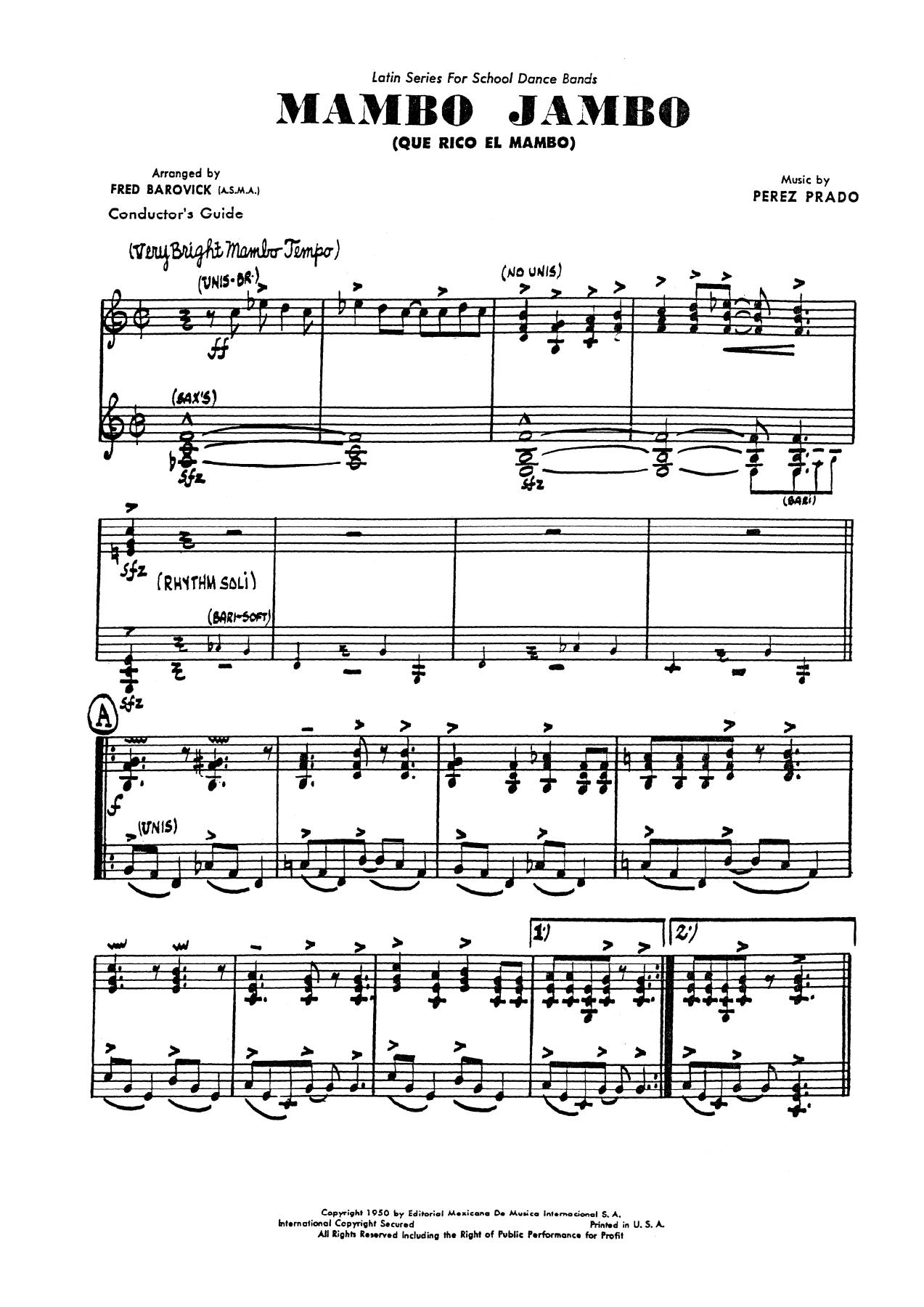
Mambo Jambo (F.Barovick)
Composed by Perez Prado
Arranged by F. Barovick
- Ensemble: Big Band Dance
- Style: Mambo
- Pages: 40
- Instruments (18): Conductor's Guide, Eb Clarinet, 1st Eb Alto Saxophone, 2nd Bb Tenor Saxophone, 3rd Eb Alto Saxophone, 4th Bb Tenor Saxophone, 5th Eb Baritone Saxophone, 1st Trumpet, 2nd Trumpet, 3rd Trumpet, 1st Trombone, 2nd Trombone, 3rd Trombone, Piano, Guitar, Bass, Drums, Special Accordion Part
- Difficulty: advanced
- Content: Individual Parts
- Format: PDF Download (Instant)
- Price: $24.99
Perez Prado's "Mambo Jambo," originally titled "Que Rico el Mambo," exploded onto the global music scene in the late 1940s, becoming an instant dance hall sensation and a definitive anthem of the mambo craze. This iconic piece, a cornerstone of Latin jazz and popular music history, epitomizes the vibrant, high-energy sound that earned Prado the moniker "King of Mambo." His innovative fusion of traditional Cuban rhythms with big band orchestration created a new sound that captivated audiences worldwide, cementing mambo's place in the popular consciousness of the mid-20th century. The original recording, characterized by its driving percussion, punctuated brass figures, and infectious call-and-response patterns, remains a benchmark for the genre, representing an era of post-war exuberance and cultural exchange. F. Barovick’s arrangement of "Mambo Jambo" captures the exhilarating spirit of Prado’s original while skillfully adapting it for the modern big band dance ensemble. Maintaining a blistering, authentic mambo tempo, this arrangement is firmly rooted in the key of C minor, providing a dark, driving harmonic foundation that perfectly complements the rhythmic intensity. Barovick’s distinctive approach is evident in the precise, often unison, horn figures that define the mambo style, showcasing the full power of the brass and saxophone sections. Expect tightly voiced soli sections that dance over the relentless rhythm section, driving the piece forward with an undeniable forward momentum. The arrangement is designed to evoke a mood of unbridled excitement and sophisticated danceability, inviting both performers and listeners to surrender to its infectious groove. The arrangement features the melody primarily carried by the trumpet section, often in unison or tight octaves, delivering the iconic "Mambo Jambo" theme with clarity and punch. The saxophone section frequently provides counter-melodies and rhythmic fills, contributing to the rich textural tapestry. While there are no explicit written-out solo sections, the arrangement’s structure allows for optional improvised solos over the established chord changes, particularly for trumpet or tenor saxophone, maintaining the improvisational spirit inherent in Latin jazz. Technical challenges include the demanding rhythmic precision required from all sections, particularly the brass, which must execute rapid, staccato figures with impeccable articulation and blend. The rhythm section is tasked with maintaining a rock-solid, authentic mambo groove throughout, requiring strong ensemble cohesion and stylistic understanding. The reward lies in performing a truly iconic piece that ignites any audience and showcases the band's collective rhythmic prowess and dynamic control. This arrangement is best suited for college-level jazz ensembles, advanced community bands, and professional big bands seeking an authentic and challenging mambo chart. Its demands for rhythmic accuracy, strong ensemble blend, and stylistic interpretation make it an excellent vehicle for developing precision and understanding of Latin jazz idioms. The arrangement’s robust orchestration and adherence to the original’s spirit ensure it will be a showstopper in any performance setting, from dance halls to concert stages. To achieve the authentic "Mambo Jambo" feel, a relentless, driving tempo around 180-200 BPM is crucial, with a strong emphasis on the two-beat mambo pulse in the bass and percussion. Drummers should prioritize a crisp cascara or timbale bell pattern alongside a driving kick drum. Horn sections must focus on razor-sharp articulation, particularly the staccato brass figures, ensuring they are short, precise, and unified. Rehearse the brass soli sections slowly to achieve perfect synchronization and blend before bringing them up to tempo. The saxophones should aim for a bright, cutting tone that can project over the powerful brass. Pay close attention to dynamics, utilizing sudden contrasts between loud, punctuated figures and softer, driving rhythmic backgrounds to build excitement. While no specific plunger mutes are indicated, brass players should be prepared for expressive falls and scoops, particularly at the ends of phrases, to enhance the Latin flair. Q: What instruments are included in this arrangement? A: This arrangement is scored for a full 17-piece big band dance ensemble, including Alto Saxophone 1, Alto Saxophone 2, Tenor Saxophone 1, Tenor Saxophone 2, Baritone Saxophone, Trumpet 1, Trumpet 2, Trumpet 3, Trumpet 4, Trombone 1, Trombone 2, Trombone 3, Bass Trombone, Piano, Bass, Guitar, and Drums. Q: What is the difficulty level of this arrangement? A: This arrangement is rated as advanced, suitable for college-level jazz ensembles, advanced community bands, and professional big bands. It demands high levels of rhythmic precision, articulation, and stylistic understanding. Q: What is the musical style and historical context of "Mambo Jambo"? A: "Mambo Jambo" is a quintessential mambo piece, originally popularized by Perez Prado in the late 1940s. It represents the height of the mambo craze, blending Cuban rhythms with big band orchestration for an energetic, dance-oriented sound. Q: What makes F. Barovick's arrangement of "Mambo Jambo" unique? A: Barovick's arrangement faithfully captures the original's blistering mambo tempo and driving energy. It features tight, often unison horn figures, powerful brass soli, and a relentless rhythmic drive, making it an authentic and challenging big band adaptation. Q: What is the typical performance duration or tempo for this piece? A: "Mambo Jambo" is designed for a very fast, driving mambo tempo, typically ranging from 180-200 beats per minute. Performance duration will vary slightly based on tempo and any optional improvised solos, but generally falls between 3-4 minutes.
Questions and answers
- What is included in the Mambo Jambo (F.Barovick) PDF?
- The verified current file contains a conductor score and individual parts across 40 pages.
- How many instruments or parts are listed for Mambo Jambo (F.Barovick)?
- The verified instrumentation list contains 18 entries for this Big Band Dance arrangement.
- Who is credited for Mambo Jambo (F.Barovick)?
- Composer: Perez Prado. Arranger: F. Barovick.
- What difficulty is listed for Mambo Jambo (F.Barovick)?
- The verified difficulty level is advanced.
- What style is listed for Mambo Jambo (F.Barovick)?
- The catalog lists the style as Mambo.
- Can I preview Mambo Jambo (F.Barovick) before buying?
- Yes. The product page provides a preview generated from the current PDF file.
- How is Mambo Jambo (F.Barovick) delivered?
- After successful payment, the digital PDF is made available for download. The displayed price is $24.99.
Musicians Also Search For
Mambo Jambo F. Barovick PDF • Mambo Jambo F. Barovick sheet music • Mambo Jambo arranged by F. Barovick • F. Barovick big band dance charts • F. Barovick jazz arrangements PDF • Mambo Jambo Perez Prado sheet music • Mambo Jambo Perez Prado big band dance arrangements • Perez Prado big band dance charts • Mambo Jambo big band dance arrangements • Mambo Jambo big band dance PDF download • Mambo Jambo jazz sheet music • big band dance sheet music download • Mambo Jambo conductor score PDF • Mambo Jambo individual parts download • Mambo Jambo sheet music PDF • Mambo Jambo Mambo charts • Mambo big band dance arrangements • buy Mambo Jambo sheet music • download Mambo Jambo PDF • Mambo Jambo jazz charts • best F. Barovick big band dance arrangements • Perez Prado arranged by F. Barovick • Mambo Jambo printable sheet music • big band dance repertoire PDF