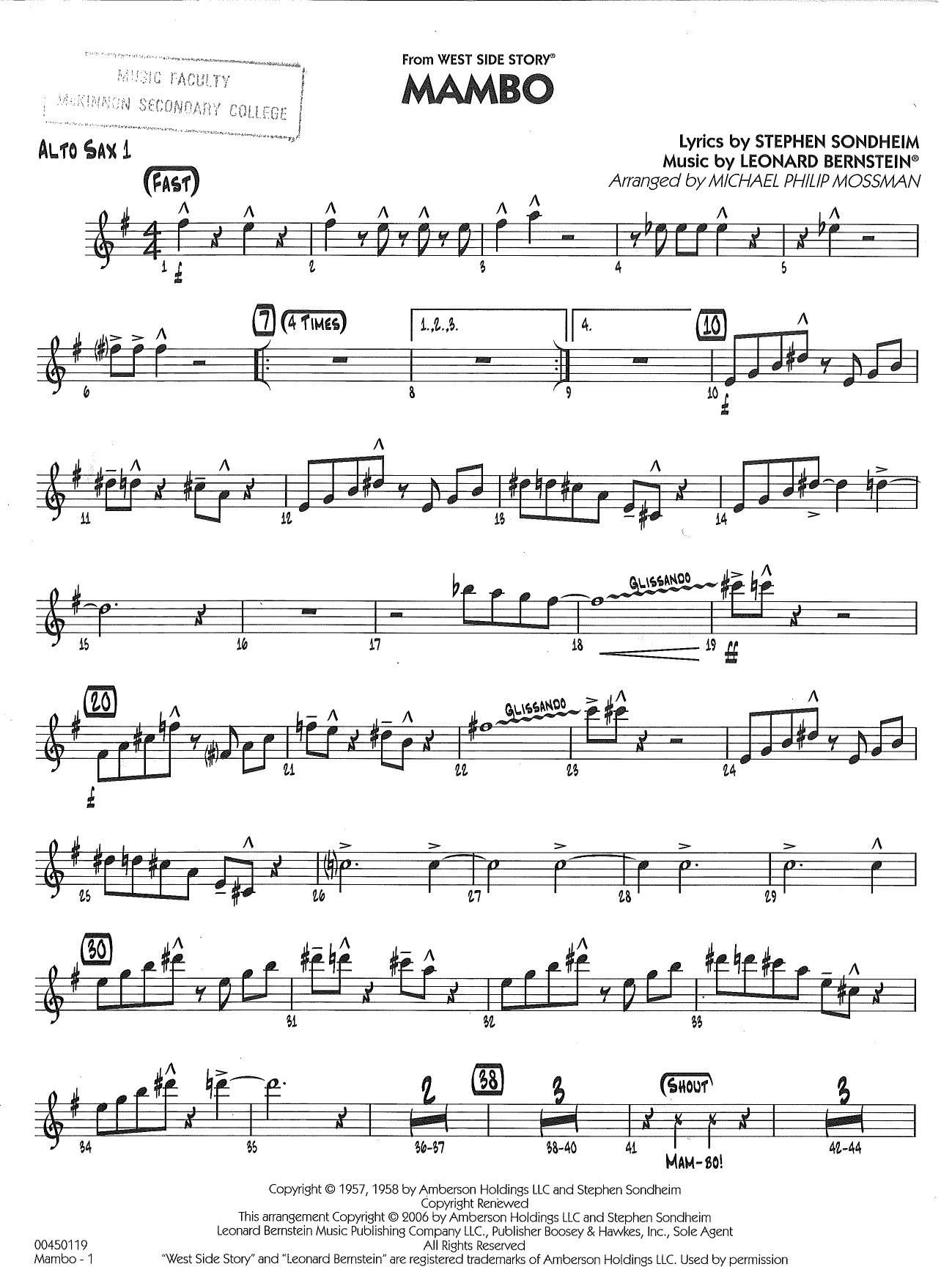
Mambo From West Side Story (M.P.Mossman)
Composed by Leonard Bernstein
Arranged by M.P.Mossman
- Ensemble: Big Band
- Pages: 50
- Instruments (18): Alto Sax 1, Alto Sax 2, Tenor Sax 1, Tenor Sax 2, Baritone Sax, Trumpet 1, Trumpet 2, Trumpet 3, Trumpet 4, Trombone 1, Trombone 2, Trombone 3, Trombone 4, Bass, Guitar, Drums, Piano, Aux. Percussion
- Difficulty: advanced
- Content: Individual Parts
- Format: PDF Download (Instant)
- Price: $24.99
Leonard Bernstein’s electrifying score for *West Side Story* permanently bridged the worlds of Broadway and modern orchestral jazz when the landmark musical premiered in 1957. Among its most kinetic movements, the "Mambo" stands out as a masterclass in rhythmic displacement, Latin-jazz fusion, and explosive theatrical energy. Originally conceived to capture the vibrant, cutthroat atmosphere of a gym dance-off in mid-century New York City, the composition has transcended its theatrical origins to become a staple of adventurous big band repertoires. Jazz luminaries have long recognized the inherent swing and syncopated brilliance of Bernstein’s themes, transforming the dance sequence into a high-octane vehicle for modern jazz orchestra. Michael Philip Mossman’s tour-de-force arrangement harnesses the raw, combustible energy of the original work and filters it through an uncompromising contemporary jazz big band lens. Propelled by an authentic Afro-Cuban mambo groove in 4/4 time, the chart features blistering brass counterlines, intricate woodwind doublings, and razor-sharp rhythmic hits that demand absolute precision. The mood shifts rapidly between sultry, tension-filled vamp sections and blindingly fast, brass-heavy eruptions. Mossman utilizes extended tertian and altered harmonies, creating a rich harmonic palette that retains Bernstein's iconic melodic motifs while injecting a sophisticated, bebop-inflected vocabulary into the ensemble writing. Throughout this 50-page manuscript, the distribution of melodic material is shared dynamically across the entire 18-piece instrumentation. The saxophones, anchored by dual altos, tenors, and a baritone, navigate labyrinthine solis that mirror the agility of the original Broadway choreography, while the brass section is pushed to its upper limits with soaring trumpet lines and guttural, harmon-muted or open trombone counterpoint. Featured solo spaces allow marquee improvisers within the ensemble to stretch out over driving Latin-percussion-friendly changes. The technical challenges lie primarily in the unyielding tempo, complex cross-rhythms, and the necessity for the rhythm section to lock in an authentic, driving tumbao feel beneath fiercely modern horn lines. Advanced collegiate ensembles, top-tier high school jazz bands with exceptional section leaders, and professional regional orchestras will find this chart an exhilarating centerpiece for any concert program. The sheer kinetic velocity and sophisticated orchestration make it a massive crowd-pleaser that simultaneously satisfies the intellectual demands of serious jazz musicians. Achieving success with Mossman’s adaptation requires immaculate articulation, endurance in the high brass, and a deep collective understanding of Latin jazz phrasing, rewarding the ensemble with one of the most thrilling rides in modern big band literature. Executing this demanding arrangement requires absolute rhythmic synchronization between the rhythm section and the horn horns, particularly during the rapid-fire syncopated hits. The conductor should establish a brisk, unyielding mambo tempo that feels both danceable and breathless, ensuring the sixteenth-note subdivisions remain crisp throughout. Brass players must exercise careful dynamic control during the dense vamp sections to allow soloists to breathe through the texture without forcing tone quality. Pay close attention to stylistic markings: staccato notes must be clipped and punchy, while accent marks require a forward-moving, vocal weight rather than a harsh attack. The rhythm section pianist and bassist should lean heavily into the montuno and tumbao feels, avoiding heavy straight-eighth interpretations in favor of buoyant, forward-leaning Latin phrasing. Rehearsals should isolate the intricate woodwind and brass soli passages at a reduced tempo before attempting the final performance velocity, ensuring every articulation lines up cleanly across sections. Q: What instruments and parts are included in this 18-piece big band arrangement? A: The instrumentation features a standard 18-piece big band lineup, including Alto Saxophone 1, Alto Saxophone 2, Tenor Saxophone 1, Tenor Saxophone 2, Baritone Saxophone, four trumpets, four trombones, and a full rhythm section comprising piano, bass, drums, and auxiliary percussion. Q: What is the difficulty level of M.P.Mossman’s arrangement of "Mambo"? A: This chart is graded as advanced, making it best suited for college jazz orchestras, professional big bands, and elite high school ensembles with strong technical proficiency, high-register brass players, and experienced rhythm section players. Q: How does this arrangement relate to Leonard Bernstein’s original composition from West Side Story? A: It takes Bernstein's iconic theatrical mambo theme from the 1957 Broadway score and re-imagines it through a sophisticated contemporary jazz idiom, incorporating complex harmonies, extended solo sections, and modern big band orchestration. Q: What makes M.P.Mossman's treatment unique compared to other big band versions? A: Mossman’s background as a premier jazz trumpet player and arranger shines through in his brilliant brass voicings, aggressive rhythmic counterlines, and authentic integration of Afro-Cuban jazz grooves with modern bebop vocabulary. Q: What is the approximate performance duration and tempo feel of the piece? A: The arrangement is set in an energetic, fast-paced Latin mambo groove in 4/4 time, typically clocking in at around 4 to 5 minutes of high-intensity performance depending on the length of the open solo sections.
Questions and answers
- What is included in the Mambo From West Side Story (M.P.Mossman) PDF?
- The verified current file contains individual parts across 50 pages.
- How many instruments or parts are listed for Mambo From West Side Story (M.P.Mossman)?
- The verified instrumentation list contains 18 entries for this Big Band arrangement.
- Who is credited for Mambo From West Side Story (M.P.Mossman)?
- Composer: Leonard Bernstein. Arranger: M.P.Mossman.
- What difficulty is listed for Mambo From West Side Story (M.P.Mossman)?
- The verified difficulty level is advanced.
- Can I preview Mambo From West Side Story (M.P.Mossman) before buying?
- Yes. The product page provides a preview generated from the current PDF file.
- How is Mambo From West Side Story (M.P.Mossman) delivered?
- After successful payment, the digital PDF is made available for download. The displayed price is $24.99.
Musicians Also Search For
Mambo From West Side Story M.P.Mossman PDF • Mambo From West Side Story M.P.Mossman sheet music • Mambo From West Side Story arranged by M.P.Mossman • M.P.Mossman big band charts • M.P.Mossman jazz arrangements PDF • Mambo From West Side Story Leonard Bernstein sheet music • Mambo From West Side Story Leonard Bernstein big band arrangements • Leonard Bernstein big band charts • Mambo From West Side Story big band arrangements • Mambo From West Side Story big band PDF download • Mambo From West Side Story jazz sheet music • big band sheet music download • Mambo From West Side Story individual parts download • Mambo From West Side Story sheet music PDF • buy Mambo From West Side Story sheet music • download Mambo From West Side Story PDF • Mambo From West Side Story jazz charts • best M.P.Mossman big band arrangements • Leonard Bernstein arranged by M.P.Mossman • Mambo From West Side Story printable sheet music • big band repertoire PDF