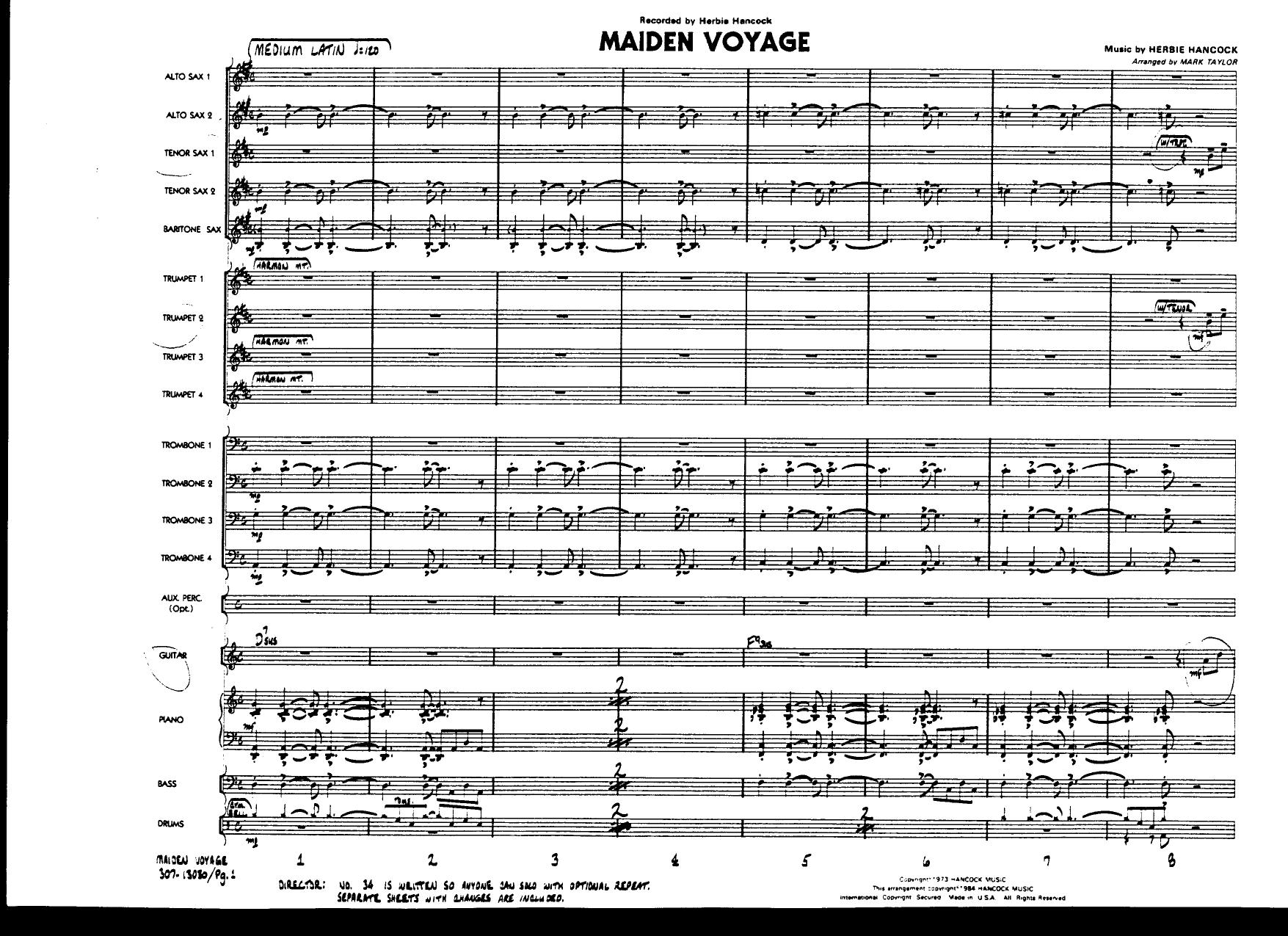
Maiden Voyage (M.Taylor)
Composed by Herbie Hancock
Arranged by Mark Taylor
- Ensemble: Big Band
- Pages: 49
- Instruments (19): Alto Sax 1, Alto Sax 2, Tenor Sax 1, Tenor Sax 2, Baritone Sax, Trumpet 1, Trumpet 2, Trumpet 3, Trumpet 4, Trombone 1, Trombone 2, Trombone 3, Trombone 4, Guitar, Piano, Bass, Drums, Vibes, Solo Changes Part
- Difficulty: medium
- Content: Individual Parts
- Format: PDF Download (Instant)
- Price: $24.99
Herbie Hancock’s modal masterpiece "Maiden Voyage," originally recorded on his landmark 1965 Blue Note album of the same name, stands as one of the defining pillars of 1960s post-bop jazz. Built upon a suspended, floating harmonic framework using stacked fourths and open voicings, the composition evokes the serene, mysterious expanse of the open ocean. Hancock’s original recording—featuring Freddie Hubbard, George Coleman, Ron Carter, and Anthony Williams—redefined how jazz ensembles could utilize space, atmosphere, and modal ambiguity without relying on traditional functional chord progressions. Mark Taylor’s masterful big band adaptation captures the tranquil, impressionistic essence of Hancock’s original while translating its delicate textures into a rich, dynamic landscape for a 19-piece jazz orchestra. Set at a relaxed, hypnotic medium tempo with an even-eighths Latin-jazz or contemporary modal groove, the chart maintains an aura of cool sophistication. The mood shifts fluidly between introspective, harmonically lush ensemble passages and moments of expansive rhythmic release. Taylor expertly balances the exposed, fragile nature of the melody with the immense sonic palette of the full big band, creating an atmosphere that is both meditative and dramatically compelling. The arranger’s treatment relies heavily on sophisticated coloristic voicings in the woodwinds and muted brass, avoiding heavy-handed block writing in favor of shimmering, transparent textures that let the modal harmonies breathe. The melody is initially introduced with great subtlety, often shared between muted brass and saxophones, before expanding into gorgeous, full-ensemble soli sections that highlight Taylor’s gift for contemporary big band orchestration. Rather than employing a traditional high-energy shout chorus, Taylor builds intensity through cumulative counterpoint, shifting rhythmic layers, and expansive harmonic tension. Featured solo spaces are woven naturally into the arrangement, allowing designated improvisers to explore the modal terrain freely over a supportive, undulating rhythm section vamp. Advanced high school ensembles, collegiate jazz orchestras, and professional community big bands will find this chart to be an exceptional vehicle for developing modal improvisational skills and ensemble sensitivity. The technical challenges lie less in executing rapid-fire bebop lines and more in maintaining impeccable intonation, balance, and stylistic cohesion during exposed, slow-moving harmonic shifts. Performers and audiences alike will find the chart deeply rewarding, particularly during the shimmering transitional interludes where the brass and saxophones interlock to create a lush, oceanic wave of sound. Success with this arrangement hinges on the rhythm section’s ability to establish and maintain an unhurried, hypnotic groove without rushing the tempo. The drummer should utilize a crisp, subtle ride cymbal pattern paired with light cross-stick or brush work during the head, avoiding overly dense fills that could clutter the open modal texture. For the wind sections, primary technical hurdles involve long, sustained tones requiring meticulous breath support and dynamic control to prevent sagging intonation. Conductor focus should be directed toward the delicate balance of inner-voiced harmonies in the saxophones and trombones, ensuring that no single voice overpowers the transparent textures. Brass players should pay close attention to specified mute markings (such as cup or harmon mutes where indicated), utilizing them to achieve a warm, breathy timbre rather than a biting, aggressive edge. Rehearsals should begin with sectional tone-matching exercises on the modal vamps before integrating the full ensemble, allowing the band to internalize the shifting color palettes unique to Taylor's writing. Q: What instruments and parts are included in this big band publication? A: The 49-page publication includes a full conductor score and complete parts for a standard 19-instrument big band lineup: 2 alto saxophones, 2 tenor saxophones, baritone saxophone, 4 trumpets, 4 trombones, guitar, piano, bass, drums, and auxiliary percussion. Q: What is the difficulty level of Mark Taylor's arrangement of "Maiden Voyage"? A: This chart is graded as advanced intermediate to advanced, making it ideal for high school top bands, collegiate ensembles, and professional community jazz orchestras. Q: How does this arrangement fit into the broader historical context of jazz? A: It adapts Herbie Hancock’s legendary 1965 modal jazz composition, transforming a seminal post-bop small-group recording into a sophisticated contemporary big band vehicle while preserving its impressionistic, ocean-inspired atmosphere. Q: What makes Mark Taylor's arrangement unique compared to other big band charts? A: Taylor avoids heavy-handed shout choruses and standard swing clichés, instead utilizing transparent voicings, atmospheric modal vamps, and cumulative counterpoint to maintain the serene, floating quality of the original recording. Q: What is the recommended performance duration and tempo feel for this piece? A: The arrangement is set at a relaxed, hypnotic medium tempo with an even-eighths modal groove, and typically runs between 5 and 6 minutes depending on the length of the improvised solos.
Questions and answers
- What is included in the Maiden Voyage (M.Taylor) PDF?
- The verified current file contains a conductor score and individual parts across 49 pages.
- How many instruments or parts are listed for Maiden Voyage (M.Taylor)?
- The verified instrumentation list contains 19 entries for this Big Band arrangement.
- Who is credited for Maiden Voyage (M.Taylor)?
- Composer: Herbie Hancock. Arranger: Mark Taylor.
- What difficulty is listed for Maiden Voyage (M.Taylor)?
- The verified difficulty level is medium.
- Can I preview Maiden Voyage (M.Taylor) before buying?
- Yes. The product page provides a preview generated from the current PDF file.
- How is Maiden Voyage (M.Taylor) delivered?
- After successful payment, the digital PDF is made available for download. The displayed price is $24.99.
Musicians Also Search For
Maiden Voyage Mark Taylor PDF • Maiden Voyage Mark Taylor sheet music • Maiden Voyage arranged by Mark Taylor • Mark Taylor big band charts • Mark Taylor jazz arrangements PDF • Maiden Voyage Herbie Hancock sheet music • Maiden Voyage Herbie Hancock big band arrangements • Herbie Hancock big band charts • Maiden Voyage big band arrangements • Maiden Voyage big band PDF download • Maiden Voyage jazz sheet music • big band sheet music download • Maiden Voyage conductor score PDF • Maiden Voyage individual parts download • Maiden Voyage sheet music PDF • buy Maiden Voyage sheet music • download Maiden Voyage PDF • Maiden Voyage jazz charts • best Mark Taylor big band arrangements • Herbie Hancock arranged by Mark Taylor • Maiden Voyage printable sheet music • big band repertoire PDF