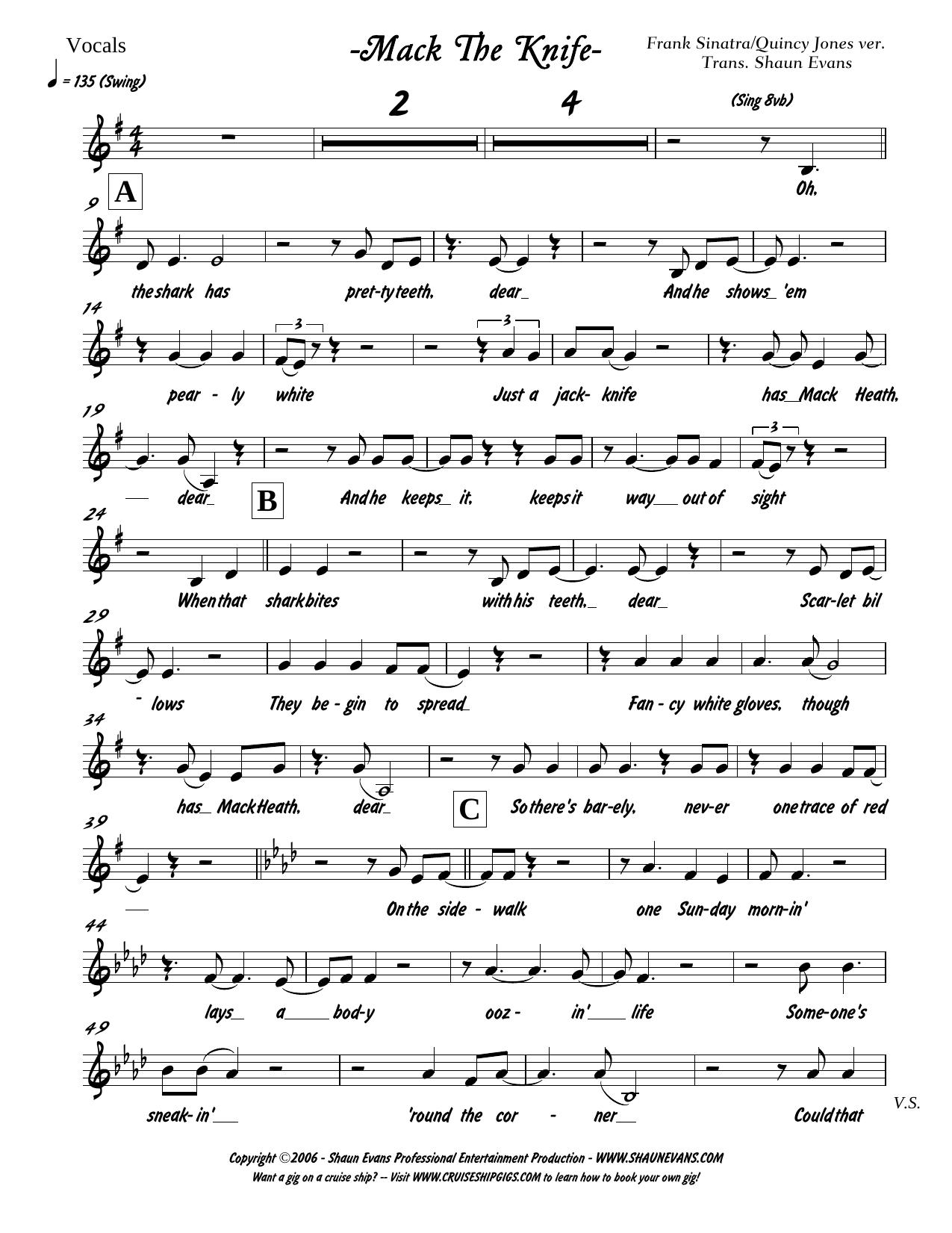
Mack The Knife (Q.Jones) sheet music preview

Mack The Knife (Q.Jones)

Composed by Quincy Jones

Arranged by Frank Sinatra & Nelson Riddle

  • Ensemble: Big Band
  • Pages: 79
  • Instruments (18): Vocals, Alto Saxophone I & Flute, Alto Saxophone II & Flute, Tenor Saxophone I, Tenor Saxophone II, Baritone Saxophone, Trumpet I, Trumpet II, Trumpet III, Trumpet IV, Trombone I, Trombone II, Trombone III, Bass Trombone, Piano, Guitar, Drums, Bass
  • Difficulty: advanced
  • Content: Individual Parts
  • Format: PDF Download (Instant)
  • Price: $24.99

Kurt Weill and Bertolt Brecht originally penned "Mack the Knife" for *The Threepenny Opera* in 1928, but it transformed into an American jazz standard following Louis Armstrong's 1956 crossover recording. The track achieved legendary status when Quincy Jones crafted his high-octane, swinging framework for Frank Sinatra’s iconic 1986 live and studio collaborations. This specific iteration represents the pinnacle of late-era big band vocal arranging, capturing the bravura, swagger, and sophisticated cosmopolitan energy of the Las Vegas Rat Pack era. It stands as a masterclass in building theatrical tension through a swinging, multi-key modular structure that demands absolute precision from every section. Propelled by an infectious, driving medium-up swing feel in 4/4 time, the chart exudes unmistakable confidence and mischievous charm. The musical journey begins with an iconic, teasing vamp before unfolding into a series of brilliant chromatic key modulations that continually elevate the energy. Nelson Riddle’s scoring techniques are on full display here, utilizing sparse, punchy brass stabs and slithering saxophone voicings to mirror the cinematic narrative of Mackie Messer. As the chart progresses through its successive upward shifts, the harmonic density thickens, transforming a simple cabaret tune into a roaring, high-energy big band tour-de-force that consistently electrifies audiences. The arrangement features intricate woodwind doubles and tight, interwoven horn solis where the saxophones carry the agile, bebop-inflected counter-melodies. Brass players must navigate crisp, articulated plunger effects and dramatic fall-offs that punctuate Sinatra’s vocal delivery, while the rhythm section functions as an unyielding engine room, relying on a steady walking bassline and crisp hi-hat comping. Technical challenges center around maintaining flawless intonation through the abrupt key changes and executing the razor-sharp syncopations required during the dynamic shout chorus. For the ensemble, the immense reward lies in locking into the aggressive, swinging groove and capturing the sophisticated theatricality that defines the Sinatra-Riddle catalog. Advanced high school, collegiate, and professional jazz orchestras will find this 79-page powerhouse exceptionally well-suited for their libraries. Because of its demanding stylistic requirements—specifically the need for authentic mid-century jazz articulation, stamina across shifting key centers, and seamless communication with a vocal soloist—it serves as a premier showcase piece for competitive festivals or headline concert sets. Ensembles equipped with strong lead brass players and a cohesive rhythm section will unlock the authentic brilliance of this timeless swinging arrangement. Mastering this arrangement requires acute attention to stylistic articulation and endurance through its multiple key changes. The tempo should be kept at a brisk, confident medium-swing (approx. Quarter Note = 152–160), avoiding any tendency to drag during the transitional vamps. Conductors must ensure that the rhythm section maintains an even, unhurried pulse, anchoring the dynamic expansions as the chart modulates upward. In the brass section, precision is paramount; use clipped, short accents on all background figures to leave ample sonic space for the vocal line or featured soloist. Trumpets and trombones should utilize subtle cup or plunger mutes where indicated to achieve that authentic mid-century vocal accompaniment color, ensuring falls and doits are executed cleanly without sacrificing pitch center. Rehearsals should initially isolate the tricky modulation checkpoints, practicing the transitional bars slowly before integrating the full ensemble swing feel. Focus heavily on section blending during the dynamic shout chorus, balancing the dense chordal voicings so that the upper-structure extensions of the altered dominant chords cut through cleanly without masking the foundational bass movement. Q: What instruments and parts are included in this 79-page big band arrangement? A: This arrangement is scored for a 10-instrument core big band instrumentation, featuring comprehensive parts for Alto Saxophone, Tenor Saxophone, Baritone Saxophone, Trumpets, Trombones, and a full rhythm section. Q: What is the difficulty level of this Quincy Jones-styled chart? A: This piece is graded as advanced, making it ideal for collegiate, professional, and advanced high school jazz ensembles with strong sight-readers and experienced lead players. Q: What is the historical style and context of this specific version? A: This chart embodies the swinging, high-stakes aesthetic of Frank Sinatra's 1980s collaborations, building upon Quincy Jones's famous arranging concepts and Nelson Riddle's signature sophisticated big band orchestration techniques. Q: What makes this particular arrangement unique compared to standard charts of the tune? A: Unlike standard charts that remain in one key, this version features Sinatra's signature cascading chromatic key modulations and intricate, theatrical horn stabs that steadily escalate the performance's dramatic tension and energy. Q: What is the performance duration and tempo feel of the piece? A: The arrangement runs approximately 3 to 4 minutes depending on the chosen vocal or instrumental solo extensions, and is anchored by a driving, energetic medium-up swing feel.

Questions and answers

What is included in the Mack The Knife (Q.Jones) PDF?
The verified current file contains a conductor score and individual parts across 79 pages.
How many instruments or parts are listed for Mack The Knife (Q.Jones)?
The verified instrumentation list contains 18 entries for this Big Band arrangement.
Who is credited for Mack The Knife (Q.Jones)?
Composer: Quincy Jones. Arranger: Frank Sinatra & Nelson Riddle.
What difficulty is listed for Mack The Knife (Q.Jones)?
The verified difficulty level is advanced.
Can I preview Mack The Knife (Q.Jones) before buying?
Yes. The product page provides a preview generated from the current PDF file.
How is Mack The Knife (Q.Jones) delivered?
After successful payment, the digital PDF is made available for download. The displayed price is $24.99.

Musicians Also Search For

Mack The Knife Frank Sinatra & Nelson Riddle PDFMack The Knife Frank Sinatra & Nelson Riddle sheet musicMack The Knife arranged by Frank Sinatra & Nelson RiddleFrank Sinatra & Nelson Riddle big band chartsFrank Sinatra & Nelson Riddle jazz arrangements PDFMack The Knife Quincy Jones sheet musicMack The Knife Quincy Jones big band arrangementsQuincy Jones big band chartsMack The Knife big band arrangementsMack The Knife big band PDF downloadMack The Knife jazz sheet musicbig band sheet music downloadMack The Knife conductor score PDFMack The Knife individual parts downloadMack The Knife sheet music PDFbuy Mack The Knife sheet musicdownload Mack The Knife PDFMack The Knife jazz chartsbest Frank Sinatra & Nelson Riddle big band arrangementsQuincy Jones arranged by Frank Sinatra & Nelson RiddleMack The Knife printable sheet musicbig band repertoire PDF

All arrangements by Frank Sinatra & Nelson Riddle All Quincy Jones sheet music